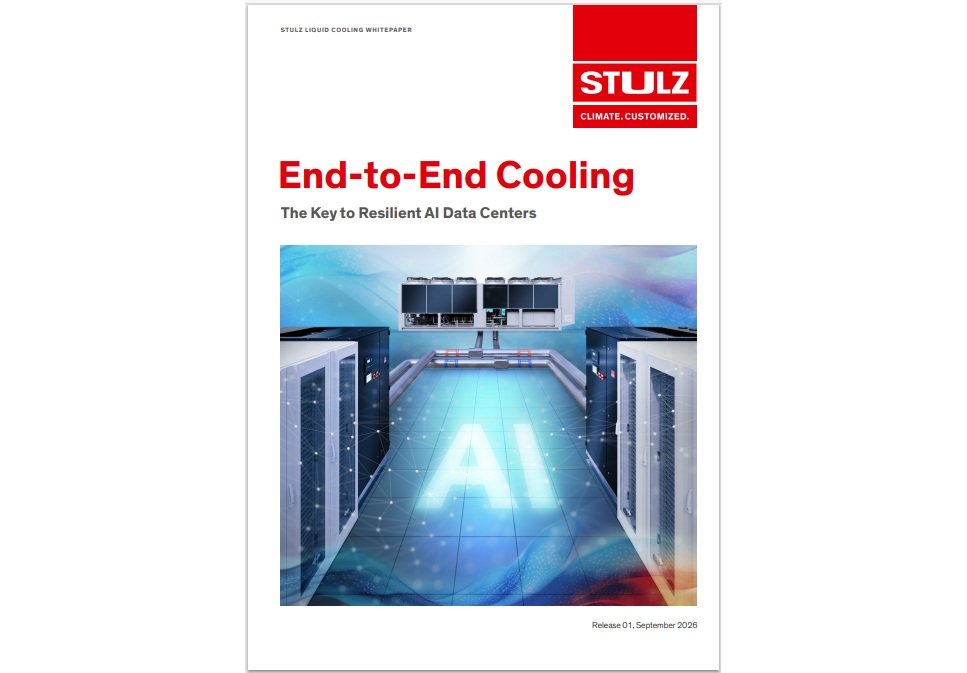
STULZ has published a white paper outlining an end-to-end approach to cooling high-density AI data centers, combining Direct Chip Liquid Cooling (DCLC) with precision air cooling. The company says liquid cooling addresses processor-level hotspots, while heat from voltage converters, memory modules, optical transceivers and other server electronics still needs to be removed by air cooling. Whitepaper_Liquid_Cooling_End-t…
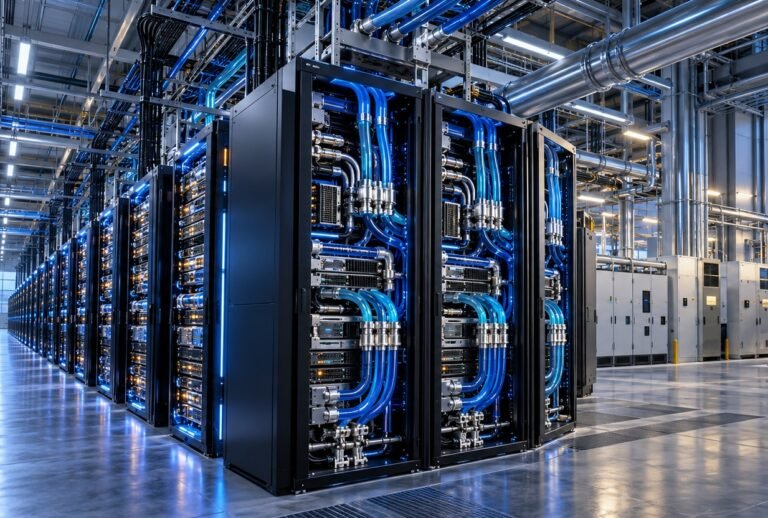
The paper divides liquid cooling infrastructure into six coordinated levels: server cooling, rack subdistribution, row and zone distribution, building services management, central Coolant Distribution Units (CDUs), and external heat rejection. At server level, cold plates remove heat from CPUs, GPUs, memory modules and voltage converters, while quick disconnects and leak detection support operation and maintenance.
STULZ identifies the CDU as the hydraulic separation point between the primary chilled-water supply and the secondary rack circuit. The paper describes plate heat exchangers, controlled pumps, N+1 redundancy and PLC-based control, alongside filtration, degassing, pressure maintenance and chemical dosing. It also discusses reducing the approach temperature across CDU heat exchangers from 4 K to 2 K and the implications for primary water temperatures and heat exchanger sizing.
For dynamic AI loads, STULZ says cooling design should account for transient peaks rather than relying on time-averaged loads. One example calculates that 500 liters (132 US gal) of water-glycol mixture with a specific heat capacity of about 3.8 kJ/(kg·K) and a 10 K (18°F) temperature rise can absorb roughly 19 MJ of heat, providing a theoretical buffer of around 38 seconds at an uncovered 500 kW (approx. 1.71 million BTU/h) load or around 10 seconds at 2 MW (approx. 6.82 million BTU/h).
The white paper also covers control strategies based on differential pressure, differential temperature and flow, with approximately 1.5 L/min per kW (0.40 US gal/min per kW) cited as an anchor value for flow-rate planning. It describes dual PID parameter sets and N+1 CDU group control, including load thresholds of at least 80% and no more than 40% for staging pumps and valves.
STULZ concludes that CDUs in high-density AI installations need to operate in coordination with IT thermal loads through programmable logic controllers and automated interfaces, rather than as isolated building-services equipment.