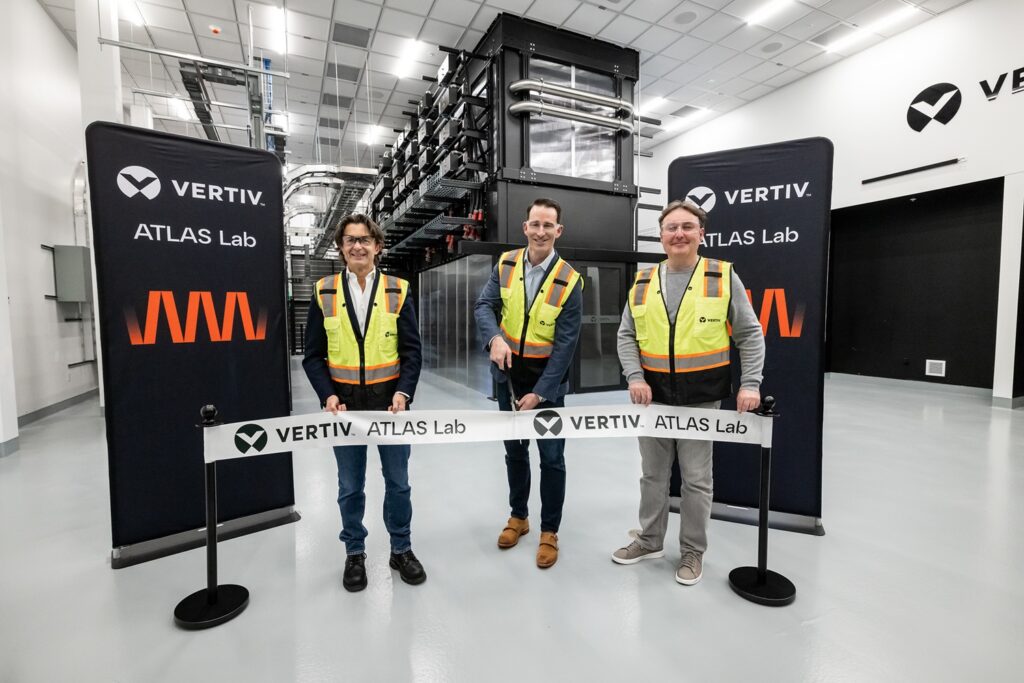
Vertiv has introduced the ATLAS Lab (Advanced Test Lab for Architecture and Systems), a system-level testing facility designed to validate power, cooling and controls infrastructure for AI data centers before next-generation computing hardware becomes commercially available. The facility supports Vertiv’s engineering collaboration with NVIDIA to address infrastructure integration challenges ahead of deployment.
ATLAS combines workload emulation, digital modeling and physical testing to reproduce the power consumption and thermal behavior of current and future NVIDIA accelerated computing architectures. Its simulation workflows use the NVIDIA DSX AI Factory Platform, including NVIDIA Omniverse libraries, DSX Sim and SimReady assets, incorporating Vertiv power and cooling equipment into digital models.
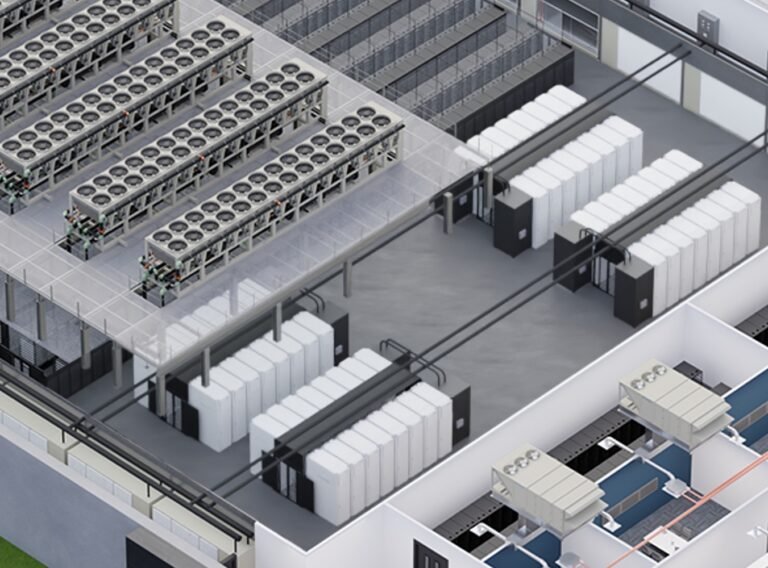
The laboratory operates as a representative AI factory pod, integrating power distribution, thermal management, controls and IT infrastructure in a single testing environment. Engineers evaluate system responses to dynamic AI workloads, including rapid changes in electrical and thermal loads. Validated designs developed at pod scale can serve as reference architectures for larger campus-scale deployments.
Testing covers the infrastructure chain from grid interconnection to server racks, including chip-level liquid cooling, heat rejection and heat reuse. The approach addresses five interconnected challenges identified by Vertiv: density, speed, scale, complexity and dynamic load profiles. On November 6, Vertiv and NVIDIA engineers conducted technical sessions at the laboratory to evaluate interactions between power systems, liquid cooling, controls and emulated AI workloads.
“ATLAS lets us find and solve integration issues before they reach a customer site. We design in simulation, prove it on the floor and test ahead of the silicon, so infrastructure keeps pace with the platform,” said Scott Armul, Chief Product and Technology Officer at Vertiv.
According to Vertiv, the laboratory is intended to reduce integration and deployment risks by validating complete infrastructure architectures before customer installations begin. The collaboration with NVIDIA aims to shorten the transition from reference designs to operational AI computing infrastructure.