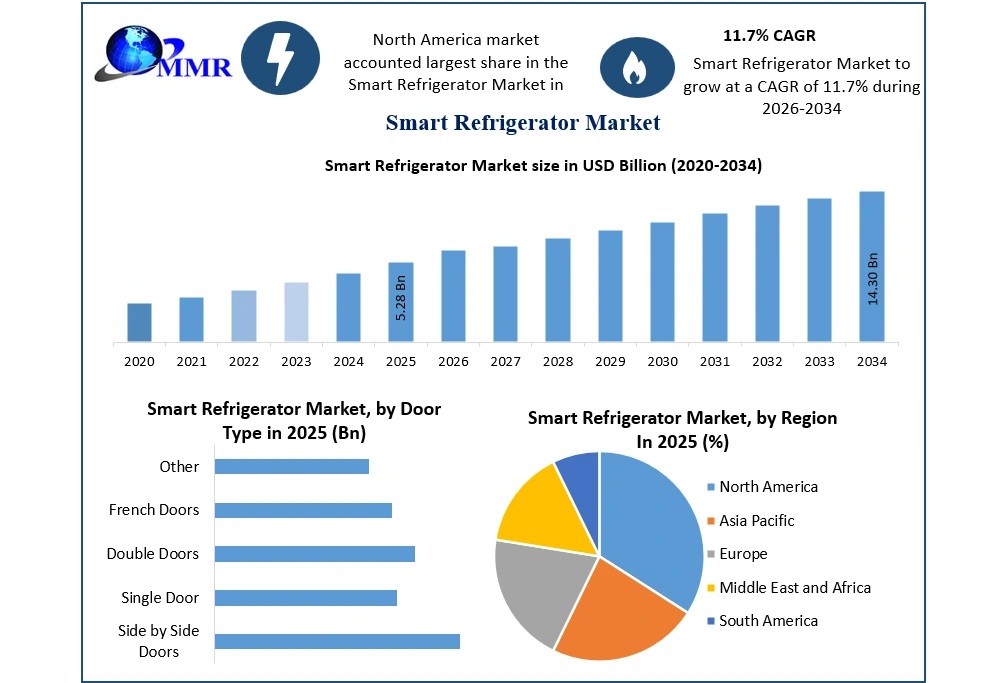
The global smart refrigerator market is projected to reach USD 14.30 billion by 2034, up from USD 5.28 billion in 2025, according to a report published by Maximize Market Research on October 6, 2026. The report forecasts a compound annual growth rate (CAGR) of 11.7% between 2026 and 2034, supported by growing adoption of connected home appliances, artificial intelligence and energy-efficient refrigeration technologies.
Smart refrigerators incorporate Wi-Fi connectivity, touchscreen displays, internal cameras, voice assistants, inventory management, food expiration tracking, remote diagnostics and energy monitoring. The report identifies AI-powered cooling optimization, predictive maintenance, inverter compressors and eco-friendly refrigerants among the technologies influencing market development.
North America leads the global market, supported by smart-home adoption and demand for premium appliances. Asia Pacific is expected to experience the fastest growth, particularly across China, Japan, South Korea and India. By product category, side-by-side refrigerators held the leading position in 2025, while French-door models are forecast to record the fastest growth. Premium refrigerators accounted for the largest share by price range, with economy models expected to expand as connected features become available in more affordable products.
Several manufacturers introduced or expanded smart refrigeration technologies in 2026. Samsung Electronics upgraded its Bespoke AI Refrigerator Family Hub with Google Gemini-powered AI Vision for food recognition and inventory tracking. GE Appliances introduced its GE Profile 27.9-cu.-ft. (approximately 790 L) Smart 4-Door French-Door Refrigerator with Kitchen Assistant and a built-in barcode scanner. LG showcased a SIGNATURE refrigerator featuring conversational AI and AI Fresh technology, while Haier India introduced a Wi-Fi-enabled side-by-side refrigerator with Smart Sense AI.
The report also identifies cybersecurity, software compatibility, smart-home integration and energy efficiency as areas of focus for manufacturers. Its analysis covers market segmentation by door type, price range, distribution channel, end-user and region, with forecasts extending through 2034.