A study published in Scientific Reports has evaluated the thermodynamic performance of a cascade refrigeration system using propane (R290) and ethane (R170) for cold thermal energy storage applications. The researchers applied energy, exergy, and advanced exergy analysis to identify the main sources of efficiency losses and potential improvements in ultra-low-temperature refrigeration.
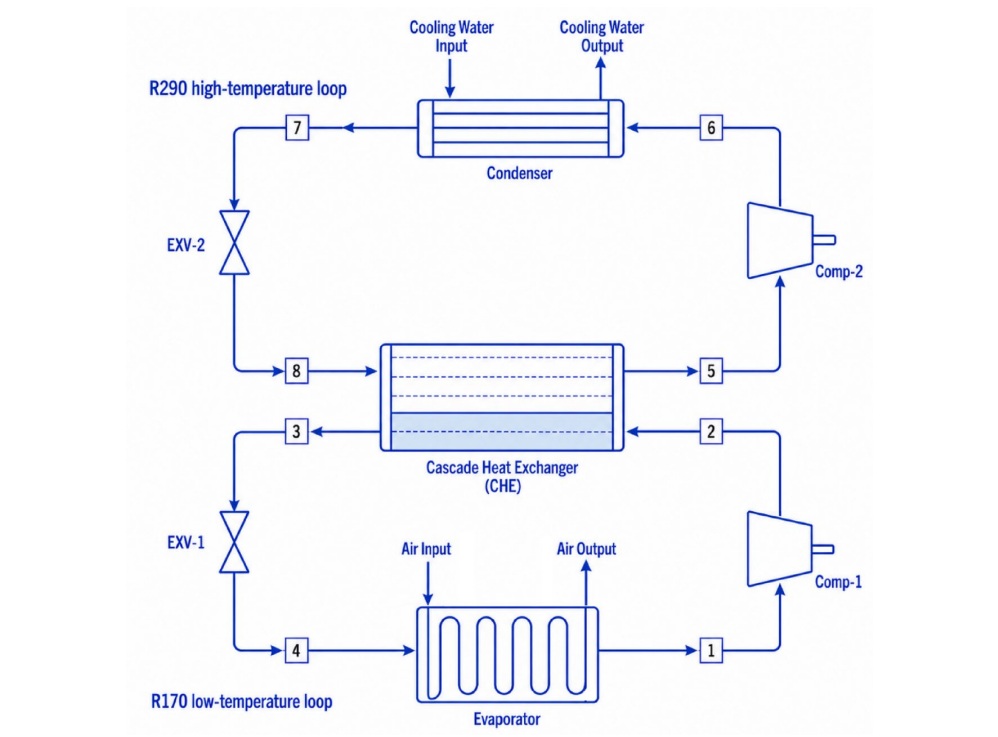
The system uses R170 in the low-temperature cycle and R290 in the high-temperature cycle, with the two circuits connected through a cascade heat exchanger. Under a simulated cooling load of 5 kW (approximately 17,060 BTU/h) and an evaporation temperature of −80°C (−112°F), the reference operating case achieved a coefficient of performance (COP) of 0.6035, with total power consumption of 8.285 kW (approximately 28,270 BTU/h).
Total exergy destruction reached 6.671 kW, with the compressors accounting for 2.350 kW, or 35.2% of the total. The cascade heat exchanger contributed another 1.600 kW, representing 24%. Advanced exergy analysis identified the high-temperature compressor as the largest source of avoidable exergy destruction, followed by the low-temperature compressor, cascade heat exchanger, and second expansion valve.
The researchers also examined alternative operating conditions. The unavoidable case, representing the practical limits adopted in the model, achieved a COP of 1.044 and reduced power input to 4.789 kW. The ideal thermodynamic case reached a COP of 1.71 with 2.924 kW of power input. Increasing compressor isentropic efficiency from 0.78 to 0.87 improved COP from 0.541 to 0.604 while reducing compressor power consumption from 9.241 to 8.285 kW.
Both refrigerants have zero ozone depletion potential and very low global warming potential. The study reports 100-year GWP values of 3.3 for R290 and 5.5 for R170, while noting that both are classified as A3 flammable refrigerants and require appropriate safety measures.
The authors emphasize that the research evaluates only the steady-state refrigeration subsystem. Thermal storage capacity, charging and discharging processes, and storage material behavior were not modeled. The findings identify compressor performance and cascade heat exchanger design as priorities for improving the refrigeration subsystem before integration with a separately designed cold thermal energy storage unit.