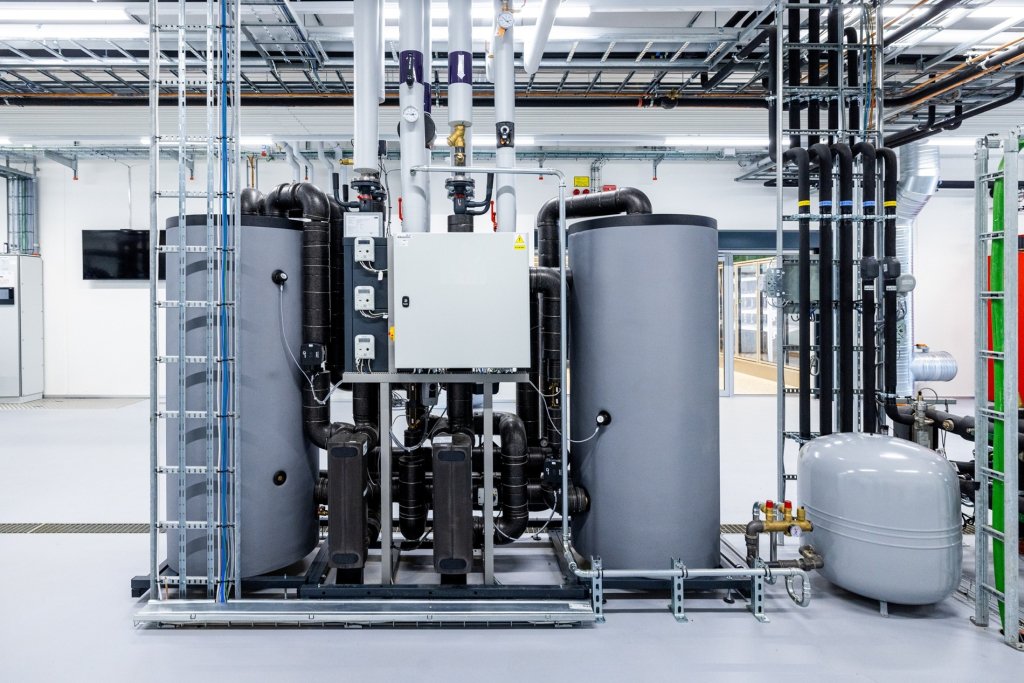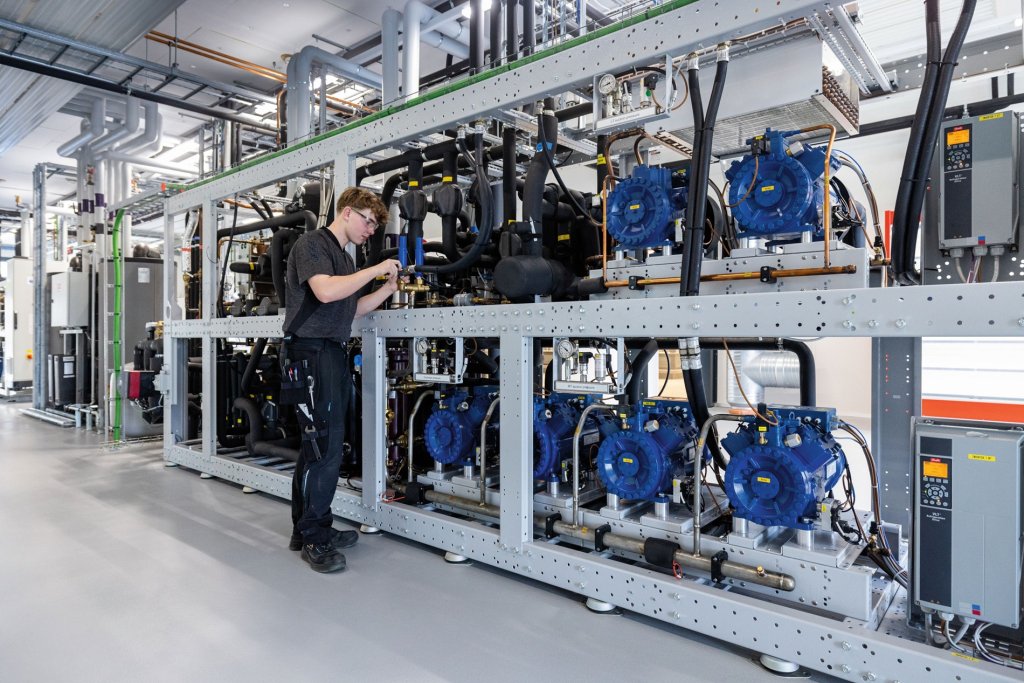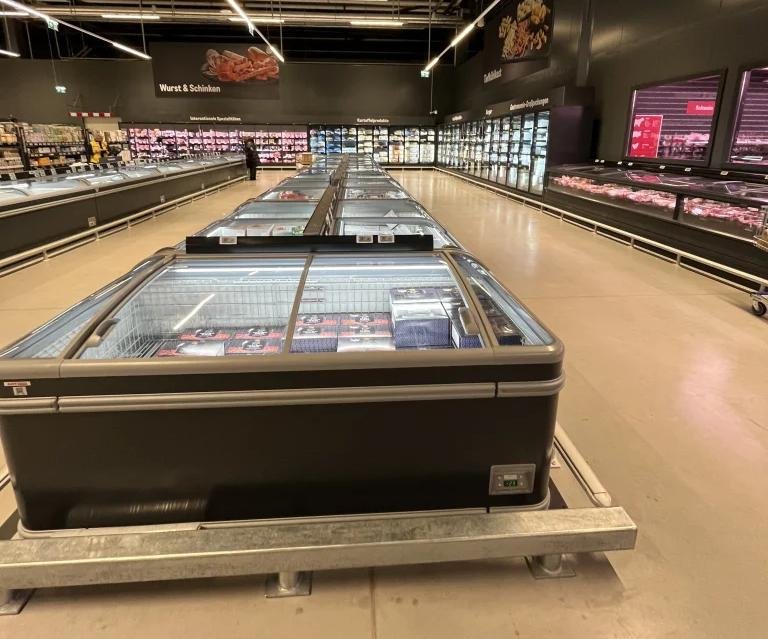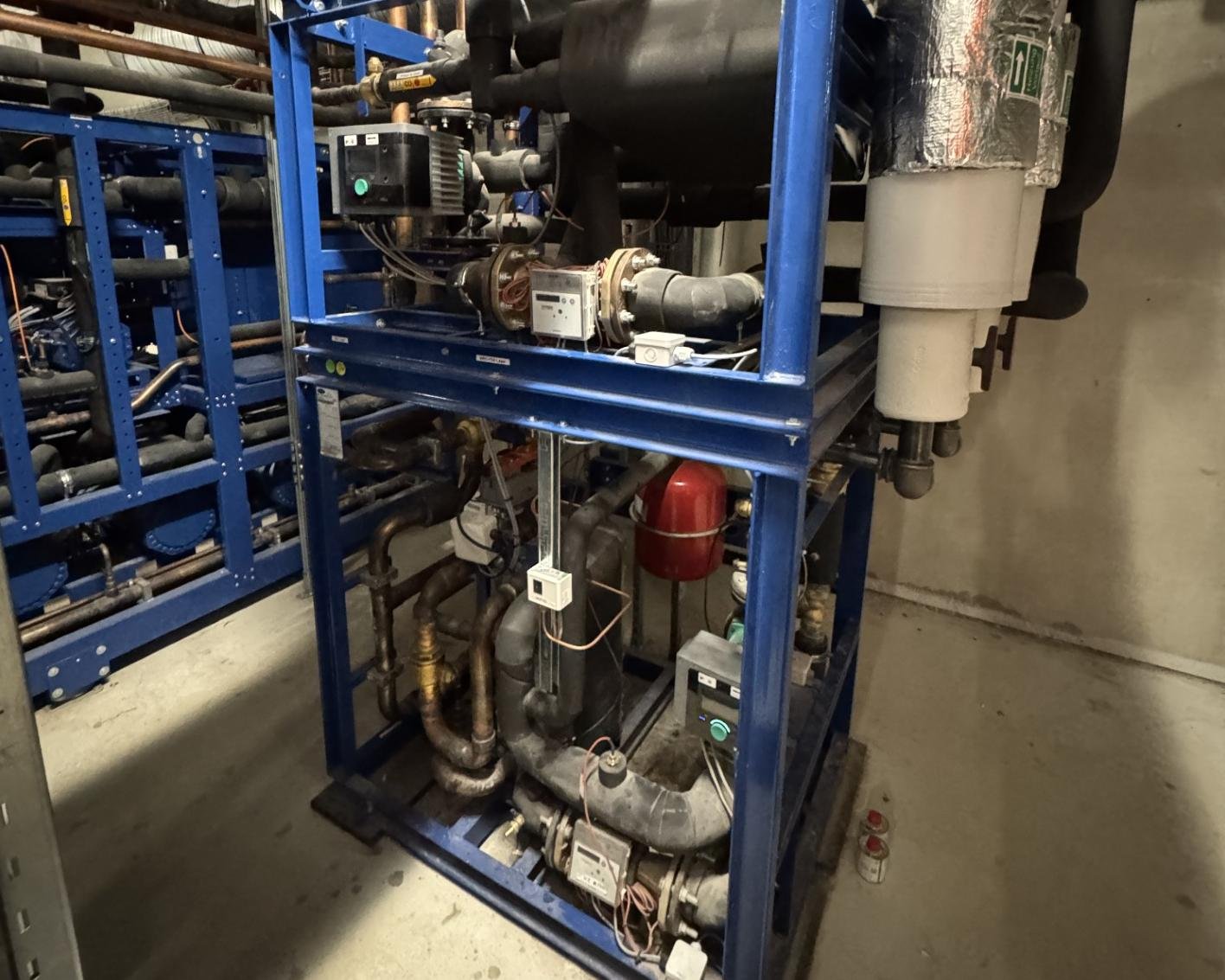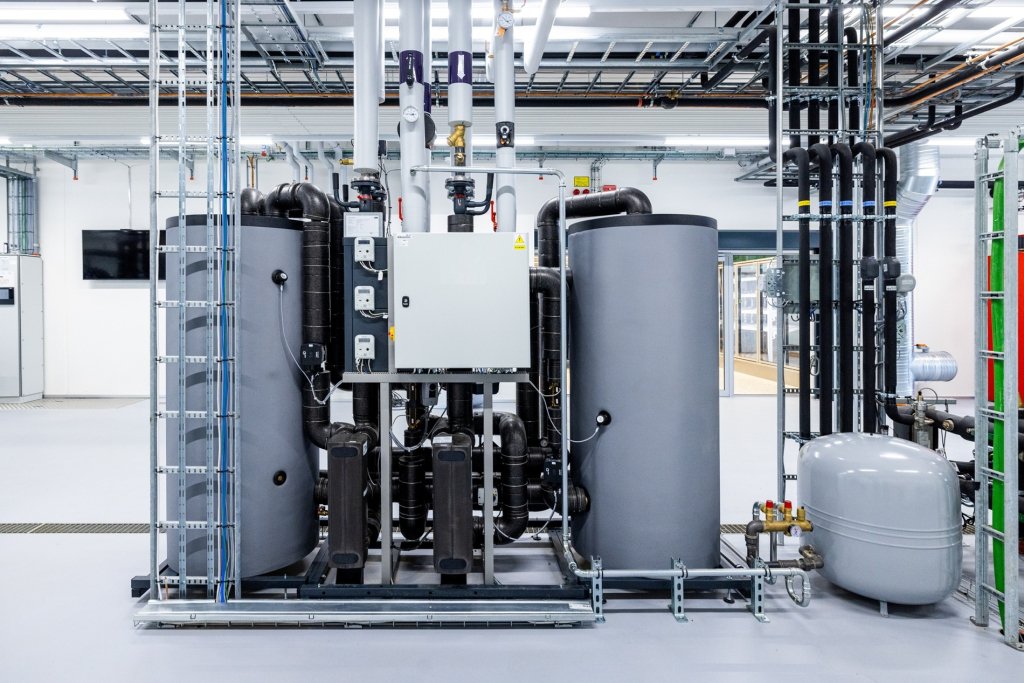
The Danfoss Smart Store ADC in Nordborg. Source: Danfoss A/S.
A Danish convenience store covered 100 percent of its heating demand from refrigeration waste heat through the coldest winter in more than a decade. Over two years of operation, the same site exported 36 MWh of surplus heat to its city’s district network and saved close to €8,800 on heat it would otherwise have purchased from the same grid. The electricity penalty for delivering that heat was, in the operator’s words, marginal.
The site is the Danfoss Smart Store ADC in Nordborg, instrumented and monitored since May 2023.
The question this raises is no longer whether CO₂ refrigeration can heat a building; it can. The real questions are how transferable the model is, what it costs, and where it fails. When a transcritical CO₂ system simultaneously cools, heats a building, produces hot water, and exports surplus heat to a district network, how much of that holds up outside a showcase installation, and does it change the investment case? This market analysis puts those questions to operators, manufacturers, an independent consultant, and an independent training specialist across Europe and North America. Their answers are not identical. Together they describe a technology that is approaching default-inclusion in new builds in Europe while still moving from pilot projects to strategic adoption in North America.
Why CO₂ delivers different heat
CO₂’s appeal as a heat source is not theoretical. In a transcritical cycle, the gas cooler rejects heat over a temperature glide rather than at a single condensing point, which means the working fluid leaves the cooler hotter than an HFC condenser would. What that translates to in real installations is documented across four manufacturers in this market analysis.
Jeffrey Gingras, Chief Growth Officer at Evapco Systems LMP in Laval, Quebec, gives the most explicit gradient: “in commercial operation, CO₂ systems can reliably deliver water temperatures in the range of 35–45°C under most conditions, 50–60°C with proper design and controls, and up to 60–70°C when heat reclaim is prioritized.” For comparison, Gingras notes, HFC systems are “largely limited to low-grade heat recovery” with typical outputs of 30–40°C without an efficiency penalty. Gingras also notes that heat recovery works in both directions: an optimised reclaim strategy delivers a measurable subcooling benefit, improving gas cooler efficiency and reducing compressor workload.
Modine’s experience aligns with the upper part of that range. “In real-world CO₂ transcritical installations, not laboratory settings, recovered water temperatures of 60–70°C are reliably achievable, with higher short-term temperatures possible depending on system configuration,” Umberto Di Barbora, Global Refrigeration Coolers Product and Marketing Director at Modine, says. The implication, in his words, is that the recovered heat enables “direct DHW production without booster heat pumps” and “direct replacement of gas boilers in many retail and industrial settings.”
Andre Patenaude, Director, Business Development and Solutions Strategy at Copeland, places rack systems higher: 60–88°C from CO₂ booster racks, 35–60°C from CO₂ scroll condensing units. Patenaude frames the technical difference plainly: “Unlike HFC systems, CO₂ refrigeration enables true heat recovery utilization, making it a potential primary energy source.”
Massimiliano Sfragara, Product Management Director at Enex Technologies, pushes the envelope further. Recovered water at 80–90°C, he says, is achievable depending on the unit type. That temperature opens up applications outside food retail. Sfragara cites wineries, where recovered hot water at 80°C is used to clean wine tanks, replacing fossil-fuel boilers in a process step that is otherwise hard to electrify cleanly.
The cumulative point is that CO₂ shifts heat recovery out of the preheat category, where HFCs operate, and into direct burner-replacement territory. That qualitative shift is what makes the integrated energy-hub model viable.
From one function to many
What the recovered heat is actually used for has expanded steadily. Sergio Girotto, Founder and Honorary President of Enex Technologies and one of the early developers of CO₂ refrigeration, describes the hierarchy across Enex’s installed base: “First comes domestic hot water. Second is space heating, around 50 percent. Summer cooling is less frequently used. This is a pity, because thanks to the ejector it can be implemented in a way that makes it very cost-effective.” Exporting heat to district networks remains rare in Southern Europe; Girotto notes Enex has done it for projects in Finland, where district heating infrastructure is dense.
The smallest end of the use-case spectrum may be the most revealing. In Irún, Spain, a 100-square-metre convenience store runs its entire cooling and heating load on a single Panasonic iCO2RE OCU-CRC150A08-D condensing unit (15 kW MT). According to Piotr Jabłoński, Senior Product Manager Refrigeration Europe at Panasonic Heating & Cooling Solutions Europe, recovered heat from the R744 circuit feeds a heating DX cassette directly, eliminating the need for a separate heating system in the store. “Heat recovery from the refrigeration unit is a primary heating source, allowing the store to operate without an additional heating system,” Jabłoński says.
At a larger scale, the same principle works through aggregation. The Cuisine Centrale de Puellemontier in France, a central kitchen producing 5,000 plates per day, uses two Panasonic iCO2RE OCU-CR1000 condensing units operating in parallel, with a third unit (OCU-CR400) for a freezer cold room. Recovered heat from the medium-temperature units preheats roughly 524 litres per hour of domestic hot water to 55°C, supplying the kitchen with an annual average of 2,871 litres per day. Jabłoński characterises the result as “substantial and stable heat recovery” in a decentralised CO₂ architecture.
The Cuisine Centrale de Puellemontier in France. Source: Panasonic Heating & Cooling Solutions Europe
The German food wholesale operator METRO has pushed integration further. At its new Hamburg-Rahlstedt store, opened on 11 November 2025, recovered heat is the sole source of floor heating, with no heat pump and no fossil-fuel backup. “In new store openings like Hamburg, the heat recovery is the only source for floor heating, no heat pump, no fossil sources,” says Olaf Schulze, Vice President Energy Management at METRO Properties Holding GmbH in Düsseldorf. The same architecture is planned for the new METRO store in Düsseldorf-Ulmenstraße opening in 2027. At MAKRO Opole in Poland, recovered heat is used year-round to preheat water for industrial dishwashers, addressing the seasonal question of what heat recovery does when space heating is not needed.
Hamburg Rahlstedt METRO Deutschland. Source: METRO
In North America the picture sharpens around Canada, where colder annual climates result in a longer heating season. Andre Patenaude reports that Copeland’s North American field services teams see “an overwhelming majority of Canadian retailers that use CO₂ as a refrigerant are also leveraging it for space heating,” with adoption running close to 95 percent of CO₂ retailers. Three integration architectures are common: direct heat reclaim of discharge gas to a rooftop unit, a glycol loop linking the CO₂ rack to one or several rooftop units, and hot-water preheating via heat exchangers on the rack feeding storage tanks.
The Smart Store sits at the upper end of the integration spectrum. Across two years of operation, Hans Ole Matthiesen, Senior Director, Global ADC at Danfoss A/S, reports, recovered heat has covered 100 percent of the heating demand of the store and an adjacent laboratory building, with two-thirds going to the store and one-third to the lab. The 36 MWh exported to the local district network represents only the surplus during warmer months. “In 2025, we only sold heat in the warmer periods, but are preparing to export heat based on price signals in the future,” Matthiesen says.
Smart Store ADC, Nordborg: monthly heat recovered, demand met on site, and heat exported to district network, 2025. Source: Danfoss A/S.
When the investment case actually works
Heat recovery adds incremental cost to a CO₂ booster system. Three independent manufacturer estimates put that increment at roughly 5–10 percent. What follows from there depends on local heating costs, climate, operating hours, and how the recovered heat is used.
The fastest paybacks come from the European market, where current gas prices and a regulatory push toward decarbonisation tilt the case. Andre Patenaude reports that Copeland’s CO₂ scroll condensing units with the heat recovery module sold in Europe generally achieve payback within 0.8 to 2.5 years, depending on system size and heating capacity. Larger systems pay back faster because their recoverable heat capacity is higher.
Massimiliano Sfragara gives a similar order of magnitude: incremental cost of 5–10 percent, payback under two years when the recovered heat replaces a fossil-fuel boiler. The exact figure depends on local fuel prices.
Modine’s range is wider and explicitly regional. “Given current energy prices and carbon pressures, payback periods of 2–5 years are realistic when heat replaces fossil-fuel boilers” in Europe, Di Barbora says. In North America paybacks are longer, typically 4–7 years, “reflecting lower gas prices and uneven incentive frameworks, though state programs such as CARB FRIP in California are shortening returns in select markets.”
A documented commercial case sits inside that range. The Cuisine Centrale de Puellemontier installation, with 30 kW of heat recovery capacity from two medium-temperature CO₂ units, reached payback in two years and two months without subsidies, calculated over 310 operating days per year at eight hours per day.
The Smart Store provides a more complex financial picture, because part of the heat is sold rather than self-consumed. Hans Ole Matthiesen describes a structural asymmetry in the Danish district heating market: “in our local grid there is a big difference between the price of a MWh heat sold (~€32) and a MWh heat purchased (~€100).” Over two years, the Smart Store exported 36 MWh to the local district network while saving close to €8,800 on heat it did not have to buy. The pack electricity consumption increase to deliver that heat was marginal. Matthiesen is direct about the business model: “selling heat makes sense if the connection to the grid is existing and if the heat recovered comes at little or no cost.”
The independent view tempers headline payback figures. Jonas Schoenenberger, Head of Research and Development at Frigo-Consulting Ltd. in Bern, Switzerland, frames the variables that decide outcomes: “the key decision factors are annual operating hours, simultaneity of heating and cooling demand, achievable return temperatures, and the proportion of the recovered heat that can be used on site.” Schoenenberger argues against general assumptions in either direction. “A project-specific simulation model that evaluates refrigeration load, heating demand, and local climate data provides a far more reliable basis for decision-making than subjective estimations.”
Where it actually breaks
The technology is mature; the failures cluster elsewhere. Four barriers recur across the interviews behind this article.
The first is a technical correction to a common marketing emphasis. Manufacturers tend to advertise the high supply temperatures CO₂ systems can deliver. Schoenenberger insists the binding constraint is on the other side of the loop. “The single most critical factor is return water temperature from the heating circuit. If return temperatures are higher than assumed during design, available heat recovery capacity and efficiency decline immediately.” Sfragara confirms the same effect from the heat-pump side of Enex’s product range: “one challenge we are facing in CO₂ heat pumps is the high hot water return temperature, which reduces the efficiency of the CO₂ cycle.” Two independent voices, one consultant and one manufacturer, name the same physical bottleneck. Evapco’s commissioning experience points the same way: the most common reason a heat recovery installation underperforms, Gingras says, is not a shortage of heat but controls that fail to prioritise reclaim against the building’s heating, hot water and dehumidification demands.
The second barrier is organisational. Refrigeration contractors and HVAC designers come from different disciplines and rarely share a system view. Girotto puts the gap precisely: “the ‘refrigeration’ team assumes the ‘HVAC’ team understands how CO₂ systems work, for example, the temperature glide in transcritical operation and its impact on the circuit, or they may not be aware of the variability in thermal load and recoverable heat.” Di Barbora reaches a similar conclusion from Modine’s commissioning experience: “from a technology standpoint, the bottleneck is rarely CO₂; it is the lack of a shared energy-system mindset.”
That gap is not only a matter of design; it resurfaces in the field. Trevor Matthews, founder of the independent training firm Refrigeration Mentor, has trained CO₂ technicians since 2015. Heat recovery, he says, raises the skill demand sharply, because “the refrigeration system becomes part of the building’s overall energy strategy,” and the technician must now hold refrigeration, HVAC interaction, hydronics, reclaim logic and controls together. Most heat recovery underperformance, in his experience, is human rather than mechanical: “many problems come back to commissioning, controls setup, sensor placement, sequences of operation, lack of coordination between trades, or simply lack of training and experience.” A store short of reclaimed heat in winter rarely has failed hardware; the cause is usually wrong control settings, reclaim that was never prioritised, glycol flow problems, or poor startup coordination. He also points to a structural fragmentation, with installation, commissioning, controls and service split across separate contractors and no single party owning end-to-end performance.
The learning curve is slowed further on two fronts. Manufacturers, Matthews notes, do not always document their control strategies in full, leaving technicians to “read between the lines, learn through experience, or attend very specific manufacturer training programs” to understand how a system is meant to operate. And the competence cannot be acquired quickly: a technician with solid fundamentals needs one to two years to be confident on a standard CO₂ booster, and longer again for full heat recovery integration. The curve is also regional. Technicians in Canada have practised heat reclaim on HFC systems for decades and begin with an advantage that markets without that history lack.
The third barrier surfaces specifically in retrofits. New stores can be designed around recovered heat from the start; existing stores carry HVAC infrastructure sized for a different thermal source. “In existing stores we see a conflict with the dimension of the conventional existing heating system,” Olaf Schulze reports. The fix is sometimes operational rather than mechanical. After the Smart Store opened, Matthiesen’s team discovered that rail heat had been set to 100 percent on by the commissioning engineer, and that this was standard practice. Switching to adaptive humidity-controlled rail heat reduced low-temperature compressor and case energy consumption by 32 percent overnight. The lesson, in Matthiesen’s words, was about commissioning competence, not equipment.
The fourth barrier is contractual. Schoenenberger highlights a structural reluctance among retailers to commit to long-term heat supply agreements with third parties, even where the technical case is favourable. Schemes involving multiple parties, complex legal structures, or external offtakers face additional friction. “In practice, simpler ownership and stakeholder structures tend to support broader implementation,” Schoenenberger says.
Outlook
Two manufacturers and one consultant agree the European trajectory bends toward standardisation in three to five years. “Within 3–5 years, heat recovery is likely to become a ‘de facto standard’ in new CO₂ food retail installations,” Di Barbora says, citing the EU F-Gas phase-down, potential PFAS restrictions affecting HFOs, and CSRD reporting as accelerators. Schoenenberger adds that in Switzerland regulation already obliges operators to utilise waste heat where economically feasible, and that Eastern European markets show high openness to the technology even without comparable regulatory frameworks.
There is, however, a useful disagreement on whether “standard” will become “mandatory.” Sfragara is sceptical: “we don’t believe it will become mandatory, but it can be promoted with incentive schemes.” That distinction matters. A market can reach effectively universal adoption through economics and procurement standards without legal compulsion.
North America’s path is shaped differently. Andre Patenaude points to California’s Title 24 building energy efficiency standards, which already mandates heat reclaim for refrigeration systems regardless of refrigerant, and expects other states with comparable climate goals to follow. Modine highlights CARB FRIP as a programme that already shortens paybacks in select markets. Federal direction is harder to predict.
Regulation sets the pace; the workforce sets the ceiling. Matthews names systems integration and controls as the skills gap the industry most needs to close as heat recovery becomes routine practice. Closing it, in his view, is a shared responsibility of manufacturers, contractors and training organisations alike.
For retailers weighing the question now, the consultant in this article gives a direct answer. “In most food retail applications, our honest answer would be yes,” Schoenenberger says, on whether the additional cost of heat recovery is worth paying.
The wider point comes from Modine. “As CO₂ adoption scales, the real value is no longer just refrigerant choice; it’s how efficiently recovered heat is integrated into the wider building energy system.”
This article is part of the CO₂ Refrigeration & Heat Recovery Special Edition (Refrigeration industry 2026/2)
Inside this issue:
- Migros Bellinzona (Eliwell) — boiler eliminated, −20% energy, 3,300 m³ of gas saved per year
- Romanian supermarket (Enex × Frigotehnica) — 127 kW of heat recovered with liquid-ejector technology
- BITZER Australia (SWEP) — transcritical CO₂ holding temperature in 48°C Sydney heat
- Refra — CO₂ container systems for a 44,129 m² London depot
- Eurovent Certification — gas coolers underperforming declared data by up to 53%
- Interviews: Johnson Controls, Enex Technologies, Refrigeration Mentor