The EU review of ecodesign rules for refrigeration condensing units began in February 2021, and the draft text is now expected at the end of 2026. Industry wants a seasonal efficiency metric in it, because, as Danfoss put it, CO2 “would not have a chance” in smaller units if efficiency were judged by a single COP value. That one technical detail captured the mood of the Chillventa CONGRESS on 12 October in Nuremberg: rules on efficiency, refrigerants, PFAS and standards are moving at different speeds, and manufacturers have to plan products across all of them at once.
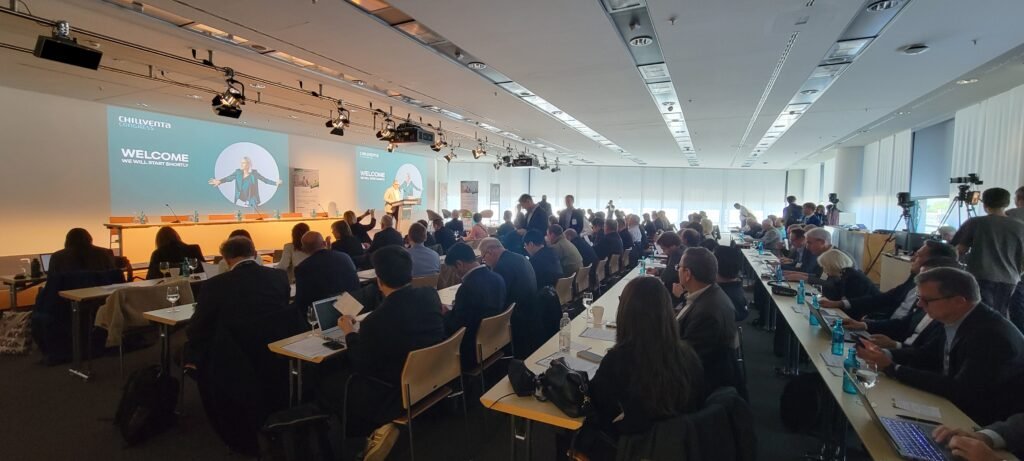
The CONGRESS ran in four streams at NCC Ost the day before the trade fair opened. This report follows the day from the opening addresses by Danfoss and the ASHRAE President to the ASERCOM + EPEE Symposium, where the European Commission, manufacturers and standards experts set out what will shape refrigeration and heat pump products through 2028.
The narrative shifts from climate to resilience
Andrea Voigt, Vice President P&I Affairs, ESG & Communication at Danfoss Climate Solutions, opened the day with a clear framing: “EU policy has not changed direction, but the narrative has shifted from climate to competitiveness and resilience.” The 2030, 2040 and 2050 climate targets stand, but the arguments for them have changed. Her slides put Europe’s fossil fuel import bill at €340 billion in 2025, with 57% of the energy consumed in the EU coming from imported fossil fuels.
The EU Electrification Action Plan, as Voigt presented it, aims to raise the share of electricity from 23% to 46%. For heat pumps that means 4 million units a year by 2030, up from 2.4 million in 2025, and a target to bring the electricity-to-gas price ratio below 2. Industrial waste heat adds a recovery potential of 300 TWh a year, enough to heat 15 to 20 million homes.
Industrial policy is entering the picture too. Under the Net Zero Industry Act, heat pumps count as net-zero technology, and the EU aims to produce at least 40% of its annual deployment needs for such technologies by 2030. The Industrial Accelerator Act introduces Union origin requirements for hydronic heat pumps in public procurement. On refrigerants, Voigt noted that the F-gas quota “declines sharply in 2027, increasing pressure on availability and price”, and that the PFAS process, while adding uncertainty, “is distinct from the adopted F-Gas Regulation”.
Her conclusion was addressed to manufacturers: value in HVACR “shifts from supplying compliant products to enabling safe, efficient lifecycle performance”. Her advice: “Think refrigerant portfolio, not silver bullets”, and make performance provable.
What this means: subsidised and public demand will increasingly depend on origin, documented performance and lifecycle support, not on the product alone.
Retrofitting the buildings that already exist
“80% of the buildings that will exist in 2050 are already here today,” said Sarah E. Maston, 2026-27 ASHRAE President, in her keynote “Changing the Game: Retrofitting for Resilience”. Buildings are designed with climate data, she said, but extreme weather now exceeds those design values more often: “When outliers become common… buildings fail.” Many existing buildings already struggle with ageing systems, deferred maintenance and limited budgets.
Her plan for the year has three parts. The first is building codes. Roughly half of new buildings constructed worldwide each year are built without mandatory energy codes or performance standards, about 2.5 billion square metres, Maston said. ASHRAE’s Building Code Assessment Tool (BCAT) helps jurisdictions assess climate risk, construction practice, workforce capacity and enforcement; pilot workshops have run in Kenya and Lebanon, with work under way in India and Brazil.
The second is existing building commissioning: assess the condition of equipment, build a team of owners, operators, designers, manufacturers, utilities, financiers and code officials, implement improvements and keep monitoring. ASHRAE has gathered the relevant documents, including Standards 100 and 230 and Guidelines 0.2, 1.2 and 1.3, on one page at ashrae.org/president. Her request to equipment makers was specific: “Assist the team by providing existing equipment capacities and operational parameters. Help the team understand new technologies.”
The third is the workforce. Fewer engineers are entering the field while retirements grow, and efficient buildings “are inherently more complicated to operate and maintain, requiring more qualified technicians that don’t yet exist.” ASHRAE’s answer is HVAC Hero, a video game in which players act as facility managers, answer maintenance calls and cut a building’s energy use while learning ASHRAE standards.
What this means: the retrofit market depends on data from equipment makers and on technicians who are not yet trained; ASHRAE is now delivering training content itself.
An industry that wants black and white
Opening the ASERCOM + EPEE Symposium, EPEE Director General Russell Patten showed a map of interlocking EU files, from F-gas and PFAS to ecodesign lots, the EPBD, the Net Zero Industry Act and the Electrification Action Plan, and admitted it was there “to confuse you”. His point was that virtually every EU policy affects the sector and that they are almost all linked. “As an industry what we like is black and white. We hate shades of grey,” he said. “We need to know where to invest, what to do, what to build for the future.”
His slides listed the pressure points: the F-gas Regulation’s “steepest phase-down step yet, with bans coming into force”, PFAS restrictions described as “existential for our sector”, electrification “moving faster than the infrastructure is ready”, and a growing skills gap. EPEE supports the Green Deal and the refrigerant transition, Patten said, “but it does take money, R&D and time to bring to market” new products and applications. He also questioned Brussels’ new emphasis: “Do I really hear competitiveness?”
There was one welcome change. In her State of the Union address, Commission President Ursula von der Leyen gave cooling political recognition for the first time, treating heat pumps and air conditioning as essential to climate adaptation after a summer of heatwaves that Patten linked to nearly 40,000 deaths in Europe. As his slide put it: “Cooling is no longer a luxury. It is a health necessity.”
What this means: the sector’s first request to Brussels is predictability; the ecodesign and standards sessions that followed showed how far that still is.
Ecodesign: a timetable stretched to 2028
Philippe Rivière, Policy Officer at the European Commission’s DG ENER, set out how the two EU product instruments work together. The energy label pulls buyers towards the most efficient products; ecodesign pushes the market by setting minimum requirements when products are placed on sale. Both are set at the least life-cycle cost. The framework started with boilers in 1992, followed by fridges and lighting, and now covers more than 30 product groups. According to the Commission’s annual accounting, the regulations cover 50% of primary energy use, and heating and cooling is among the largest contributors to savings, alongside lighting and electric motors.
The Ecodesign for Sustainable Products Regulation (ESPR) extends the approach to almost all products. The Commission will adopt measures as delegated acts, with “less direct influence of the member states, no votes required”. New elements include a mandatory declaration of substances of concern, a digital product passport building on the existing EPREL database, and possible ecodesign labels for products without an energy label.
For HVAC-R the transition matters most. Under Article 79 of the ESPR, ongoing work on 19 energy-related product groups can continue under the old Ecodesign Directive until the end of 2026. Rivière’s slide noted that this deadline is planned to move to 2028 in the Omnibus XII package on energy products, and amendments to existing regulations remain possible until 2030. Most refrigeration, air conditioning and heat pump groups sit in this transitional regime. The aim, he said, is to keep the change for products “as small as possible, not to disrupt this successful policy”.
What this means: current revisions for HVAC-R products will finish under the existing ecodesign method; ESPR requirements such as recycled content, material efficiency and the digital product passport arrive in the next round.
Condensing units: the metric decides the refrigerant
Torben Funder-Kristensen, Head of Product Compliance and Standardization at Danfoss Climate Solutions, described the revision of ecodesign rules for professional refrigeration (ENTR Lot 1) as “a little bit in limbo” for about five years. The review started in February 2021 and covers minimum efficiency (MEPS), labelling of condensing units, the refrigerant phase-down and potential PFAS restrictions. Draft measures and text are expected at the end of 2026.
A joint industry expert group has proposed new MEPS, backed by what he called “very solid data” on several thousand code numbers. For medium-temperature condensing units of 5 to 50 kW, today’s seasonal efficiency (SEPR) minimums of 2.55 and 2.65 would rise to 2.80 from July 2028 under the industry proposal. For small medium-temperature units, the minimum COP would rise from 1.40 to 1.60 (0.2 to 1 kW) and from 1.60 to 1.75 (1 to 5 kW). The Commission’s consultants (VHK) have proposed a two-tier path with medium-temperature averages for 3 to 30 kW units of 2.50 in 2026 and 2.93 in 2028.
The key change is an optional seasonal metric for smaller units. “CO2 would not have a chance if we would only go for COP values alone,” Funder-Kristensen said, because of the rating temperature used for a single-point COP. The seasonal option is meant to leave room for CO2 units in lower capacity ranges.
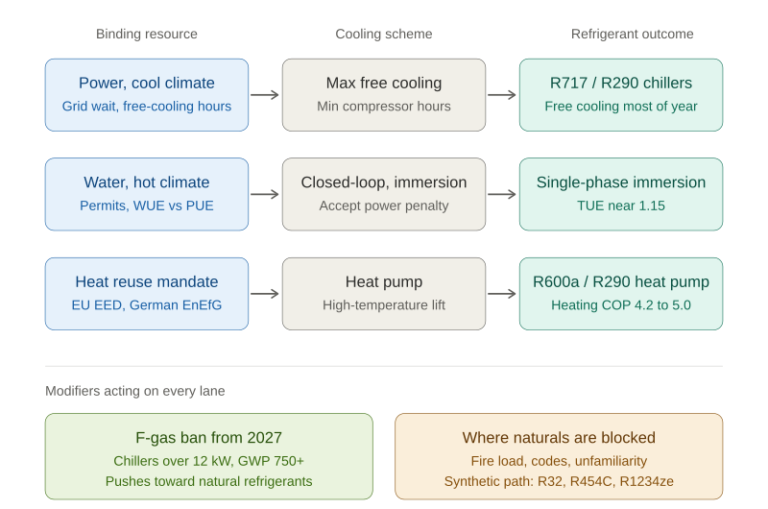
The refrigerant picture is already set in part: from 2030, condensing units face a GWP limit of 150. Low-GWP F-gas blends contain a high share of HFOs, and R1234yf has a high TFA content in its degradation products. The outcome of the PFAS restriction “will not be known before 2028 at the earliest,” he said, and strong containment measures across the life cycle can be expected whatever happens. “What we for sure can use is natural refrigerants.” R290 units already run with high efficiency but are often built as multi-circuit systems because of charge limits; CO2 is “still a newcomer” with “moderate, constant growth”; indirect systems with a secondary fluid are another route.
What this means: how efficiency is rated will decide whether CO2 can compete in small condensing units, while charge limits shape R290 designs.
Heating and cooling lots: affordability and a testing backlog
Els Baert of Daikin Europe gave the industry view on the revisions for heating, cooling and refrigeration products. Some started in 2017 and 2018 and are still running; she expects them to end before 2028, if the deadline moves as the Commission indicated. A new round under the ESPR will follow.
The scope is widening. Lot 1 will cover products up to 1 MW instead of 400 kW, so air-to-water and water-to-water chillers, including reversible units, move from Lot 21 to Lot 1, and IT and process cooling enter the scope. Baert supported the least life-cycle cost method as a guard for affordability, but warned against raising requirements for best-in-class products: that would add cost and push buyers towards cheaper, less efficient products, “and then we missed the electrification part completely.” Her slide argued for aligning minimum requirements across lots, with a proposal of SEER 6.00 and SCOP 4.00 for split air conditioners under 12 kW in Lot 10, compared with Lot 1 minimums of SCOP 2.83 at 55°C and 3.33 at 35°C for air-to-water heat pumps.
Testing is the second burden. Five new test methods are coming, including load-based testing, which will become mandatory for heat pumps below 70 kW four years after the regulation is published. The draft allows several methods, which makes products hard to compare, and the method has not yet been validated in a standard; an EU-funded Horizon project is working on it, with results hoped for from 2028. “We only have four years, and within these four years we have to retest all our models,” Baert said.
She also pointed to gaps between regulations. “Changing over to another type of refrigerant doesn’t mean necessarily that the efficiency increases.” The F-gas Regulation’s exemption based on life-cycle climate performance (LCCP) refers to ecodesign, yet no method exists to calculate it. Energy labels help consumers, she said, but “I don’t think they are valuable in a professional environment.”
What this means: manufacturers face retesting and new requirements during the refrigerant switch; cost and affordability are the industry’s main arguments in the revisions.
Standards lag behind the rules
Regulations rely on harmonised standards, and Marek Zgliczynski of Nidec Global Appliance showed how far behind several of them are. The proposed new edition of EN 378 Parts 1 to 3, the safety standard for refrigerating systems and heat pumps, was not approved at the inquiry stage in 2025. CEN TC182 WG6 is preparing an amended proposal for a second vote. The disputed points include the definition of intrinsic and extrinsic design methods, concentration factors and system charge limits in Part 1. The 2016 edition remains in force and is expected to be harmonised with the new Machinery Regulation in 2027.
The compressor safety standard EN IEC 60335-2-34 is cited under the Machinery Directive but, as his slide put it, is “still waiting for citation” under the Low Voltage Directive. The IEC has already published edition 7, and a future amendment will allow variable-speed compressors to be approved without their associated electronics. The slow EN process is “the main issue”, his slide said, proposing a return to parallel voting with the IEC.
The rating standard for condensing units, EN 13215, is harmonised with the current ecodesign regulation. A new edition that moves the medium-temperature calculation to the thermodynamic midpoint, relevant for high-glide refrigerants, is stalled: the working group is on stand-by, waiting for new experts to join. Charge limits remain the central open question. “We are still waiting for an agreement and consensus on increased charge limits that are really important for F-gas regulation and others,” Zgliczynski said.
What this means: higher charge limits for flammable refrigerants, which the F-gas transition relies on, still depend on standards that have not passed.
Heat pump economics: the price signal
The symposium’s heat pump panel, moderated by Andrea Martin of EPEE, brought together Philippe Rivière of the European Commission, Aurélie Beauvais of Euroheat & Power, Christina von Westernhagen of Johnson Controls, Dr Thomas Tomski of Copeland and, by video, MEP Michael Bloss. Opening the discussion, Rivière listed what is already in place: the energy efficiency first principle and savings obligations for member states, the recognition of ambient heat as renewable energy, the end of subsidies for stand-alone fossil fuel boilers under the EPBD, an indicative goal to phase out fossil fuels in buildings by 2040, and the second emissions trading system starting in 2028. “I’m not sure we can find a policy that will magically” solve the rest, he said.
What is missing, in his view, is economics. In many countries the ratio of electricity to gas prices has not followed heat pump deployment and remains too high. “The problem is not with the price of electricity, but it’s with taxes, there is network charge, and on this, in fact, quick action could be possible.” The revision of the Energy Taxation Directive is still stuck, but member states can already lower electricity taxes to the defined minimum and shift part of the burden to the state budget. The Commission has also proposed changes under electricity market rules to reduce network charges. Such a price signal applies across all applications, not only new buildings, and makes subsidies more effective: “It is not the only thing that we have to do, but it is clearly an enabling condition.” It links directly to the price-ratio target below 2 that Voigt presented in the morning.
What this means: the fastest lever for heat pump uptake sits in national energy taxation and network tariffs, not in new product rules.
From policy to practice: megawatt heat pumps
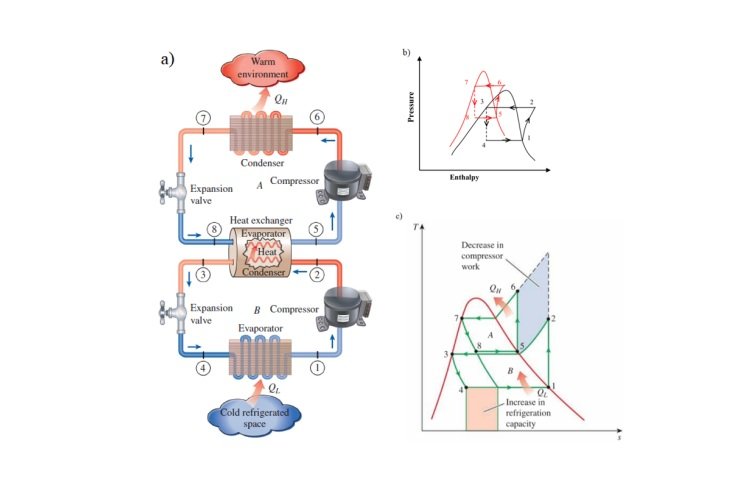
In the Heat Pumping Technologies stream, Ivo Eiermann, Senior Product Manager for centrifugal heat pumps at Johnson Controls, showed how regulation is already creating demand at the large end of the market. His slides cited two German laws: the Energy Efficiency Act (EnEfG) requires new data centres to reuse 10% of their energy, rising to 20%, and the Heat Planning Act (WPG) requires at least 30% renewable or unavoidable waste heat in heat networks from 2030 and 80% from 2040. These applications typically need lifts of 55 to 95 K at 3 to 60 MW.
In Hamburg, four multi-stage OM units on R1234ze(E) take heat from treated sewage water at 15°C and supply district heating at 95°C, with 60 MW of heating capacity (4 × 15 MW) and a heating COP of 2.86, according to his slide. With large lifts, Eiermann said, a COP of 2.7 to 3 is typical.
The refrigerant choice has moved too. Isobutane (R600a) is now available for both the two-stage CYK units (2 to 17 MW) and the OM units (10 to 22 MW), raising the OM supply temperature to up to 110°C. The consequences for the site are substantial: a 20 MW OM unit holds 9 t of A3 refrigerant, so the owner must provide an ATEX zone 2 concept with ventilation and gas detection. “Plan safety from day one,” the slide advised. For comparison, Eiermann reminded the audience that a 6 to 12 kW home heat pump holds about 150 g.
Grid capacity can also decide the design. For a brownfield unit in Stuttgart, a direct-on-line start of the 7.4 MW motor would have drawn 42.4 MVA and a soft starter still about 30 MVA, more than the grid connection allowed. A slip-ring motor cut this to 8.5 MVA, and the unit reaches full load in about 10 minutes. Johnson Controls pursues natural and synthetic refrigerants in parallel: “We strongly believe that not each and every product will be natural,” Eiermann said.
What this means: at megawatt scale, site safety and grid connection constrain refrigerant and drive choices as much as GWP does.
Outlook: the dates to watch
The CONGRESS left the industry with a dense calendar. The F-gas quota drops sharply in 2027, and the Machinery Regulation applies from the same year, with EN 378 and EN IEC 60335-2-34 still waiting to be aligned with it. Draft ecodesign text for professional refrigeration is expected at the end of 2026, while the deadline for finishing current revisions under the old directive is planned to move to 2028. Load-based testing for small heat pumps will follow four years after its regulation is published. From 2030, condensing units face a GWP limit of 150, and the PFAS decision is not expected before 2028.
Against this uncertainty, the speakers’ advice converged: prepare a refrigerant portfolio rather than a single answer, document real-world performance, and invest in the people who will install and maintain the equipment. As Funder-Kristensen put it: “What we for sure can use is natural refrigerants.”