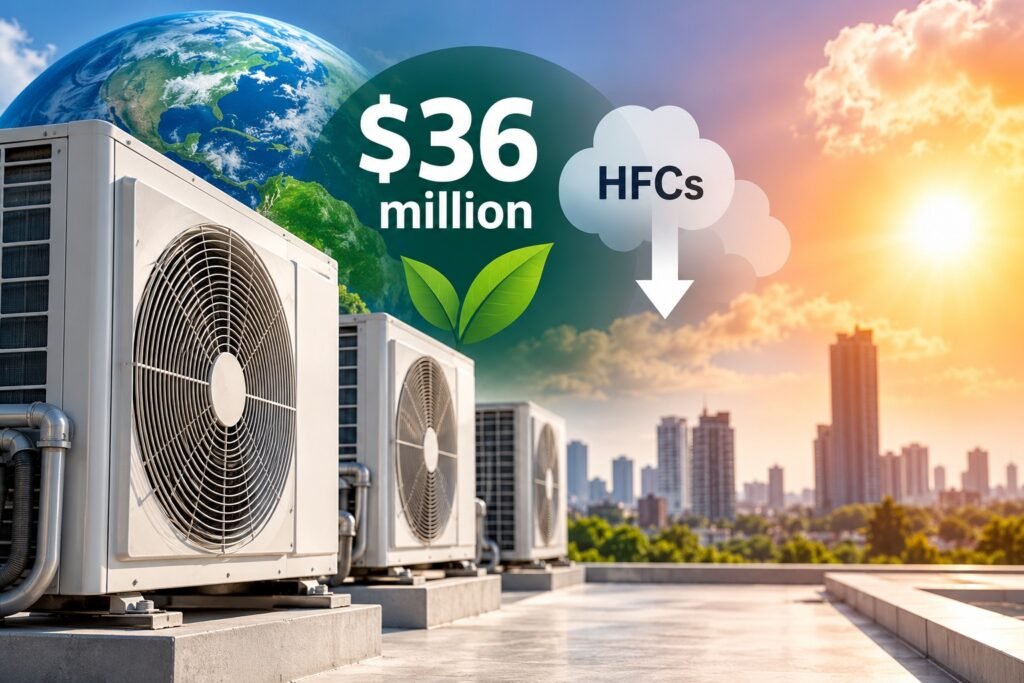
Climate philanthropies announced more than $36 million in new funding on October 15, 2026, to reduce emissions from refrigeration and air conditioning. The commitment is part of a four-year, $100 million philanthropic effort focused on reducing high-impact refrigerants and expanding access to energy-efficient, sustainable cooling.
The funders include The Bernard and Anne Spitzer Charitable Trust, The Jeremy and Hannelore Grantham Environmental Trust, and Sequoia Climate Foundation. Funding will support global organizations and initiatives under a four-year sustainable cooling strategy developed by the Super Pollutant Action Alliance (SPAA) and the Clean Cooling Collaborative.
The initiative will support stronger policies to phase down super pollutants, accelerate the adoption of climate-safe alternatives in new cooling equipment, and create incentives to prevent emissions from refrigerants already in use. Hydrofluorocarbons (HFCs), commonly used in refrigeration and air conditioning, can have thousands of times the climate impact of CO2. Global air conditioner stocks are projected to more than triple by 2050, increasing the importance of emissions reduction.
The announcement coincides with the tenth anniversary of the Kigali Amendment to the Montreal Protocol. The funding responds to a call for global foundations to continue supporting HFC reductions and sustainable cooling. According to research cited in the announcement, mitigating super pollutants, including HFCs, methane, black carbon, and nitrous oxide, is three times more effective at reducing mid-century warming than cutting CO2 alone.
“As demand for cooling grows, so do potential emissions. Targeted philanthropic funding can be a catalytic force in unlocking broader investments in sustainable cooling and fast-acting super pollutant solutions that shield vulnerable communities and advance climate goals,” said Christie Ulman, President of Sequoia Climate Foundation.