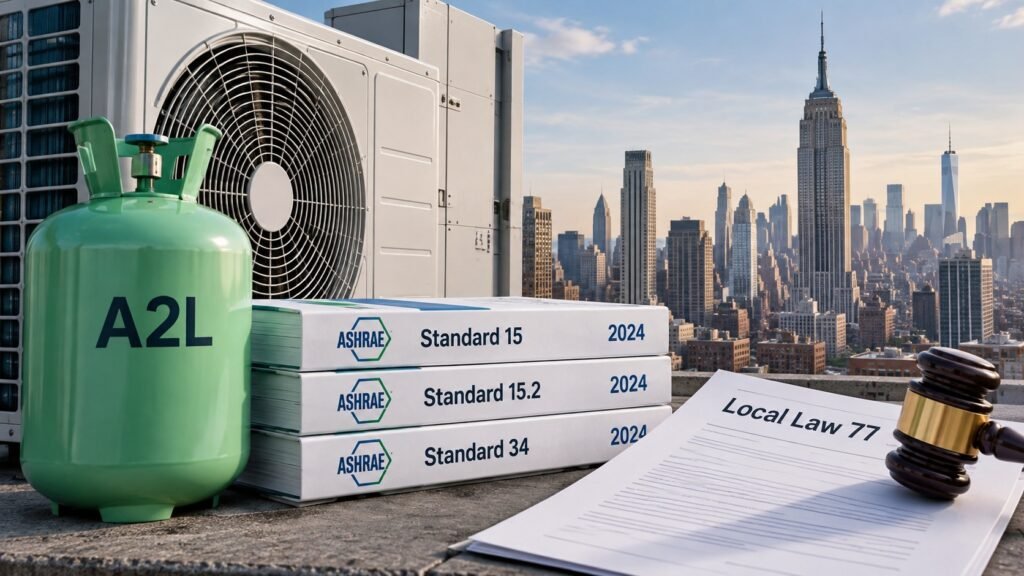
HARDI and the Air-Conditioning, Heating, and Refrigeration Institute (AHRI) have asked the New York City Department of Buildings (DOB) to amend provisions of Local Law 77 (LL77) governing A2L refrigerants. The associations said several city-specific requirements depart from ASHRAE Standards 15, 15.2 and 34 and increase material, labor and design costs.
The organizations recommended that DOB adopt the 2024 editions of ASHRAE 15, ASHRAE 15.2 and ASHRAE 34, with all addenda published through June 2026, instead of the 2022 editions referenced in LL77. According to the joint letter, the newer editions include updates intended to improve alignment with model codes and consistency between the standards.
HARDI and AHRI specifically requested changes to three provisions. They asked DOB to recognize continuous or field-tested refrigerant piping without requiring pipe-in-pipe construction and an additional two-hour fire-resistance-rated enclosure; permit refrigerant piping in public corridors when it meets current ASHRAE 15 requirements for charge, testing, penetrations and mitigation; and restore ASHRAE 15’s unmodified definition of “air circulation.”
The letter states that ASHRAE 15-2024 exempts areas containing only continuous refrigerant piping, or joints and connections tested in accordance with Section 9.13, from effective dispersal volume calculations under specified conditions. It also notes that Addenda a and b to ASHRAE 15-2024 and the 2027 International Mechanical Code include allowances related to fire-resistance-rated shaft requirements for A2L refrigerant piping.
The associations said LL77 requirements could require redesign and construction changes, limit the use of readily available compliant products and systems, and create installation and distribution challenges. They also said the requirements could complicate retrofit and equipment-replacement projects in New York City, including projects related to Local Law 97 compliance.
“Aligning LL77 with current national standards will reduce the regulatory burden on manufacturers, installers, building owners, and project developers while maintaining robust safety protections for New Yorkers and enabling access to emerging low-Global Warming Potential (GWP) technologies,” the associations stated.
Read the full text of the comment letter here.