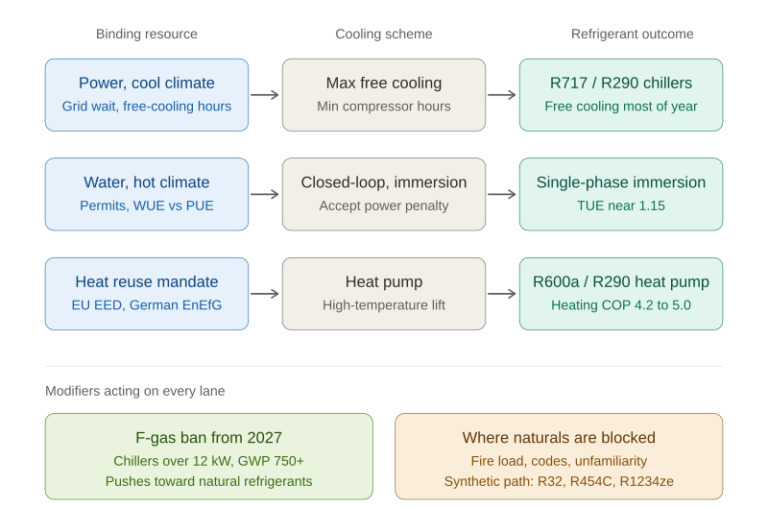
A review published in Applied Thermal Engineering examines the use of water (R-718) as a refrigerant in high-temperature heat pumps for industrial heating. Researchers Mohamed Elwardany, Y. Siva Kumar Reddy and Nabil Nassif analyzed theoretical models, simulations and experimental studies, reporting coefficients of performance (COP) from 1.3 to 6.10 at output temperatures of 130–250 °C (266–482 °F).
The review identifies twin-screw and centrifugal compressors as important technologies for R-718 systems. Water’s low vapor density creates high volumetric flow requirements, while large pressure ratios and compressor discharge temperatures present additional challenges. Multi-stage compression, intercooling and water injection are among the approaches examined to address these limitations.
Cascade systems combining R-718 with low-global-warming-potential refrigerants, including R600 and R1234ze(Z), demonstrated temperature lifts of up to 180 K (324 °F temperature difference), with COP values between 1.5 and 4.5. The review also reports that water injection can increase compressor isentropic efficiency to 80%, while multi-stage configurations can improve heating capacity and COP.
Experimental findings reviewed by the authors indicate that R-718 systems can outperform hydrocarbons, hydrofluoroolefins and hydrofluorocarbons under high-temperature operating conditions above 100 °C (212 °F). The paper also cites estimated payback periods of 2–3 years for typical industrial applications.
The authors identify compressor development, cycle optimization, corrosion, scaling and operation at sub-atmospheric pressures as areas requiring further attention. Water has zero global warming potential and zero ozone depletion potential, and the review highlights its potential for industrial waste heat recovery and high-temperature steam generation.