NOVA FRIGO introduces a new CO2 chiller with heat pump, created as part of the project promoted by the Lombardy Region “Ricerca & Innova” call for proposals, made possible also thanks to the technological contribution of Frascold, relating to an innovative heat pump with natural CO2 refrigerant and without the use of fossil fuels. This is a novel solution in the Italian context, combining high performance, reduced environmental impact and application versatility. The use of CO2 as a natural fluid and the adoption of high-performance components respond to the growing market need for solutions aligned with the principles of energy efficiency and sustainability.
Founded in 1976 as a chiller manufacturer for the plastic moulding sector, NOVA FRIGO Engineering S.r.l. has consolidated its presence in the field of production applications over time. Starting from 2019, the company began developing commercial and industrial refrigeration systems dedicated to food storage, thus expanding its range of action. Today, it designs and manufactures chillers and direct expansion units, using traditional and natural refrigerant gases. The path to greater sustainability has seen the progressive introduction of propane, CO2 and, more recently, low-charge ammonia solutions.
“This innovative chiller is the result of advanced co-design, the outcome of a solid partnership with Frascold, which provided specialised skills and cutting-edge compressors, making a difference in terms of performance, sustainability and efficiency in complex operating conditions”, states Loris Antonelli, Sales Director of NOVA FRIGO, who concludes, “Although still at the experimental stage, the project represents a concrete opportunity for us to field test the potential of CO2 in the comfort sector”.
Efficiency and control: CO2 takes shape with Frascold
Development of the new system required the resolution of three design challenges: the simultaneous management of hot and cold production, through a flexible thermo-fluid-dynamic configuration, containment and safety of the high pressures present on the entire circuit and, finally, customisation of the control electronics, necessary to integrate complex components such as the ejector, to support dynamic adjustments and to guarantee high safety standards.
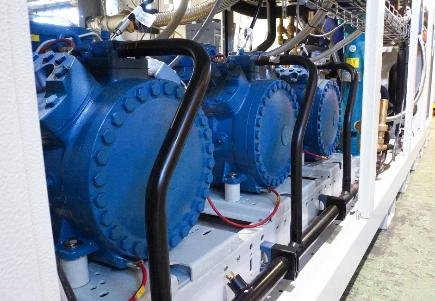
In response to these needs, the new system developed by NOVA FRIGO is based on a specific technological choice: the adoption of three Frascold compressors from the CO2 – Transcritical Heavy Duty (TK-HD) series with LSPM (Line Start Permanent Magnet) motors, guaranteeing an increase in seasonal efficiency estimated between 8% and 10%, on the overall performance of the compressor, compared to traditional systems. Designed for transcritical applications, the latter are able to operate up to 140 bar, in a wide range of evaporation temperatures (from -30 to +20°C), and to deal with high-pressure standstill conditions, up to 100 bar. The configuration combines a compressor with inverter and two on/off units in order to modulate the cooling capacity, ensuring high performance even at partial loads, stability of operating pressures and full adaptability to the variable conditions of the system. A further distinctive technical element is the integration in the refrigeration circuit of a liquid ejector, whose operation allows the evaporator to operate at zero overheating (0 K), emulating the behaviour of a semi-flooded system. Specifically, the ejector suctions the excess liquid from the suction accumulator and reintegrates it into the receiver, exploiting the energy of the high-pressure gases, without the need for additional electricity. The result is a more efficient thermal cycle, characterised by reduced consumption, lower mechanical stress of the compressors and greater operational reliability of the entire system.
Alessandro Carrubba, Engineering Manager of NOVA FRIGO comments “System management using advanced and integrated control electronics completes the solution through the regulation of temperature and pressure parameters, the monitoring of operating conditions and load management. The modular logic of the controller makes it possible to satisfy the complexity of the application without sacrificing its usability.”
The CO2-based heat pump system fits into a power range that is still under-explored by the market, thus responding to a concrete demand for innovation and the extension of natural refrigerant technologies to applications previously considered complex or inaccessible.
“It was not simply a matter of introducing an existing technology, but of overcoming the application limits in terms of efficiency, pressure management and dynamic control, validating solutions with high technical content on a scale little explored until now. In this process, co-design proved to be decisive in integrating advanced components and creating a machine capable of opening up new application perspectives for CO2 in the field of industrial comfort ” , concludes Nika Bagdasarian, North-West Italy Sales Area Manager at Frascold.