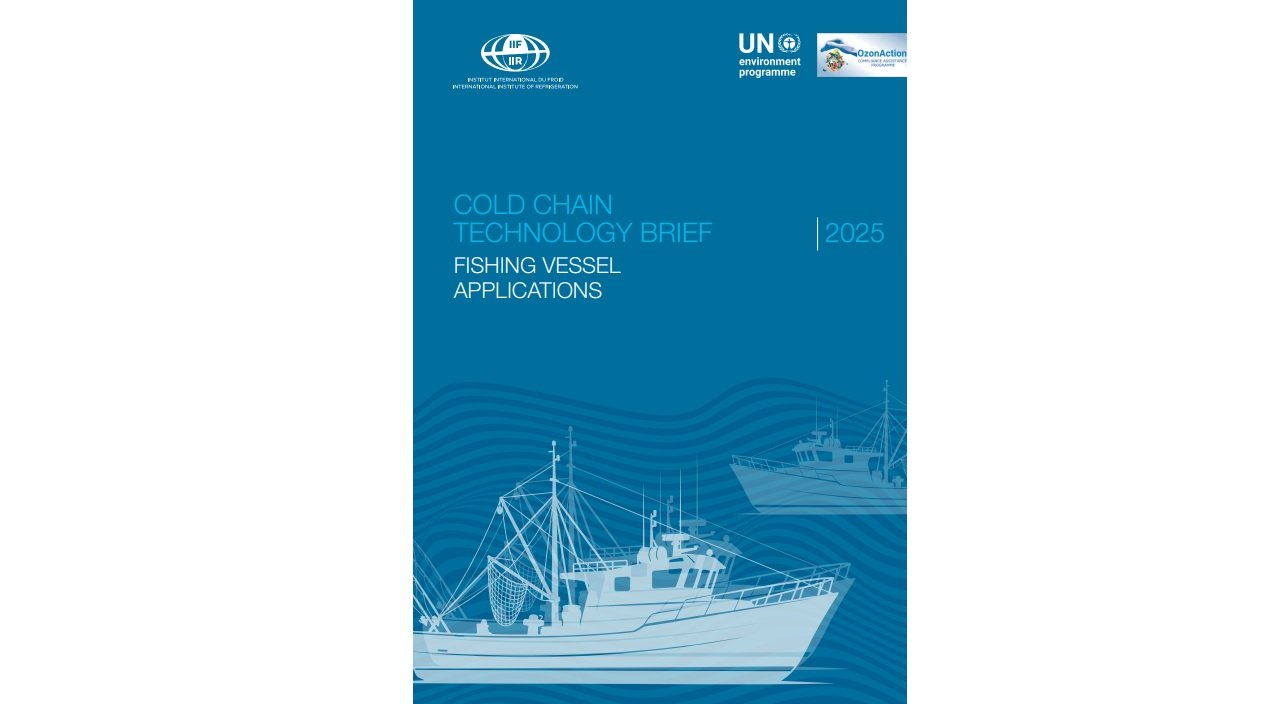
The United Nations Environment Programme (UNEP) and the International Institute of Refrigeration (IIR) have released a new Cold Chain Technology Brief addressing the use of refrigeration systems on fishing vessels. The document underscores the dual challenges faced by the global fishing sector: significant food loss due to inadequate onboard cooling, and environmental risks associated with high-GWP refrigerants.
Globally, up to 35% of seafood is lost due to cold chain limitations, with losses in small-scale fisheries reaching 50%, according to FAO. The brief notes that while chilling systems can extend shelf life and improve food quality, fossil-fuel-based refrigeration on vessels may increase emissions unless paired with energy-efficient technologies and low-GWP refrigerants.
The report provides a detailed overview of refrigeration practices by vessel type. Larger vessels often use ammonia-based refrigerated seawater (RSW) systems or freezing solutions such as plate freezers and individual quick freezing (IQF) units. Compact CO2-based systems are gaining traction due to their safety and energy efficiency, particularly in smaller vessels and cold climates. In warm regions, the use of propane (R-290) and hybrid R-717/CO2 cascade systems is being explored. Ice and slurry applications, including onboard R-290 slurry systems, are also discussed, with a case study from India showing promising results under tropical conditions.
The brief outlines the environmental impact of current refrigerants, particularly R-22, which remains in use in many vessels despite its high GWP. It highlights efforts in countries like the Maldives to phase out HCFCs, supported by the Multilateral Fund. Transitioning to ammonia and CO2 is seen as a pathway aligned with IMO regulations and climate goals. However, the brief also raises concerns over HFOs, noting their degradation into trifluoroacetic acid (TFA), a persistent PFAS compound.
Technological trends include marine-adapted materials, onboard digitalisation for maintenance and efficiency, and integration of heating and cooling systems. The use of waste heat recovery, thermal energy storage, and cryogenic fuels is suggested to optimise energy use. Safety is emphasised, with risk assessments, containment strategies, and training cited as critical components for safe refrigerant use onboard.
A life cycle assessment case study in Indonesia compared block ice transported from shore to onboard flake ice machines. While block ice had significantly lower ozone depletion and global warming impacts, the authors recommend using natural refrigerants in flake ice systems to align with climate agreements.
"Transitioning to energy-efficient refrigeration systems that utilise natural refrigerants offers a transformative opportunity," the brief concludes, calling for policy mandates, training, regulatory enforcement, and investment in sustainable technologies to support the long-term viability of the fisheries sector.