Esta página solo está disponible en inglés. Ir a la portada en español

×

Questa pagina è disponibile solo in inglese. Home page in italiano

×

Diese Seite ist nur auf Englisch verfügbar. Zur deutschen Startseite

×

Cette page est disponible uniquement en anglais. Aller à la page d'accueil en français

×

Global Cold Chain Logistics Market to Reach USD 219.44 Billion by 2034

Global Cold Chain Logistics Market to Reach USD 219.44 Billion by 2034

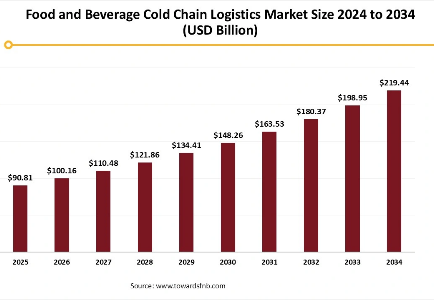
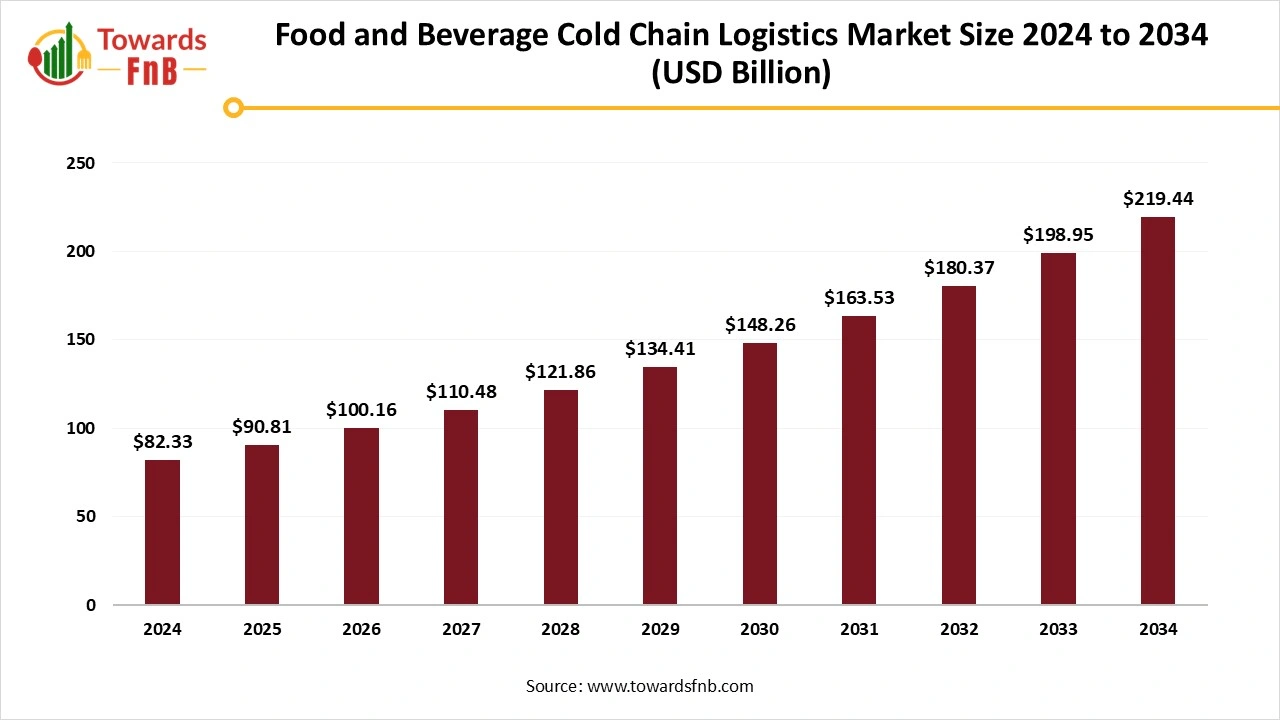
The global food and beverage cold chain logistics market is projected to grow from USD 90.81 billion in 2025 to USD 219.44 billion by 2034, according to a report by Towards FnB, a sister firm of Precedence Research. The market, valued at USD 82.33 billion in 2024, is expected to expand at a CAGR of 10.3% during the forecast period, driven by increasing demand for fresh and frozen foods.

Market growth is attributed to evolving consumer preferences, especially among younger generations, and rising demand from e-commerce and food delivery services. The adoption of advanced refrigeration technologies and real-time monitoring systems is improving food quality and operational efficiency while reducing spoilage and supporting regulatory compliance.

In 2024, the North American region led the market, supported by advanced infrastructure and a high demand for frozen snacks. Asia Pacific is expected to be the fastest-growing region through 2034, due to urbanization, improved technology adoption, and increased demand for fresh and frozen products.

By application, the fruits, vegetables, and beverages segment dominated in 2024, while meat and seafood are projected to see significant growth due to stricter storage requirements. The warehouse segment led by type, and transportation is forecasted to expand rapidly with rising demand for long-distance refrigerated shipping. In terms of end-use, the retail segment led the market in 2024, whereas the e-commerce sector is expected to grow at the fastest pace.

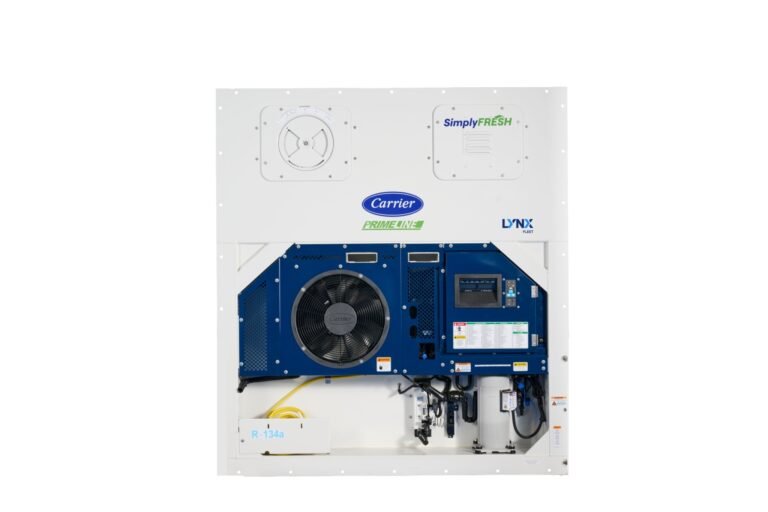
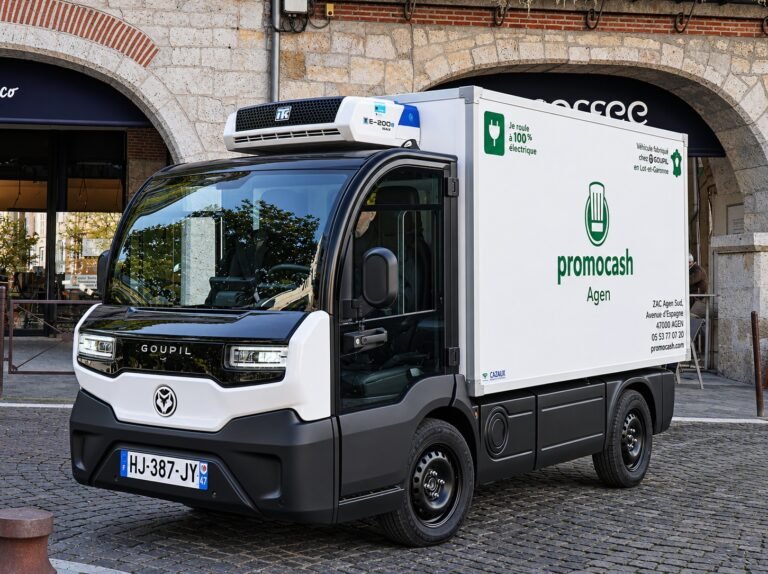
Sustainability is a growing focus, with the industry adopting low-GWP refrigerants, solar-powered warehouses, and energy-efficient refrigeration units. Artificial intelligence and IoT integration are also transforming operations by enabling predictive maintenance, route optimization, and improved traceability.

According to Vidyesh Swar, Principal Consultant at Towards FnB, “These developments are improving operational efficiency while reducing wastage and ensuring compliance with stringent food safety standards.”

Read More

Get the daily refrigeration briefing

One email a day. Trusted by 3,000+ RACHP professionals.

More on Cold Chain

All on Cold Chain →

Insights

Secop's Solar Direct Drive (SDD) System Earns WHO PQS Approval – The Team Behind It
Article

Secop’s Solar Direct Drive (SDD) System Earns WHO PQS Approval – The Team Behind It

Partner's material In March 2026, Secop’s Solar Direct Drive Power Management Module was granted WHO PQS prequalification and officially listed in the WHO Catalogue of Prequalified Immunization Devices. The WHO IMD-PQS (Immunization Devices Performance, Quality and Safety programme) is the global benchmark for cold chain equipment used in immunisation. Being listed in its catalogue is

22 Jun 2026
Case Study - Effect of Louvers or diffusers on air flow distribution and cooling time on a meat log during Chill cycle
Tech Guide

Case Study – Effect of Louvers or diffusers on air flow distribution and cooling time on a meat log during Chill cycle

By Kushal Aurangabadkar An experimental analysis was conducted on a cooler space measuring 3.66 m × 6.096 m (12.0 ft × 20.0 ft), equipped with an ammonia refrigeration coil, five 30 cm (12 in.) fans, and five diffusers. The study measured airflow patterns, cooling rates, and heat transfer efficiency in meat storage by testing two configurations:

Kushal Aurangabadkar · 21 Jan 2026
Total Cost of Ownership (TCO) for Modular Refrigeration Systems in Life Sciences Distribution Centers
Tech Guide

Total Cost of Ownership (TCO) for Modular Refrigeration Systems in Life Sciences Distribution Centers

by Ramez Naguib, P.E. Introduction Life sciences distribution centers are under immense pressure to deliver consistent temperature control, comply with increasingly stringent regulations, and optimize operational efficiency. Traditional built-up refrigeration systems often prove cumbersome, costly, and slow to implement. In contrast, modular, factory-assembled refrigeration systems have emerged as a compelling alternative. Drawing on lessons from

Ramez Naguib · 14 Jan 2026
Everything on Cold Chain: 2,056 articles, 2 case studies, 23 insights

Most read this month

All news →