Esta página solo está disponible en inglés. Ir a la portada en español

×

Questa pagina è disponibile solo in inglese. Home page in italiano

×

Diese Seite ist nur auf Englisch verfügbar. Zur deutschen Startseite

×

Cette page est disponible uniquement en anglais. Aller à la page d'accueil en français

×

Global refrigerated storage market to reach USD 426.1 billion by 2034

Global refrigerated storage market to reach USD 426.1 billion by 2034

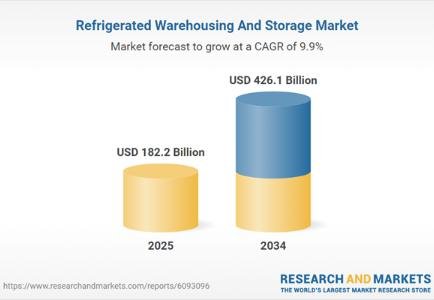
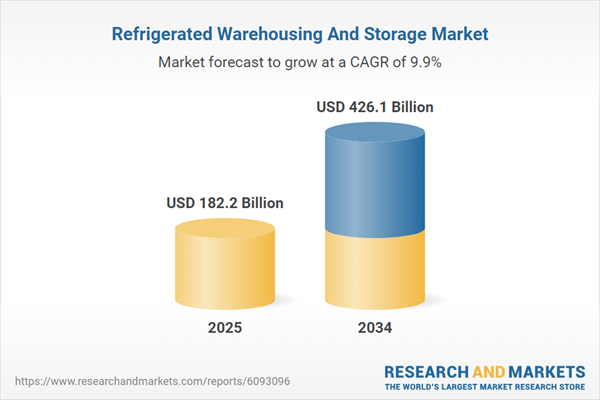
The global refrigerated warehousing and storage market is projected to grow from USD 182.2 billion in 2025 to USD 426.1 billion by 2034, reflecting a compound annual growth rate (CAGR) of 9.9%, according to a new report from Research and Markets. This growth is driven by increasing demand for perishable food, pharmaceutical distribution, and technological advancements in cold storage operations.

Cold storage facilities play a crucial role in preserving temperature-sensitive goods such as dairy, meat, seafood, fresh produce, and pharmaceuticals. Modern warehouses now feature advanced systems including automated racking, multi-temperature zones, and energy-efficient refrigeration. The sector is rapidly evolving to meet stricter requirements for food safety, traceability, and environmental sustainability.

In 2024, the market saw significant expansion, particularly in developing regions like Southeast Asia and Africa. This growth was supported by urbanization, rising disposable incomes, and the expansion of organized food retail. Operators increasingly adopted automation technologies such as warehouse management systems and real-time inventory tracking.

Sustainability remained a major focus, with facilities implementing solar power, high-efficiency insulation, and low-GWP refrigerants to cut energy use and emissions. The shift toward multi-client and on-demand storage models offered more flexibility to smaller businesses. Pharmaceutical storage also expanded, with facilities upgrading to meet GDP and WHO standards.

Looking ahead, the sector is expected to see broader adoption of AI-driven warehouse management systems that optimize space, temperature control, and energy use. Demand for flexible, scalable storage will grow to support sectors such as e-commerce grocery and pharmaceutical logistics. Emerging markets will continue to attract investment, supported by government incentives and public-private partnerships.

“Facilities will be designed with sustainability at their core,” the report notes, highlighting the adoption of green building certifications, renewable energy sources, and circular economy practices. Integration with automated fulfillment centers and robotics is also expected to improve operational efficiency and reduce labor costs.

The report identifies key players in the market, including Lineage Logistics, AmeriCold Logistics, Nichirei Corporation, Burris Logistics, and United States Cold Storage Inc., among others.

Read More

Get the daily refrigeration briefing

One email a day. Trusted by 3,000+ RACHP professionals.

More on Cold Chain

All on Cold Chain →

Insights

Secop's Solar Direct Drive (SDD) System Earns WHO PQS Approval – The Team Behind It
Article

Secop’s Solar Direct Drive (SDD) System Earns WHO PQS Approval – The Team Behind It

Partner's material In March 2026, Secop’s Solar Direct Drive Power Management Module was granted WHO PQS prequalification and officially listed in the WHO Catalogue of Prequalified Immunization Devices. The WHO IMD-PQS (Immunization Devices Performance, Quality and Safety programme) is the global benchmark for cold chain equipment used in immunisation. Being listed in its catalogue is

22 Jun 2026
Case Study - Effect of Louvers or diffusers on air flow distribution and cooling time on a meat log during Chill cycle
Tech Guide

Case Study – Effect of Louvers or diffusers on air flow distribution and cooling time on a meat log during Chill cycle

By Kushal Aurangabadkar An experimental analysis was conducted on a cooler space measuring 3.66 m × 6.096 m (12.0 ft × 20.0 ft), equipped with an ammonia refrigeration coil, five 30 cm (12 in.) fans, and five diffusers. The study measured airflow patterns, cooling rates, and heat transfer efficiency in meat storage by testing two configurations:

Kushal Aurangabadkar · 21 Jan 2026
Total Cost of Ownership (TCO) for Modular Refrigeration Systems in Life Sciences Distribution Centers
Tech Guide

Total Cost of Ownership (TCO) for Modular Refrigeration Systems in Life Sciences Distribution Centers

by Ramez Naguib, P.E. Introduction Life sciences distribution centers are under immense pressure to deliver consistent temperature control, comply with increasingly stringent regulations, and optimize operational efficiency. Traditional built-up refrigeration systems often prove cumbersome, costly, and slow to implement. In contrast, modular, factory-assembled refrigeration systems have emerged as a compelling alternative. Drawing on lessons from

Ramez Naguib · 14 Jan 2026
Everything on Cold Chain: 2,056 articles, 2 case studies, 23 insights

Most read this month

All news →