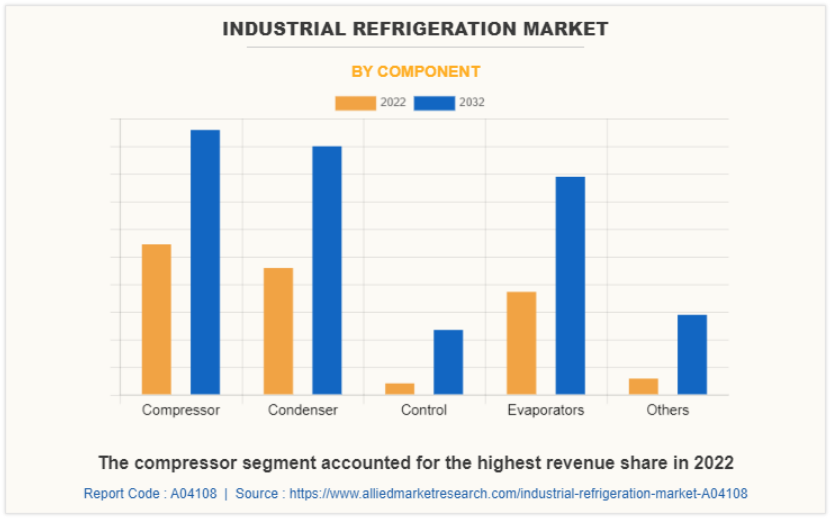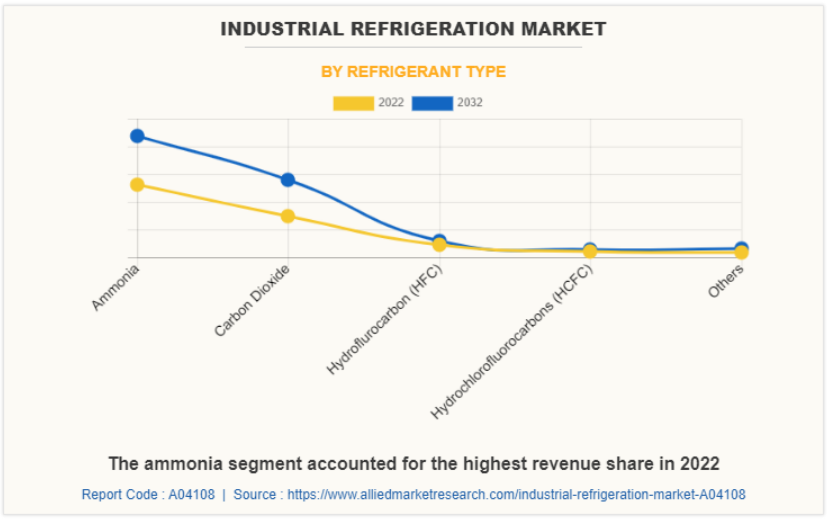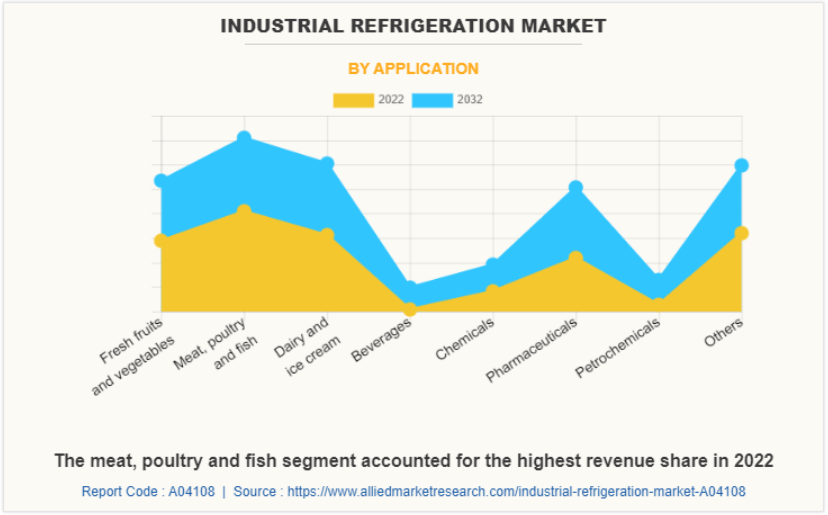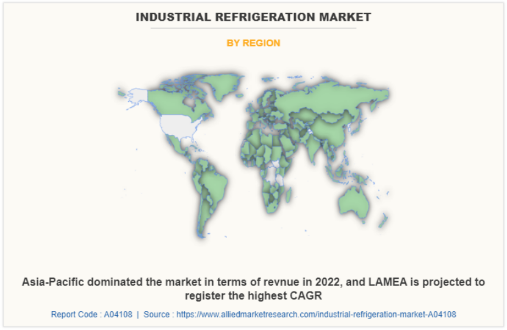
Allied Market Research published a report, titled, “Industrial Refrigeration Market By Component (Compressor, Condenser, Control, Evaporators, and Others), By Refrigerant Type (Ammonia, Carbon Dioxide, Hydroflurocarbon (HFC), Hydrochlorofluorocarbons (HCFC), and Others), By Application (Fresh Fruits And Vegetables, Meat, Poultry And Fish, Dairy And Ice Cream, Beverages, Chemicals, Pharmaceuticals, Petrochemicals, and Others), By Type (Stationary Refrigeration, and Transport Refrigeration), By Sales Type (New Sales, and Aftermarket): Global Opportunity Analysis And Industry Forecast, 2023-2032”. According to the report, the global industrial refrigeration industry generated $24.7 billion in 2022, and is anticipated to generate $41.7 billion by 2032, witnessing a CAGR of 5.2% from 2023 to 2032.
Industrial Refrigeration Market Research, 2032
The global industrial refrigeration market size was valued at $24.7 billion in 2022, and is projected to reach $41.7 billion by 2032, growing at a CAGR of 5.2% from 2023 to 2032. Industrial refrigeration systems are widely used in various industries, including food and beverage processing, cold storage facilities, chemical and petrochemical, pharmaceuticals, and other sectors that produce products which require cold and controlled temperatures during storage and transportation. By using refrigeration systems, industries can ensure the quality, freshness, and longevity of perishable goods, and facilitate the seamless functioning of various industrial operations.
Market Dynamics
The industrial refrigeration market is primarily driven by various factors such as growth in food and beverages and pharmaceutical industries, rise in cold-chain industries, and increase in industrialization in developing economies. In these industries, industrial refrigeration is used for maintaining a conducive environment for the storage and transportation of perishable goods, as well as volatile chemicals. Moreover, various industries use refrigeration systems such as chillers, compressors, and other components to keep the machines cool in industries as well as in data centers.
Furthermore, world trade is rising at a rapid pace, which is expected to increase the demand for cold-chain industries. According to the World Trade Organization, the overall monetary value of international trade involving physical goods reached value of $25.3 trillion in the year 2022. Projections indicate a gradual expansion of 1.7% in 2023, which is expected to grow substantially by 3.2% in 2024. A significant portion of this extensive trade include perishable products that require specific temperature conditions to maintain their quality and prevent spoilage. These goods are typically from sectors such as pharmaceuticals, both frozen and non-frozen food and beverages, chemicals, and various other industries. In addition to this, the demand for frozen and non-frozen foods & beverages such as ice-creams, desserts, meat, poultry, dairy, and others is also rising across the world. According to the American Frozen Food Institute (AFFI), the retail sales of frozen food increased significantly by 23% in 2021, as compared to 2019. Furthermore, similar development can be seen in Europe also. For instance, based on data provided by the Freshfel Europe’s Consumption Monitor, the European Union witnessed a notable surge in fruit and vegetable consumption in 2021. The per capita daily consumption of these fruit and vegetable products reached 364.58 grams, marking a substantial growth of 2.2% compared to the previous year i.e., 2020. Furthermore, this figure surpasses the average consumption of the European Union over the last five years by 1.27%. This upward trend indicates an increasing preference for, and awareness of the health benefits associated with the consumption of fruits and vegetables within the European Union population. Thus, owing to growth in trade and consumption of perishable products, various companies involved in providing cold-chain logistics are expanding their capabilities. For instance, in December 2022, a 5,000 metric ton capacity cold-storage facility began its operation in the state of Assam in India. This cold storage facility is said to be the largest in the Northeastern region of the country. These facilities significantly require various refrigeration systems; therefore, many companies in the refrigeration market have launched their refrigeration products for cold-chain industry.
However, according to the U.S. Environment Protection Agency, a typical food retail store leaks an estimated 25% of refrigerant annually, leading to negative impact on the environment. This emphasizes the importance of regulating the use of refrigerants to protect the planet. Thus, governments across the world have implemented strict regulations on a wide range of refrigerants that have adverse effects on the environment which is expected to restrain the market growth. For instance, the U.S. government has also planned to ban the use of high GWP refrigerants, including R134a, R410A and R407C, from use in new chillers in the U.S. from January 1, 2024.
Moreover, among various industrial refrigeration market opportunities, technological and other developments in the refrigeration systems are expected to positively affect the key market players in the coming years. For example, technologies such as Artificial Intelligence (AI), the Internet of Things (IoT), cloud connectivity, and others are also being incorporated into industrial refrigeration. For example, the Danfoss iMCHE allows different circuits to use a single coil’s heat transfer area, eventually boosting the efficiency of the system by over 20%. This also helps in maximizing heat-transfer efficiency, and reducing refrigerant charge in a compact, lightweight design. Moreover, it also offers the CO2 Adaptive Liquid Management (CALM) Solution for its Refrigeration category.
The industrial refrigeration market is witnessing various obstructions in its regular operations due to the COVID-19 pandemic and the economic slow-down due to inflation across the world. Earlier, the worldwide lockdowns due to COVID-19 resulted in reduced industrial activities, eventually leading to reduced demand for industrial refrigeration from various sectors such as food and beverages sectors. However, COVID-19 has subsided, and the major manufacturers in 2023 are performing well. Contrarily, the rising global inflation which is soon expected to cause recession in major economies is a new major obstructing factor for the entire industry. The inflation, which is a direct result of the Ukraine-Russia war, and few long-term impacts of the coronavirus pandemic, has introduced volatility in the prices of food and oil & gas, including raw materials used for manufacturing industrial refrigeration systems. Furthermore, the countries in Europe, Latin America, North America, the Middle East, and Sub-Saharan Africa are experiencing severe negative impacts on industrial production, including the production of industrial refrigeration systems. However, India and China are performing relatively well, and the industrial refrigeration market outlook is positive in these countries. In addition, inflation is expected to worsen in the coming years, as the possibility of the ending of the war between Ukraine and Russia is less. Moreover, the cost of food products has risen substantially, discouraging their trade, which is also expected to have slight negative effects on the industrial refrigeration market growth. However, with the continued talks between different countries, a peace agreement between Ukraine and Russia can be devised.