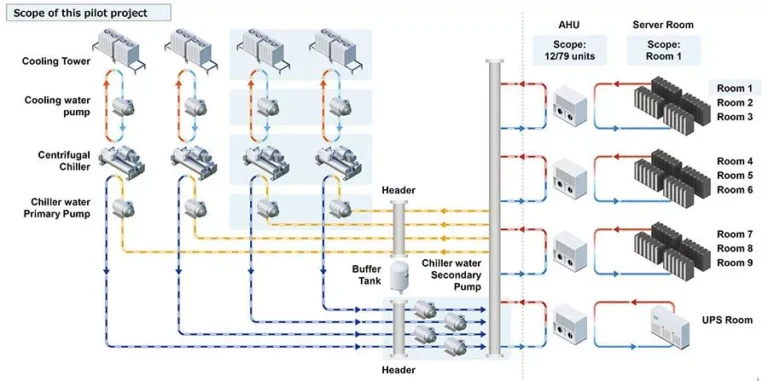
Keppel Corporation Limited (Keppel), through its Infrastructure Division, has been awarded a contract by the Urban Redevelopment Authority (URA) of Singapore to design, build, own and operate a new large-scale district cooling system (DCS) plant for 30 years located in the Jurong Lake District (JLD). The contract is expected to generate about $950 million for Keppel, comprising payments from real estate developers, owners and occupants for the design and building of the DCS, as well as the supply of chilled water and operations and maintenance of the DCS over 30 years.
The DCS will have a design capacity of 29,000 Refrigeration Tons (RT) to supply chilled water and related services to an estimated 1.4 million square metre gross floor area (sqm GFA) and is intended to serve future developments in JLD, including office, business park, residential, retail, hotel and institutional uses. The DCS will be operational in tandem with the completion of future developments in the district.
Through state-of-the-art technology and proven operating know-how, Keppel’s DCS solution for JLD can achieve superior efficiency levels which are over 30% higher than conventional in-building systems and 18% higher than the National Environment Agency’s Minimum Energy Efficiency Standards (MEES), as well as garner significant cost savings of up to 30% compared to conventional systems. With best-in-class design and operations, the JLD DCS plant is estimated to be able to abate over 145,000 tonnes of carbon emissions over the 30-year operating period, compared to the industry benchmark. This is equivalent to the carbon abatement of planting 100,000 trees.
Mr Lim Eng Hwee, CEO, URA said, “The award of this contract to Keppel to build and operate the DCS is an important step forward in realising our vision for Jurong Lake District as a model sustainability district that is anchored by innovative infrastructure and smart urban solutions. This not only contributes to more environmentally-friendly places to live, work and play in, but also drives our ambition for new developments in JLD to achieve net zero emissions by around 2045, five years ahead of the national target of 2050.”