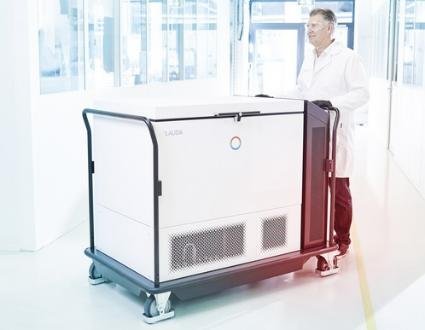
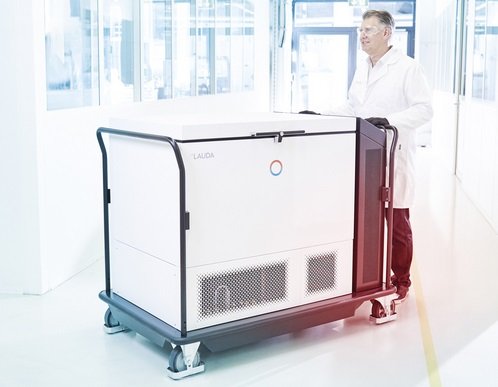
The constant temperature equipment manufacturer LAUDA is launching a new product on the market to start the new year: the Mobifreeze M 270, the first mobile battery-powered ultra low-temperature chest freezer. Valuable samples or APIs can be safely stored and transported from -86 °C to -50 °C with high temperature resistance – without dry ice. Natural refrigerants are used to provide active temperature control instead.
The actively temperature-controlled, mobile ultra-low-temperature chest freezer with sophisticated insulation technology has a battery life of four hours and therefore enables the cold chain to be reliably maintained in intralogistics and for inter-factory transport in road logistics. Delicate and temperature-sensitive substances such as gene therapy medicinal products, monoclonal antibodies or vaccines, which require storage under validated conditions, can now be transported under identical conditions. Cooling is freely adjustable between -86 °C and -50 °C. If the set limits are exceeded, a warning is provided by an acoustic and visual signal. An integrated data logger stores the temperature and alarm data. In addition to this, a customer-specific monitoring system can be installed. The Good Distribution Practice (GDP) Guidelines for pharmaceutical products can therefore be complied with to the full extent. Furthermore, the Mobifreeze can be used as a hybrid system with flexible switching between battery and mains operation, stationary use for storage, or mobile use for transport. Transfer processes that pose a risk of damage and contamination to the samples are avoided, which means that the overall logistics are more product-friendly.
Battery operation also means that dry ice, which is a hazardous material, and phase-change materials (PCM for short) can be dispensed with during transport. In particular, dispensing with the former eliminates significant health risks for employees. At the same time, expensive exhaust air systems and specific personal protective equipment are no longer required. Together with the elimination of the PCMs and dry ice as a consumable, this represents a significant cost saving. Natural, future-proof refrigerants are used in the refrigeration unit of the Mobifreeze. The ultra-low temperature chest freezer therefore eliminates health risks, offers flexibility, and cuts operating costs.
The freezer is operated via a 4.3″ touch screen, whose functionality is also not restricted by gloves. Password-protected user management prevents unauthorized access to configuration parameters. The mobile ultra-low temperature chest freezer is equipped with two rotating heavy-duty casters, which make movement and steering easy in spite of the volume of 270 l. The ergonomic handles provide a secure grip and the dead man’s brake offers extra safety. In addition to this, the bottom panel and wheels are safeguarded by ram and impact protection. The stable design enables it to be loaded with a forklift truck.
LAUDA is Launching Mobile Battery-Powered Ultra-Low Temperature Chest Freezer
Get the daily refrigeration briefing
One email a day. Trusted by 3,000+ RACHP professionals.