Esta página solo está disponible en inglés. Ir a la portada en español

×

Questa pagina è disponibile solo in inglese. Home page in italiano

×

Diese Seite ist nur auf Englisch verfügbar. Zur deutschen Startseite

×

Cette page est disponible uniquement en anglais. Aller à la page d'accueil en français

×

AGRI-COOL Consortium Reviews Cold-Chain Progress and Training in Cape Verde

Partners assessed project milestones and cold-storage challenges while building African expertise in integrated food, energy and cooling systems.

AGRI-COOL Consortium Reviews Cold-Chain Progress and Training in Cape Verde

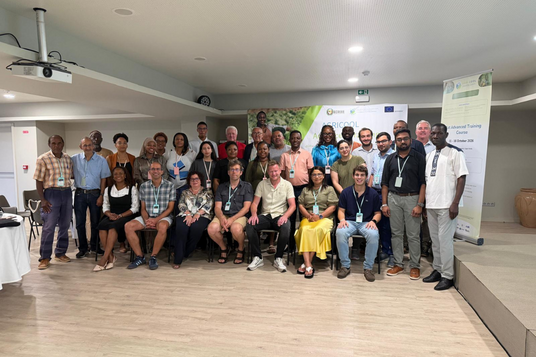
The AGRI-COOL consortium held its annual meeting and first advanced training course in Cape Verde from October 12–15, 2026, focusing on project progress, sustainable cooling technologies, and climate-resilient agricultural systems. Hosted by project partner ECREEE, the activities brought together consortium members and training participants from across Africa.

During the consortium meeting on October 13–14, project coordinator University of Twente reviewed deliverable deadlines, procedural guidelines, and outcomes from the first European Commission review meeting. Partner organisations presented updates on their work packages and milestones as the project passed the halfway point of its timeline. Participants also visited local partner Inalca Food & Beverage to examine existing cold-storage conditions and challenges on Sal Island.

The advanced training course, organised by ECREEE and the University of Western Cape, aimed to strengthen African expertise in sustainable and climate-resilient food systems through the integration of agriculture, energy, and cooling technologies. The fully funded, in-person programme welcomed candidates from across Africa, with particular attention to North, Central, and West African countries.

Training covered three modules addressing technical, economic, and social aspects of integrated agricultural systems. Topics included off-grid renewable energy for agricultural applications, cold-chain and cooling technologies to reduce post-harvest losses, sustainable farming systems, and integrated food-energy-water approaches. Expert presentations were followed by a project-based learning assessment.

The programme also included a visit by Cape Verde’s Deputy Minister Carlos Monteiro, who discussed AGRI-COOL’s objectives and activities in the country with consortium representatives. The training materials emphasised practical applications of sustainable agriculture and cooling solutions across different African contexts.

Get the daily refrigeration briefing

One email a day. Trusted by 3,000+ RACHP professionals.

More on Cold Chain

All on Cold Chain →

Insights

Secop's Solar Direct Drive (SDD) System Earns WHO PQS Approval – The Team Behind It
Article

Secop’s Solar Direct Drive (SDD) System Earns WHO PQS Approval – The Team Behind It

Partner's material In March 2026, Secop’s Solar Direct Drive Power Management Module was granted WHO PQS prequalification and officially listed in the WHO Catalogue of Prequalified Immunization Devices. The WHO IMD-PQS (Immunization Devices Performance, Quality and Safety programme) is the global benchmark for cold chain equipment used in immunisation. Being listed in its catalogue is

22 Jun 2026
Case Study - Effect of Louvers or diffusers on air flow distribution and cooling time on a meat log during Chill cycle
Tech Guide

Case Study – Effect of Louvers or diffusers on air flow distribution and cooling time on a meat log during Chill cycle

By Kushal Aurangabadkar An experimental analysis was conducted on a cooler space measuring 3.66 m × 6.096 m (12.0 ft × 20.0 ft), equipped with an ammonia refrigeration coil, five 30 cm (12 in.) fans, and five diffusers. The study measured airflow patterns, cooling rates, and heat transfer efficiency in meat storage by testing two configurations:

Kushal Aurangabadkar · 21 Jan 2026
Total Cost of Ownership (TCO) for Modular Refrigeration Systems in Life Sciences Distribution Centers
Tech Guide

Total Cost of Ownership (TCO) for Modular Refrigeration Systems in Life Sciences Distribution Centers

by Ramez Naguib, P.E. Introduction Life sciences distribution centers are under immense pressure to deliver consistent temperature control, comply with increasingly stringent regulations, and optimize operational efficiency. Traditional built-up refrigeration systems often prove cumbersome, costly, and slow to implement. In contrast, modular, factory-assembled refrigeration systems have emerged as a compelling alternative. Drawing on lessons from

14 Jan 2026
Everything on Cold Chain: 2,051 articles, 2 case studies, 23 insights

Most read this month

All news →