Esta página solo está disponible en inglés. Ir a la portada en español

×

Questa pagina è disponibile solo in inglese. Home page in italiano

×

Diese Seite ist nur auf Englisch verfügbar. Zur deutschen Startseite

×

IIR Launches Fifth Edition of Blue Book on Chilled Food Storage

The revised guide adds chapters on eggs, brewing and non-fruit juice drinks, plus updated storage and practical storage-life recommendations.

IIR Launches Fifth Edition of Blue Book on Chilled Food Storage

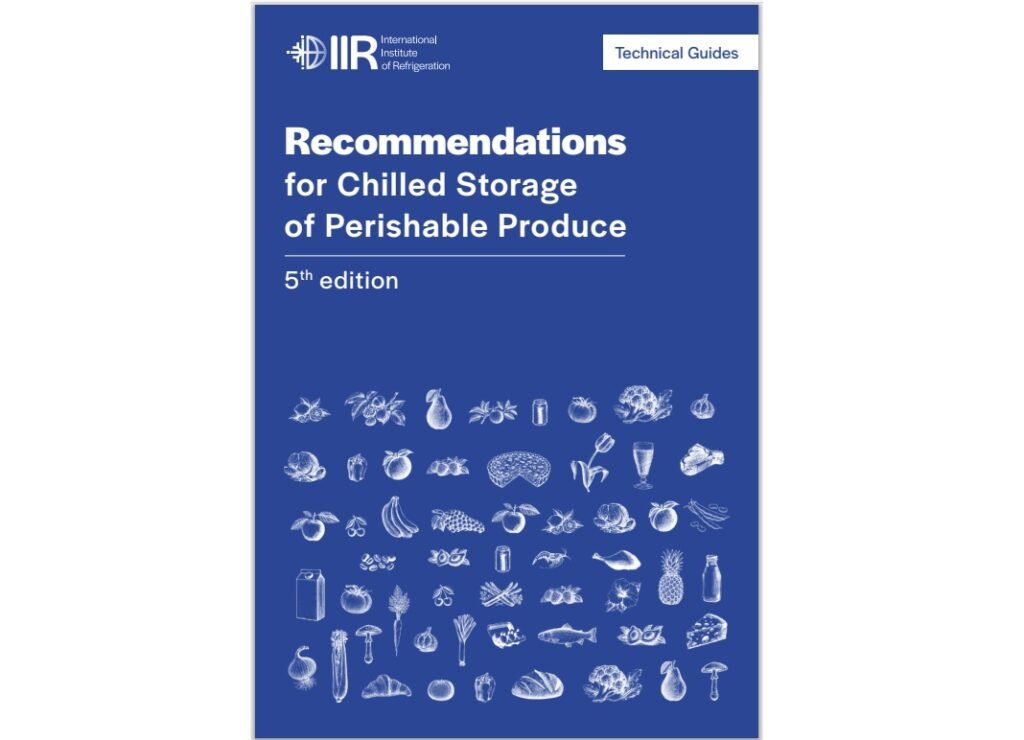
The International Institute of Refrigeration (IIR) launched the fifth edition of its technical guide, Recommendations for Chilled Storage of Perishable Produce, on November 2, 2026, at the 38th Meeting of the Parties to the Montreal Protocol (MOP 38) in Kigali, Rwanda. The publication provides updated guidance on chilled storage conditions and technologies for perishable products, addressing food quality, safety and cold chain management.

First published in 1959, with subsequent editions in 1967, 1979 and 2000, the Blue Book has been revised with contributions from specialists worldwide. The update was coordinated by Judith Evans, President of IIR Section C “Biology and food technology”, with contributions from 20 lead authors and reviews by international experts.

The fifth edition includes two new chapters covering eggs and brewing and non-fruit juice drinks. Other chapters address chilling technology, modelling, food quality, fruit and vegetables, meat and poultry, fishery products, dairy products, pre-cooked ready prepared products, cut flowers and seeds. The guide includes recommendations on storage conditions and practical storage life for different perishable products.

The publication was presented during a side event titled “Cold Chain Temperature Standards, Refrigerants and Efficiency for Cutting Food Loss and Emissions for Kigali’s Next Decade”, organised by the IIR and the Climate & Clean Air Coalition (CCAC). The event marked the 10th anniversary of the Kigali Amendment and included discussions of CCAC cold chain projects supporting sustainable, energy-efficient refrigeration capacity in developing countries.

“Updating the Blue Book has been a large international initiative which has been ongoing for the past 2 years. Everyone involved has been working on this in their spare time and so I wanted to thank everyone who contributed for their expert advice, commitment, and willingness to get involved in this great initiative,” said Judith Evans, Chair of the Publication.


Get the daily refrigeration briefing

One email a day. Trusted by 3,000+ RACHP professionals.

More on Cold Chain

All on Cold Chain →

Insights

Secop's Solar Direct Drive (SDD) System Earns WHO PQS Approval – The Team Behind It
Article

Secop’s Solar Direct Drive (SDD) System Earns WHO PQS Approval – The Team Behind It

Partner's material In March 2026, Secop’s Solar Direct Drive Power Management Module was granted WHO PQS prequalification and officially listed in the WHO Catalogue of Prequalified Immunization Devices. The WHO IMD-PQS (Immunization Devices Performance, Quality and Safety programme) is the global benchmark for cold chain equipment used in immunisation. Being listed in its catalogue is

22 Jun 2026
Case Study - Effect of Louvers or diffusers on air flow distribution and cooling time on a meat log during Chill cycle
Tech Guide

Case Study – Effect of Louvers or diffusers on air flow distribution and cooling time on a meat log during Chill cycle

By Kushal Aurangabadkar An experimental analysis was conducted on a cooler space measuring 3.66 m × 6.096 m (12.0 ft × 20.0 ft), equipped with an ammonia refrigeration coil, five 30 cm (12 in.) fans, and five diffusers. The study measured airflow patterns, cooling rates, and heat transfer efficiency in meat storage by testing two configurations:

Kushal Aurangabadkar · 21 Jan 2026
Total Cost of Ownership (TCO) for Modular Refrigeration Systems in Life Sciences Distribution Centers
Tech Guide

Total Cost of Ownership (TCO) for Modular Refrigeration Systems in Life Sciences Distribution Centers

by Ramez Naguib, P.E. Introduction Life sciences distribution centers are under immense pressure to deliver consistent temperature control, comply with increasingly stringent regulations, and optimize operational efficiency. Traditional built-up refrigeration systems often prove cumbersome, costly, and slow to implement. In contrast, modular, factory-assembled refrigeration systems have emerged as a compelling alternative. Drawing on lessons from

14 Jan 2026
Everything on Cold Chain: 2,049 articles, 2 case studies, 23 insights

Most read this month

All news →