Esta página solo está disponible en inglés. Ir a la portada en español

×

Questa pagina è disponibile solo in inglese. Home page in italiano

×

Diese Seite ist nur auf Englisch verfügbar. Zur deutschen Startseite

×

Cette page est disponible uniquement en anglais. Aller à la page d'accueil en français

×

CLASP Identifies Key Barriers to Solar Cold Storage Deployment in India

Stakeholders called for local demand studies, stronger market links and seasonal financing to boost cold room use.

CLASP Identifies Key Barriers to Solar Cold Storage Deployment in India

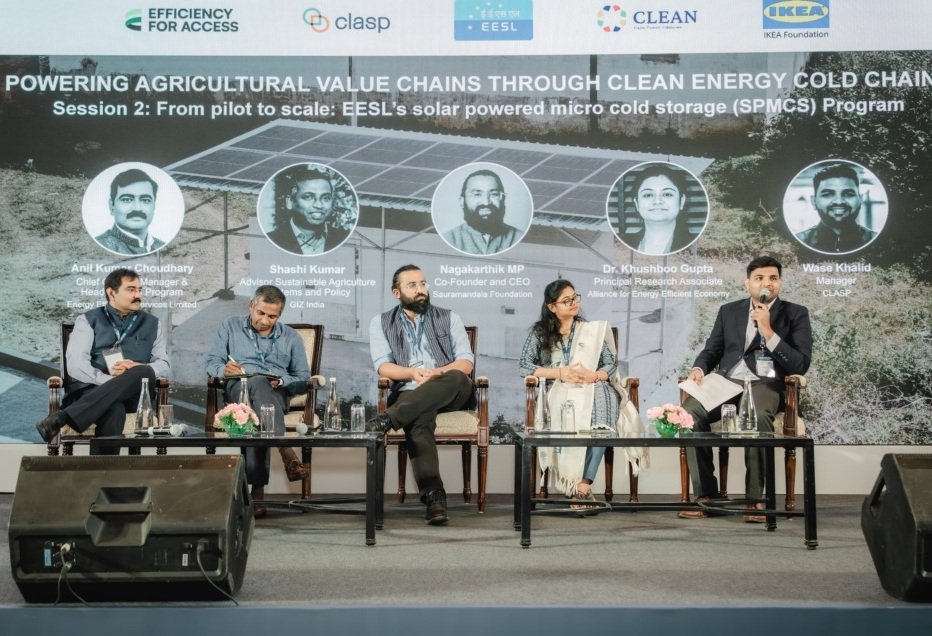
CLASP, through Efficiency for Access, held a national convention in India in June 2026, followed by workshops in Odisha and Himachal Pradesh, to examine how solar-powered cold storage can reduce agricultural losses and support rural businesses. Discussions highlighted the need for demand assessments, viable business models and stronger market connections to improve cold room utilization.

India loses an estimated 4.87–15.05% of fruits and vegetables along the supply chain, while annual post-harvest losses across agriculture are estimated at USD 18.5 billion. At the convention, participants identified inadequate planning and limited understanding of local demand as major barriers to effective cold storage deployment. An upcoming report by Efficiency for Access and the National Institute of Solar Energy (NISE) examines differences in agricultural production, harvest periods, market structures and financing conditions across states and agricultural clusters.

Workshops in Odisha emphasized assessing crop volumes, seasonal demand, facility capacity and potential customers before installation. In Himachal Pradesh, participants highlighted low utilization outside the harvest season for fruits such as apples and kiwis. They discussed integrating cold rooms with produce collection, processing and buyer networks to generate revenue beyond peak storage periods.

Participants recommended five measures to improve utilization: conducting cluster-level demand assessments, connecting operators with farmers and buyers, providing post-installation business support, designing facilities for multiple commodities and services, and adapting financing to seasonal revenue cycles. For subsidized installations, support from operators or NGOs for at least two to four seasons was proposed. Participants also discussed risk mitigation mechanisms funded by governments or philanthropic organizations to support financing.

CLASP is conducting cluster-level demand assessments in Maharashtra, Tamil Nadu, Assam and Meghalaya, building on previous solar pilots with small businesses in Assam and Meghalaya. The organization aims to develop a common framework to help procurement agencies and state departments identify suitable locations for future cold storage installations. Separately, a new global standard developed with VeraSol support establishes testing requirements for refrigerators designed for off-grid and unreliable electricity supplies.


Get the daily refrigeration briefing

One email a day. Trusted by 3,000+ RACHP professionals.

More on Cold Chain

All on Cold Chain →

Insights

Secop's Solar Direct Drive (SDD) System Earns WHO PQS Approval – The Team Behind It
Article

Secop’s Solar Direct Drive (SDD) System Earns WHO PQS Approval – The Team Behind It

Partner's material In March 2026, Secop’s Solar Direct Drive Power Management Module was granted WHO PQS prequalification and officially listed in the WHO Catalogue of Prequalified Immunization Devices. The WHO IMD-PQS (Immunization Devices Performance, Quality and Safety programme) is the global benchmark for cold chain equipment used in immunisation. Being listed in its catalogue is

22 Jun 2026
Case Study - Effect of Louvers or diffusers on air flow distribution and cooling time on a meat log during Chill cycle
Tech Guide

Case Study – Effect of Louvers or diffusers on air flow distribution and cooling time on a meat log during Chill cycle

By Kushal Aurangabadkar An experimental analysis was conducted on a cooler space measuring 3.66 m × 6.096 m (12.0 ft × 20.0 ft), equipped with an ammonia refrigeration coil, five 30 cm (12 in.) fans, and five diffusers. The study measured airflow patterns, cooling rates, and heat transfer efficiency in meat storage by testing two configurations:

Kushal Aurangabadkar · 21 Jan 2026
Total Cost of Ownership (TCO) for Modular Refrigeration Systems in Life Sciences Distribution Centers
Tech Guide

Total Cost of Ownership (TCO) for Modular Refrigeration Systems in Life Sciences Distribution Centers

by Ramez Naguib, P.E. Introduction Life sciences distribution centers are under immense pressure to deliver consistent temperature control, comply with increasingly stringent regulations, and optimize operational efficiency. Traditional built-up refrigeration systems often prove cumbersome, costly, and slow to implement. In contrast, modular, factory-assembled refrigeration systems have emerged as a compelling alternative. Drawing on lessons from

14 Jan 2026
Everything on Cold Chain: 2,043 articles, 2 case studies, 23 insights

Most read this month

All news →