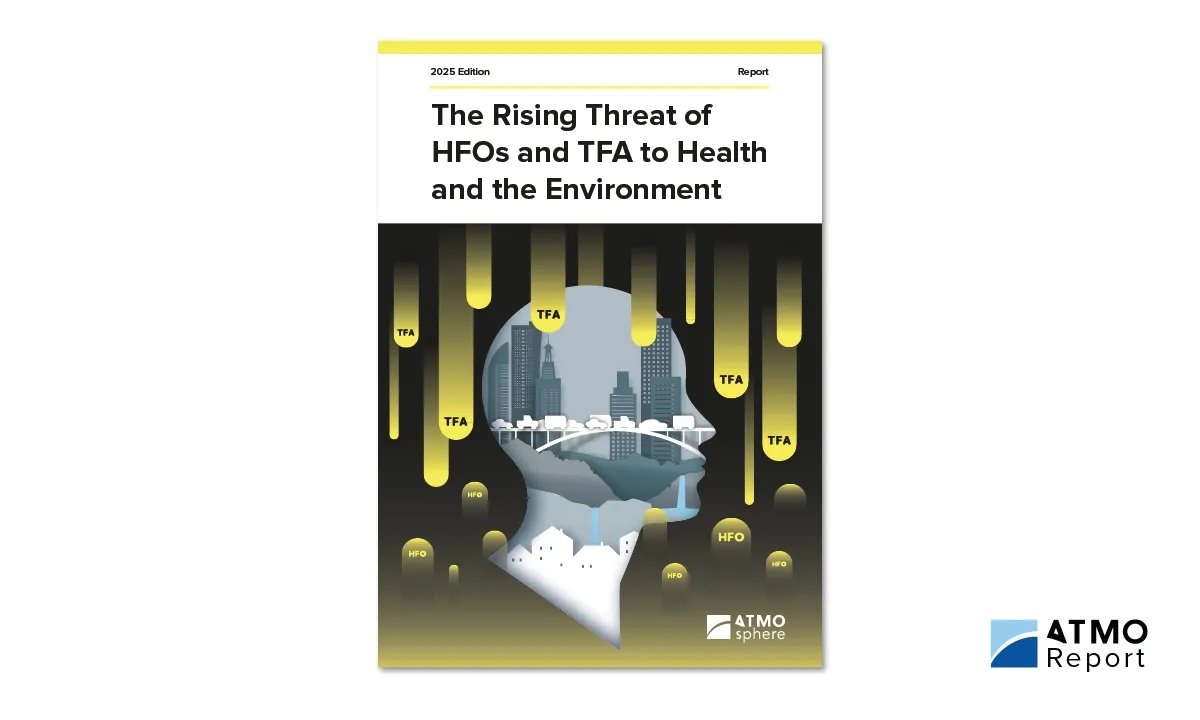
ATMOsphere has released a new report highlighting the increasing environmental and health concerns linked to hydrofluoroolefins (HFOs), especially HFO-1234yf, and their degradation product, trifluoroacetic acid (TFA). The report will be discussed at an ATMOsphere-hosted side event during the 47th meeting of the Open-Ended Working Group (OEWG) of the Parties in Bangkok on July 10.
The publication outlines how TFA, a persistent and water-soluble byproduct formed when HFO-1234yf and other f-gases break down in the atmosphere, is spreading throughout surface water, rain, soil, and even into food, beverages, and the human bloodstream. ATMOsphere classifies TFA as an ultrashort-chain PFAS (per- and polyfluoroalkyl substance), noting that both TFA and many f-gases meet the widely accepted definition of PFAS.
The report summarizes ongoing regulatory activity in the EU, Canada, and several U.S. states. The European Chemicals Agency (ECHA) is reviewing a proposal from Germany to classify TFA and its salts as reproductively toxic under the EU’s CLP regulation, and broader EU efforts are under way to restrict PFAS as a class. Meanwhile, U.S. states such as Maine and Minnesota are developing legislation targeting PFAS refrigerants, including TFA. Canada is considering a proposal to regulate PFAS as a group, with HFOs included but fluoropolymers excluded.
ATMOsphere’s report also references recent studies on TFA’s toxicity and environmental persistence, including one labeling TFA as a “planetary boundary threat.” It includes opposing views from the chemical industry defending the continued use of HFOs and responses from scientists calling for stricter controls.
“In this report we show how TFA has become the most widespread PFAS in the world and the focus of great concern, with a direct link to the HVAC&R industry,” said Marc Chasserot, Founder and Publisher of ATMOsphere.
The report concludes by calling for global efforts to phase out TFA precursors such as HFO-1234yf in favor of alternatives like natural refrigerants. It also recommends expanded monitoring, toxicity research, water treatment solutions, and regulatory limits, with cleanup costs borne by polluters.
The new report, available for free here.