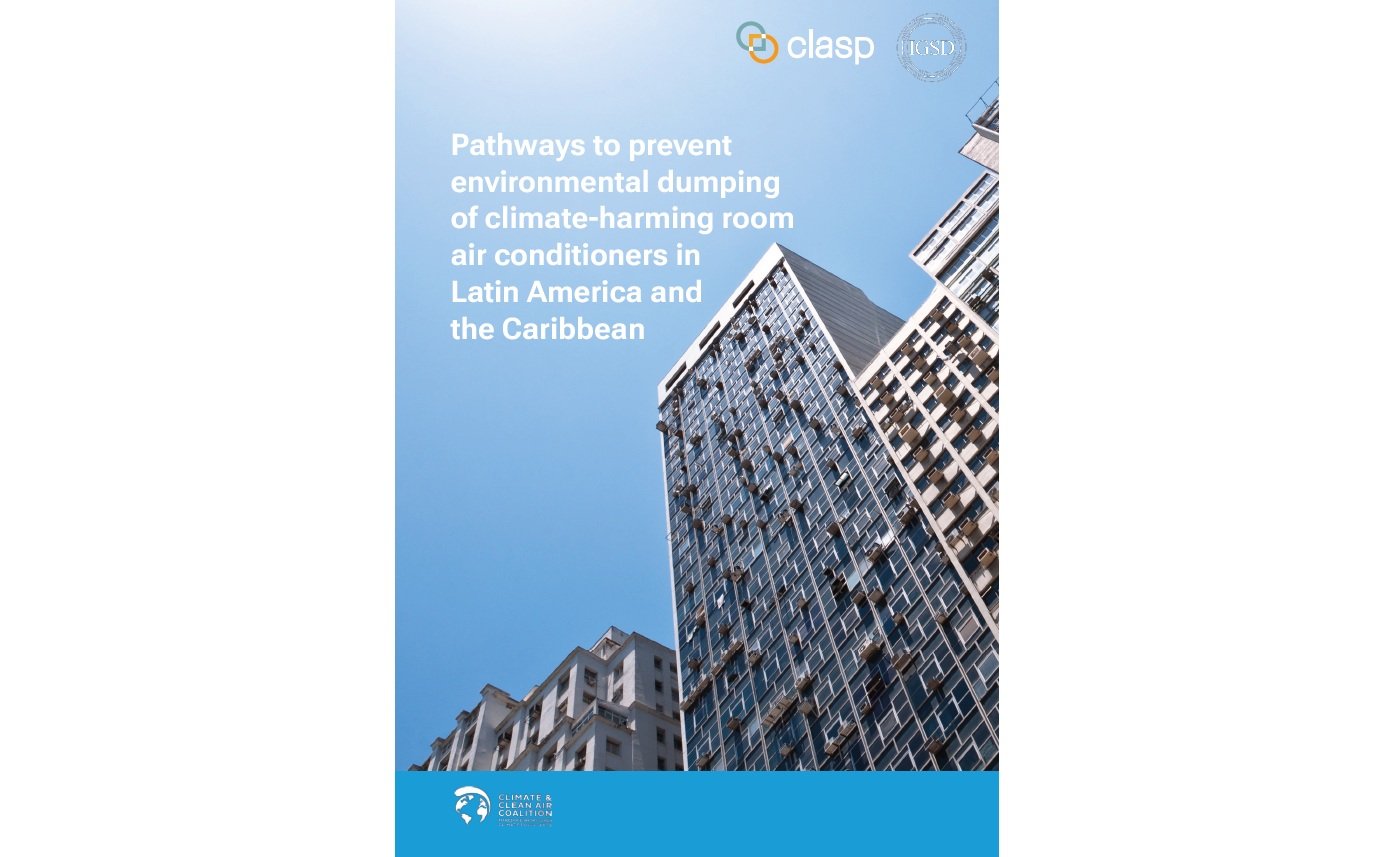
CLASP and the Institute for Governance & Sustainable Development (IGSD) have released a
2026 report assessing “environmental dumping” of new room air conditioners (room ACs) in Latin America and the Caribbean (LAC) and its links to cooling access and affordability. The study covers 11 countries—Argentina, Barbados, Brazil, Chile, Colombia, the Dominican Republic, Grenada, Jamaica, Mexico, Panama, and Uruguay—and relies on room AC data from 2023 and 2025.
The report estimates that about 44% of new room ACs sold in nine of the 11 focus countries in 2023 qualify as environmental dumping, defined as exporting equipment or components that cannot be legally sold in the exporting country due to performance or other standards. Of the units classified as environmental dumping, 13% were imported by multinational companies, 12% were imported by local companies, and 19% were locally manufactured by multinational companies.
CLASP and IGSD also report that low-efficiency units represented 52% of total room AC sales across nine countries in 2023, with nearly 4.3 million low-efficiency units sold. On refrigerants, the study finds obsolete refrigerants (primarily R-410A) dominate 10 of the 11 focus countries, while R-32 accounts for 62% of 2023 sales where refrigerant data was available, driven by Brazil’s market. Grenada is cited as the only focus country to successfully introduce R-290 room ACs, reaching 10% market share in 2023 and forecast to grow to 65% by 2028.
Beyond equipment performance, the report links efficiency and refrigerant choices to affordability and cooling access. It states that only 15% of households in the region own air conditioners, and that 67.8 million people in LAC are at high risk due to a lack of access to cooling, with access gaps in focus countries reaching above 50% in some cases. The authors note that low-efficiency units may cost less upfront, but higher operating costs can make them more expensive over their lifetimes.
In its policy analysis, the report projects that without significant policy changes, room AC use in the region could result in 1,350 MtCO2e of emissions by 2050. It estimates that achieving global-benchmark minimum energy performance standards (MEPS) in 2027 could cut cumulative emissions by 43 MtCO2e and deliver over $20 million in consumer savings through 2050, while a scenario combining global-benchmark MEPS in 2027 with more stringent next-generation MEPS in 2029 could avoid 173 MtCO2e and save consumers over $105 million in energy costs by 2050. The report was prepared by CLASP and IGSD with financial support from the Climate and Clean Air Coalition (CCAC) and is published with DOI: 10.70098/JCRA7148.