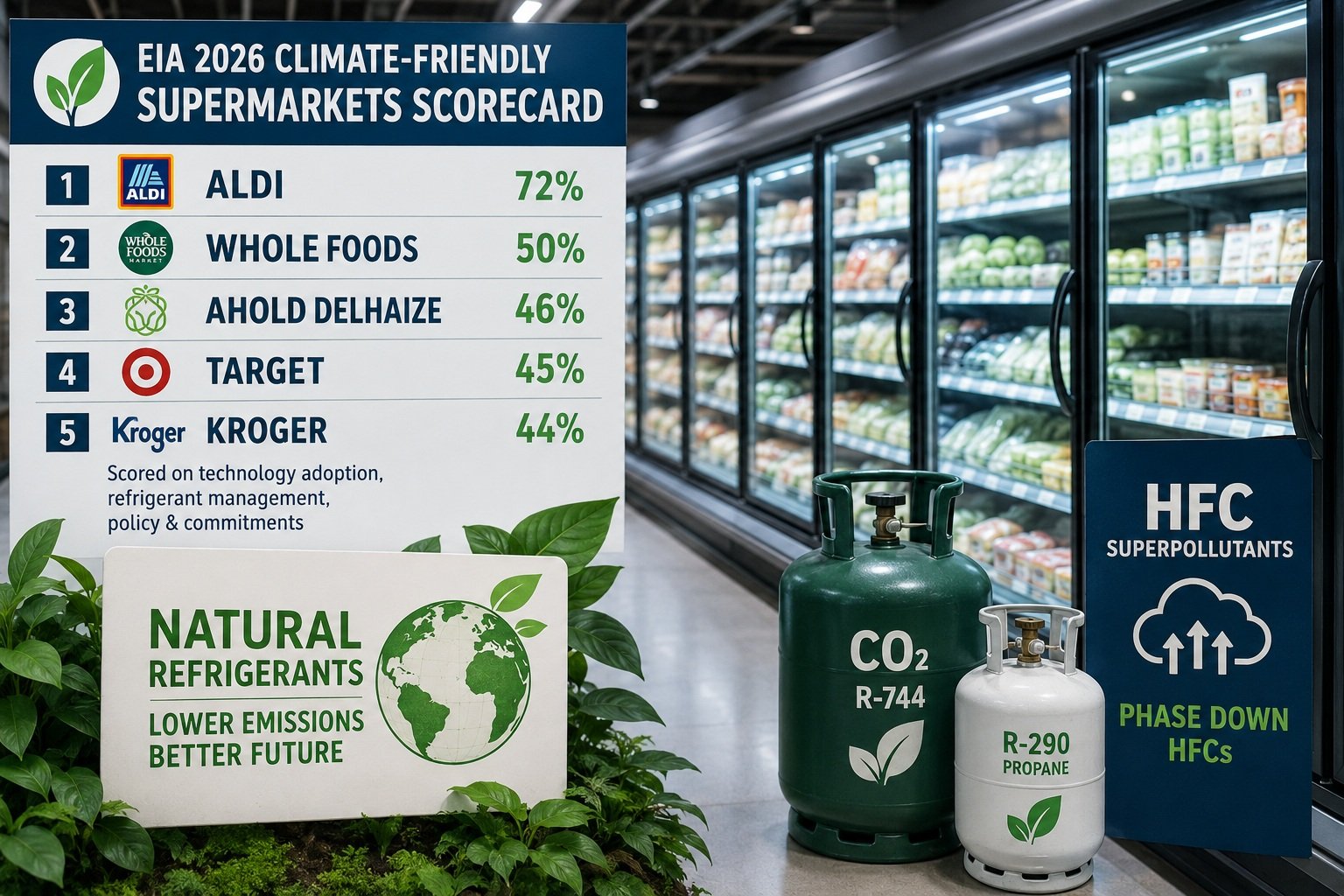
The Environmental Investigation Agency has released its
2026 Climate-Friendly Supermarkets Scorecard, assessing major U.S. food retailers on efforts to reduce hydrofluorocarbons used as refrigerants in stores. The scorecard was issued one week after the Environmental Protection Agency rolled back requirements on refrigerant use in the sector.
The biennial scorecard evaluates companies in three areas: adoption of climate-friendly refrigerants with global warming potentials below 10, refrigerant management, and corporate commitments to reduce HFCs. EIA said most companies reviewed have reported that at least some store refrigeration systems are entirely HFC-free.
ALDI U.S. led the overall scorecard with 72%, including 68% for technology adoption, 46% for refrigerant management and 88% for policy and commitments. EIA said ALDI accounts for the largest share of HFC-free stores, with nearly 1,000, and remains the only company with a public target to transition all new and existing U.S. stores to natural refrigerants by 2035.
Whole Foods ranked second with 50%, followed by Ahold Delhaize at 46%, Target at 45% and Kroger at 44%. Meijer led the refrigerant management category with a reported average annual leak rate below 8%, compared with an EPA-reported industry average of 25%. EIA said only four companies — ALDI, Meijer, Target and Kroger — disclose leak rates for U.S. stores.
Eleven companies have public commitments to reduce HFC use or emissions, but EIA said gaps remain in time-bound targets, interim benchmarks and public updates. The scorecard also noted a recent EPA and U.S. Department of Justice consent decree with Kroger for alleged violations of refrigerant leak repair provisions under the Clean Air Act.
“Our 2026 scorecard shows that affordability is not a barrier to climate leadership and regulatory uncertainty is no excuse for inaction,” says Avipsa Mahapatra, Climate Campaigner Director at EIA US. “Every new HFC-based refrigeration system installed today locks in high costs and climate pollution for years to come. Companies that choose to fall behind can no longer argue that climate-friendly technology is too expensive, too difficult, or too early.”