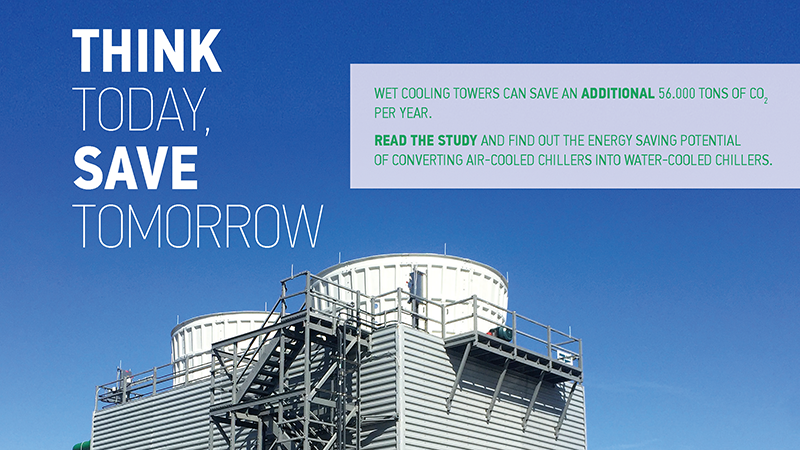
As outcome of the two-year Special Project ‘Evaporative Cooling 2030’, the Eurovent Association has published a set of documents including a new Eurovent Recommendation and a dedicated flyer, providing a clear overview of what the evaporative cooling industry saves in terms of CO2 emissions today and what it can save tomorrow. These documents are complemented by the first-ever European evaporative cooling industry monograph providing a clear indication on its size and scope.
Eurovent, in close cooperation with Europe’s leading evaporative cooling equipment manufacturers[1] , has conducted an extensive study for a variety of load profiles, climate conditions, and control strategies. One year of operation was simulated for each system; the same yearly load profile and weather conditions were used in all simulations. The results of this study show that the refrigeration system using wet cooling towers has the lowest year-round CO2 footprint.
Mr Rob Vandenboer, Chairman of the Eurovent Special Project ‘Evaporative Cooling 2030’ (SP-CT2), states: “When comparing a highly efficient evaporative cooling system with an alternative dry cooling solution, the CO2 saving potential of the evaporative cooling for the entire system is clearly proven by this robust simulation. This project eliminates the challenge that every end-user, designer and legislator faces when they want to truly understand the CO2 emission reduction potential of evaporative cooling.”
Furthermore, he adds: “The European evaporative cooling industry, very well assessed in the Eurovent Industry Monograph 9/1, is working very hard towards long-term sustainable solutions which will represent an important contribution towards achieving the EU climate targets.”
Mr Alessandro Fontana, Vice-Chairman of the Special Project, concludes: “The Eurovent Recommendation 9/13 is a foundation for everyone dealing with evaporative cooling equipment. It eliminates all the false myths of a wrong water consumption calculation.”
The Recommendation (REC 9/13), Industry Monograph (MON 9/1), as well as the related flyer ‘Think Today, save Tomorrow’ can now be downloaded free of charge in the Eurovent Document Web Shop at www.eurovent.eu or in the right sidebar of this article.
[1] Participants of the Special Project include the major European manufacturers: Baltimore Aircoil Company (Belgium), Decsa (Italy), Evapco (Belgium), Gohl (Germany), Jacir (France), KTK (Germany), Mita (Italy).