According to new data, excess heat in the EU alone amounts to 2,860 TWh/y, corresponding almost to the EU’s total energy demand for heat and hot water in residential and service sector buildings.
Danfoss President & CEO Kim Fausing says it is remarkable that the EU has “close to no initiatives that push for more efficient use of the vast amounts of wasted energy in the form of excess heat.” New whitepaper details that it would give a productivity boost to the economy, lower energy prices for consumers and businesses and accelerate the green transition.
A new whitepaper from Danfoss highlights the vast untapped potential of excess heat as a source of energy. In the EU alone, excess heat amounts to 2,860 TWh/y, corresponding almost to the EU’s total energy demand for heat and hot water in residential and service sector buildings such as schools, hospitals, hotels, restaurants, offices and shopping centers.
A full implementation of technologies that tap into synergies between different sectors and enable a utilization of excess heat has the potential to save EUR 67.4 bn a year once fully implemented in 2050.
Every time an engine runs, it generates heat. Anyone who has felt the warmth behind their fridge can confirm this. The same is true on a larger scale in supermarkets, data centers, factories, wastewater facilities, metro stations and commercial buildings. Excess heat can be reused to supply a factory with heat and warm water or reused by neighboring homes and industries through a district energy system.
Using this energy that would otherwise go to waste can give a productivity boost to the economy and lower energy prices for consumers.
Utilizing excess heat can replace significant amounts of fossil fuels that are otherwise needed to produce heat. Used this way, excess heat can help stabilize the future electricity grid and thereby ease the transition to a green energy system.
In some countries the excess heat can even match the entire heat demand. In the Netherlands, excess heat amounts to 156 TWh/y while the heat demand is only 152 TWh/y.
Yet the potential of excess heat is not even close to being utilized and is politically ignored.
According to Kim Fausing, President & CEO of Danfoss, recycling heat is not only an overlooked measure in the current energy crisis, but also the next frontier of the green transition:
“Excess heat is the world’s largest untapped source of energy. Still, very few initiatives have pushed for more efficient use of the vast amounts of wasted energy in the form of excess heat even though we already have the solutions available today. We urgently need policy measures to accelerate the use of excess heat across sectors, both so that citizens and businesses can benefit from lower energy costs and to ensure we step up progress in the green transition.”
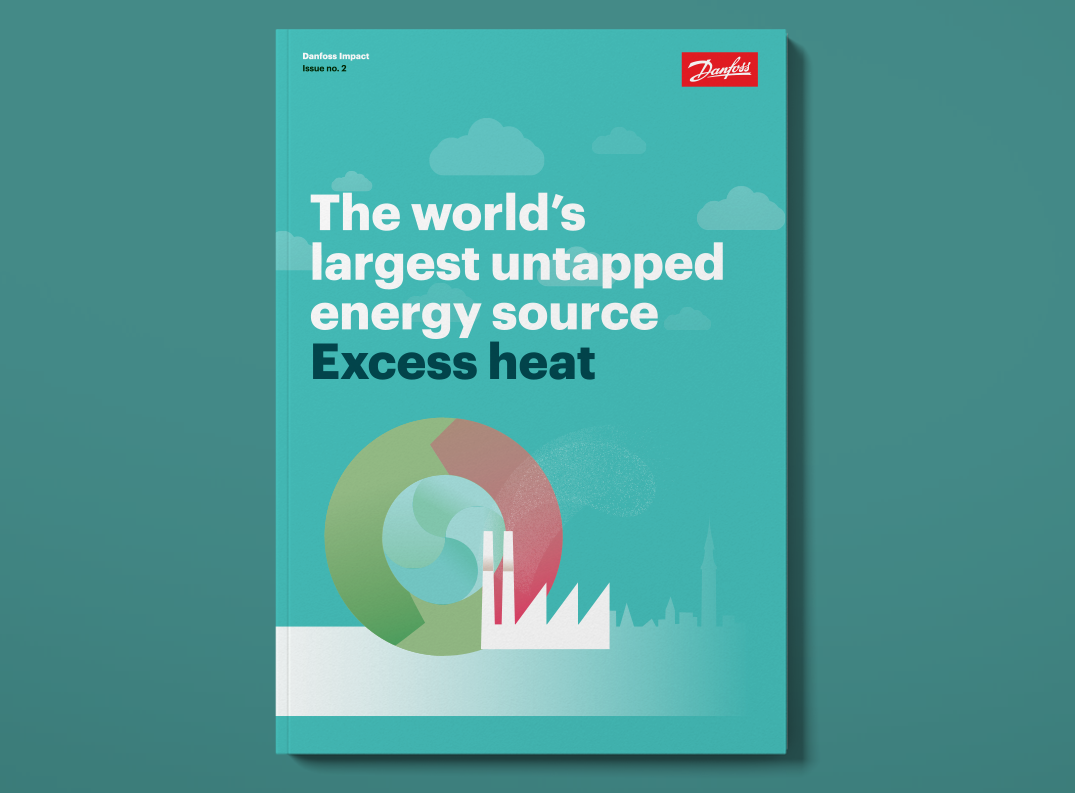
The whitepaper, titled ‘The world’s largest untapped energy source: Excess heat’ assesses the potential of excess heat as an efficient energy source. According to the International Energy Agency (IEA), a global push for more efficient use of energy can reduce CO2 emissions by an additional 5 gigatons per year by 2030 compared with current policy settings. A third of the reduction needed in energy-related CO2 emissions this decade according to the IEA net zero scenario must come from improvements in energy efficiency.
In terms of energy security, these energy savings can help avoid almost 30 million barrels of oil per day and 650 billion cubic meters (bcm) of natural gas per year (around four times what the EU imported from Russia in 2021).
“The potential in reusing excess heat is staggering. But we need to change our perspective on it and begin to consider excess heat as an energy resource instead of waste to be disposed of,” adds Kim Fausing.
The world’s largest untapped energy source: Excess heat’ is available for
download here.