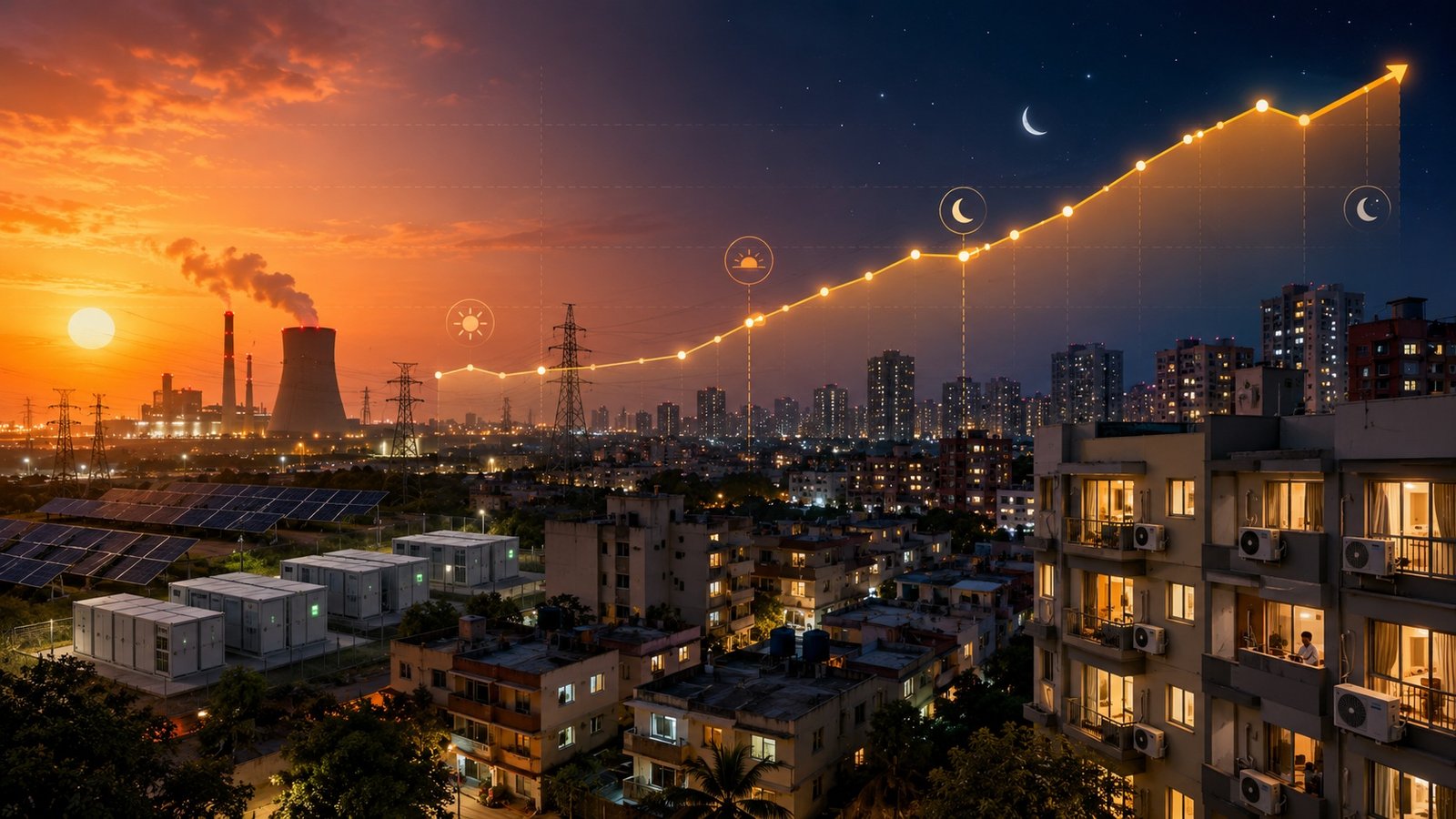
India’s electricity demand is rising as economic and population growth, higher temperatures and wider air conditioning use increase power consumption, according to an IEA commentary published on 3 June 2026. Since 2019, India’s electricity demand has grown by 5% per year, while solar PV has accounted for two-thirds of power capacity additions.
The IEA said an extreme heatwave in Northwest and Central India since mid-May has pushed daytime maximum temperatures to 40-47 °C (104-117 °F), with some locations reaching 48 °C (118 °F). Peak demand reached 270 GW on 21 May, compared with around 180 GW in 2019.
Nighttime cooling needs are becoming a larger electricity security issue because solar PV cannot contribute after sunset. The IEA said nighttime temperatures in India are rising twice as fast as daytime temperatures, while cooling already accounts for slightly more than 10% of annual electricity demand and can drive as much as one-third of power consumption on hot summer nights.
India added a record 50 GW of solar PV in 2025, and renewables supplied about one-quarter of electricity meeting peak demand on 21 May. However, India’s summer peak net load typically occurs around 8 p.m., and net load at 4 a.m. is only 10% lower on average than the peak.
The IEA said India’s dispatchable capacity reached 90% of available capacity on 21 May, showing tight operating margins. It noted that batteries can help reduce peak demand and coal ramping requirements, while conventional and pumped-storage hydropower, wind, natural gas and coal each face specific limits or roles in meeting night demand.
The commentary said continued implementation of stringent air conditioner efficiency standards, building efficiency codes and behavioural measures will be important. IEA analysis indicates these interventions could reduce peak demand growth in India by as much as one-quarter over the medium term.