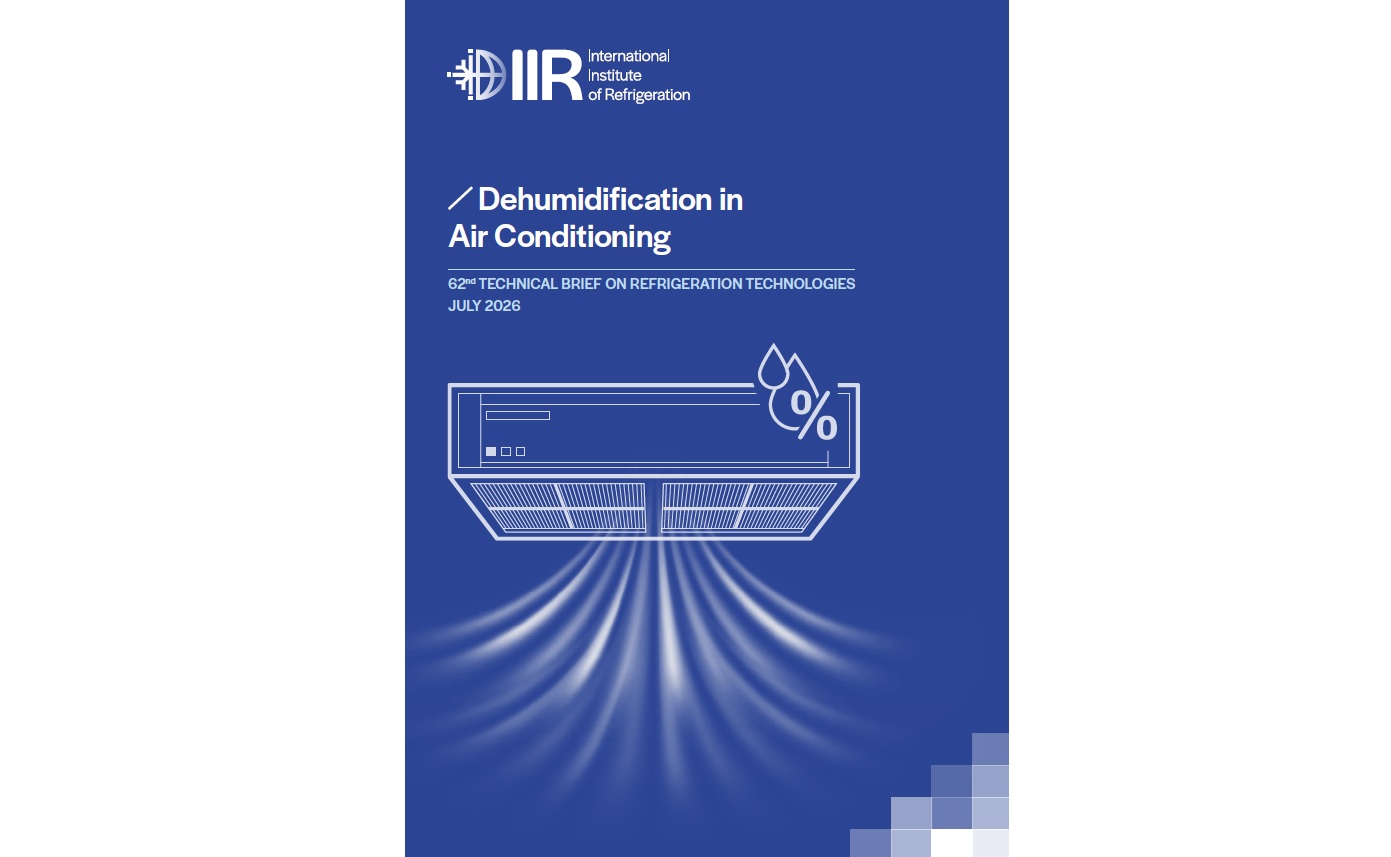
The IIR has published its
62nd Technical Brief on Refrigeration Technologies, reviewing dehumidification processes and technologies used in air conditioning. The brief states that HVAC systems can account for more than half of a building’s total energy use in hot and humid climates, with more than half of that load linked to moisture removal rather than temperature reduction.
Led by Baolong Wang, Vice President of IIR Commission E1, Air Conditioning, and President of the IIR Working Group on Dehumidification in Air Conditioning, the author team assesses condensation, liquid desiccant and solid desiccant dehumidification, as well as emerging membrane-based approaches.
Condensation dehumidification is identified as the mature and widely used method behind most vapour-compression and thermoelectric systems. Liquid desiccant systems can use low-grade waste heat and are increasingly applied where precise humidity control is required, including hospitals and laboratories.
Solid desiccant systems, including desiccant wheels, can achieve dew points as low as –70°C (–94°F) and are used in pharmaceutical, electronics and battery manufacturing applications. Emerging electrolyte membrane and hollow-fibre membrane systems offer compact, electrically driven approaches but remain at an early stage of commercialisation.
The brief recommends prioritising humidity control so air-conditioning systems can operate at higher chilled-water or evaporating temperatures, accelerating efficient dehumidification deployment in hot and humid regions, and increasing support for emerging technologies through research funding, technical alliances and international collaboration. It also calls for humidity-control metrics to be included in global air-conditioning test standards and for closer cooperation among ISO, CENELEC, ASHRAE and JSRAE.
“Humidity control is a critical factor in maintaining a comfortable and productive indoor environment. Advanced dehumidification technologies can substantially lower the energy consumption and carbon footprint of air conditioning systems, thereby advancing global initiatives for low-carbon cooling,” said Baolong Wang, Lead Author, Vice President of Commission E1, Air Conditioning, and President of the IIR Working Group on Dehumidification in Air Conditioning.