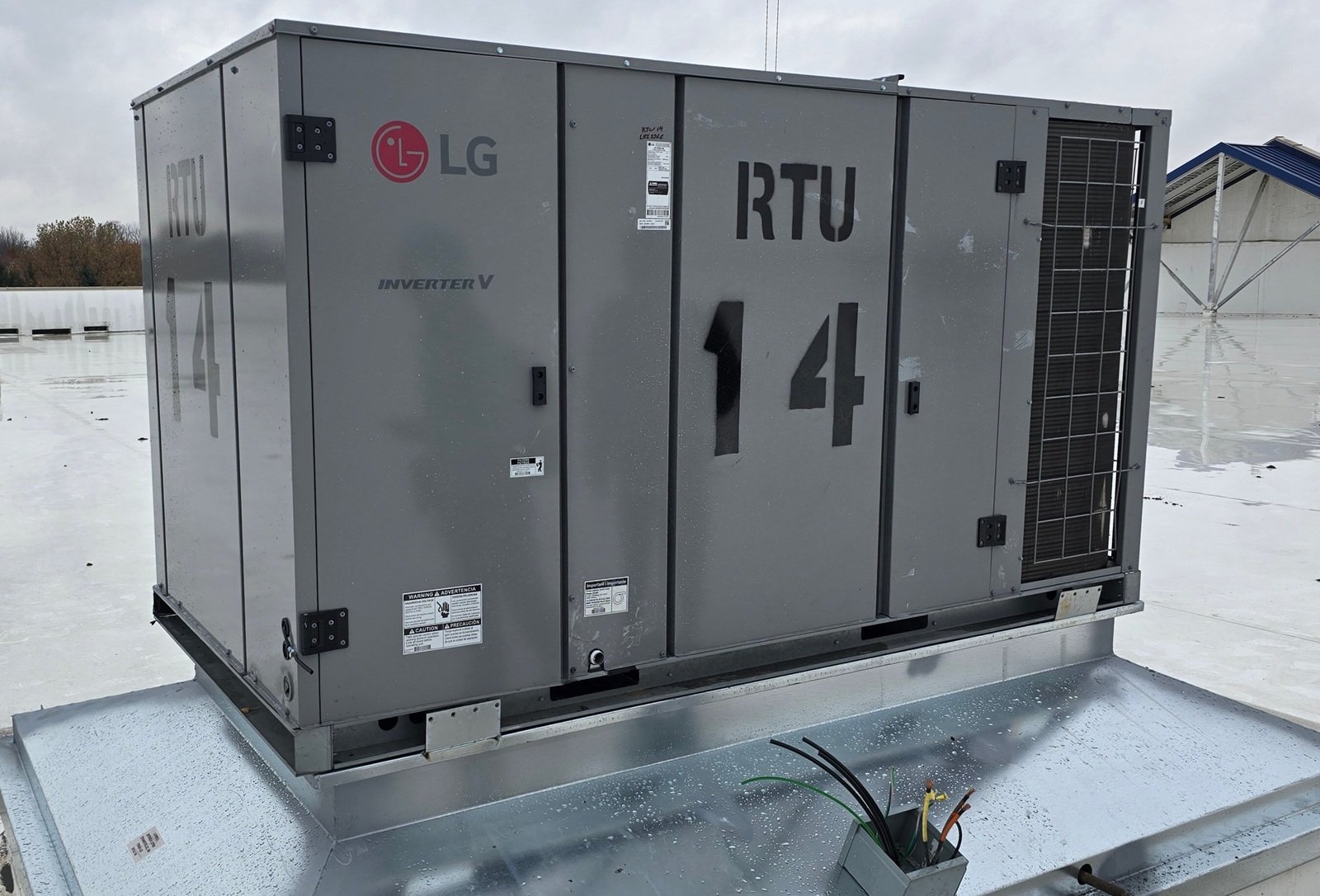
LG Electronics has completed laboratory validation of its next-generation heat pump rooftop unit in the U.S. Department of Energy’s Commercial Building HVAC Technology Challenge. The unit is now entering field trials to assess commercial building performance in real operating conditions.
The 10-ton (approx. 120,000 BTU/h) all-electric rooftop unit is participating in the challenge’s 10- to 14-ton category. LG said the compact unit is developed to support performance in cold climates and integrates R-32 low-GWP refrigerant as part of its configuration.
According to LG, the unit includes refrigerant flow control, compressor and electric heating capabilities, and dual-sensing control for humidity and temperature. It is designed to support building automation system integration, with additional grid-interactive and demand flexibility capabilities planned for future development phases.
The company said the RTU demonstrated heating performance and efficiency in laboratory testing, including operation at low ambient temperatures down to minus 10°F (approx. minus 23°C). LG also reported performance improvement in controlled testing conditions including IVHEC, H-10Max Capacity, H10Max COP2 and IVEC, with results varying by application and conditions.
Following validation at Intertek, a prototype unit has been installed at a large retail store in Indiana. A second prototype is scheduled for installation at the Pacific Northwest National Laboratory research facility in Washington state. Data from the field trials will be evaluated to assess energy performance, operation and reliability, with testing continuing through 2027.
“Our successful validation in the DOE Technology Challenge highlights LG's commitment to meeting commercial market needs,” said Gautham Devarakonda, HVAC product development and engineering manager at LG Electronics USA. “LG's 10-ton heat pump RTU, participating in the challenge's 10- to 14-ton category, demonstrated strong heating performance and efficiency in laboratory testing, including operation at low ambient temperatures down to minus 10°F, while supporting broader performance efforts.”