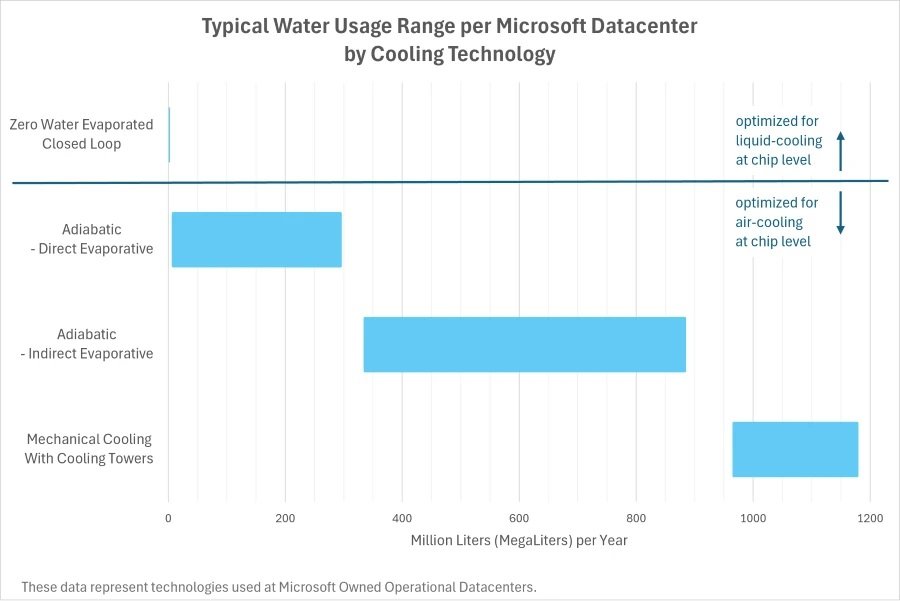
Microsoft has unveiled a new datacenter design that eliminates water consumption for cooling, a move aimed at reducing its environmental impact amid growing concerns over water scarcity. Starting in August 2024, the company began implementing chip-level cooling solutions that provide precise temperature control without relying on water evaporation.
This innovation is expected to save more than 125 million liters (33 million gallons) of water per year per datacenter. While water will still be used for administrative purposes, such as in restrooms and kitchens, the cooling systems will operate through a closed-loop mechanism, continually recycling water between servers and chillers.
Advancing Water Efficiency in Datacenters
Microsoft measures water efficiency through Water Usage Effectiveness (WUE), a metric calculated by dividing total annual water consumption for humidification and cooling by the total energy consumption of IT equipment. In the last fiscal year, the company’s datacenters achieved an average WUE of 0.30 L/kWh, a 39% improvement compared to 2021. This was accomplished by expanding the operating temperature range, reducing water wastage, and integrating reclaimed and recycled water sources in locations such as Texas, Washington, California, and Singapore.
Since the early 2000s, Microsoft has reduced its WUE by 80%. The transition to next-generation datacenters with zero-water evaporation is expected to bring WUE near zero in facilities using this technology, further reducing Microsoft’s fleetwide WUE as adoption increases.
Energy Impact and Mitigation Strategies
Traditional datacenters have relied on water evaporation to reduce the power demand of cooling systems. Moving to mechanical cooling will increase Power Usage Effectiveness (PUE), but Microsoft’s chip-level cooling solutions allow for higher operating temperatures, reducing the energy impact. The company plans to further optimize cooling efficiency through high-efficiency economizing chillers and ongoing innovations in targeted cooling.
Pilot Projects and Implementation Timeline
While Microsoft’s existing fleet will continue using a mix of air-cooled and water-cooled systems, the transition to zero-water cooling is underway. Pilot projects in Phoenix, Arizona, and Mt. Pleasant, Wisconsin, will introduce zero-water evaporated designs in 2026. Additionally, starting in August 2024, all new Microsoft datacenter designs have incorporated this next-generation cooling technology. These new sites are expected to go online by late 2027.
Microsoft’s commitment to sustainable datacenter operations aligns with its broader Datacenter Community Pledge, which prioritizes environmental responsibility and local watershed protection. With water stress increasing globally, the shift to zero-water cooling represents a significant step toward more sustainable IT infrastructure.