Subscribe to the daily news Sign in
En
National Cooling Action Plans
14 October 2021

National Cooling Action Plans

National Cooling Action Plans (NCAPs) are strategies or roadmaps that promote sustainable and smart cooling practices across a country. These include the identification of groups that are vulnerable due to a lack of cooling; promoting the adoption and increased stringency of Minimum Energy Performance Standards (MEPS), and identification of potential financial mechanisms for cooling.

NCAPs can also include measures that can support countries to achieve major international treaties such as the Kigali Amendment to the Montreal Protocol and the Paris Agreement. NCAPs also provide a framework for coordination and cooperation among stakeholders and government agencies recognizing the cross-cutting nature of sustainability interventions in the cooling sector. 

Overview of progress by countries

More countries are recognizing the risks caused by a lack of cooling and are in the process of establishing these plans. NCAPs have been published by Cuba, China, India, Panama, Rwanda and Trinidad and Tobago. In 2020 the COVID-19 pandemic caused a significant delay in the publication of other NCAPs previously in development. Currently, over 20 countries are developing NCAPs. 

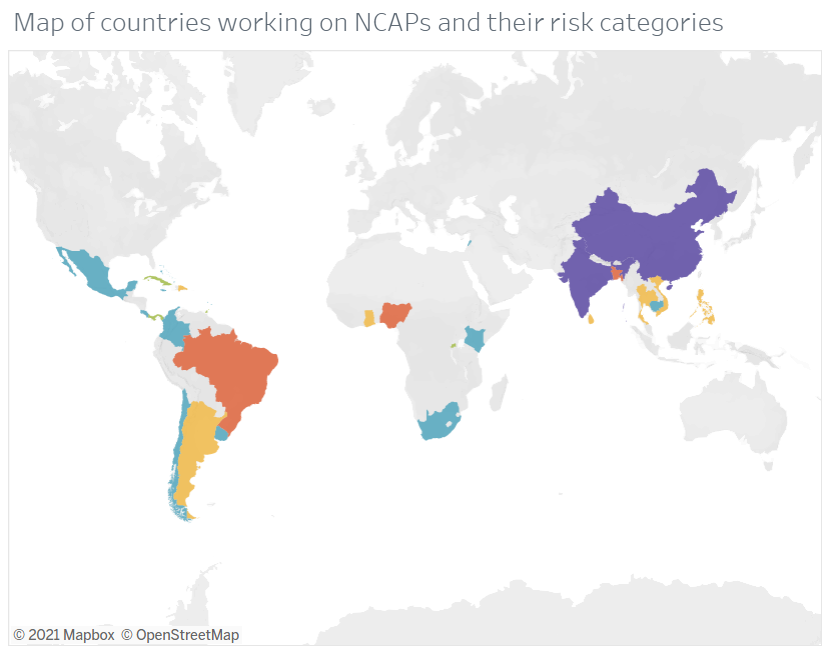
The map below shows an overview of countries currently working on their NCAPs, and where possible, the prevalence of SEforALL’s identified groups of vulnerable populations in the country.

  • Half of the countries with NCAPS underway or published are part of SEforALL’s list of high-impact countries including Bangladesh, Brazil, China, India and Nigeria, which have been identified as critical countries due to their large number of vulnerable populations at high risk.
     
  • The other half of the countries in the map are considered to be at a lower risk, given that many of the risk indicators such as population density or high temperatures are missing or very localized. Developing NCAPs for this set of countries would present an opportunity to target those regional needs. 
Read More
Share
Get the daily refrigeration briefing
Trusted by 3,000+ refrigeration professionals worldwide
By subscribing, you create a free Refindustry account and agree to our Terms of Service and Privacy Policy.
No spam. Only industry-relevant news.
Unsubscribe anytime.

Related news

France bans gas boilers in new buildings from 2027
France will ban the installation of gas boilers in new buildings from January 1, 2027, as part of a broader strategy to reduce dependence on fossil fuels. The measure was presented by the French pr...
01 May 2026
The IIR publishes brief on high-temperature heat pumps
The International Institute of Refrigeration has published a Technical Brief on High-Temperature Heat Pumps, examining system configurations, working fluids, components, commercial products, applic...
04 May 2026
Danfoss expands support for liquid cooling in data centers
Danfoss is increasing its focus on supporting the development of liquid cooling systems for data centers, with particular attention to Coolant Distribution Units (CDUs). The company said the sh...
23 Apr 2026
IOR launches Heat Recovery brief in decarbonisation series
The IOR’s Environmental Committee has published the first Technology Brief in a new series of free resources on heat recovery. The series is intended to provide an overview of technologies that...
30 Apr 2026
German VDKF Calls for HVACR Survey Participation
The Verband Deutscher Kälte-Klima-Fachbetriebe (VDKF e.V.) is conducting its Kälte-Klima-Konjunkturumfrage again this year to assess the current and expected market situation in Germany’s refri...
01 May 2026
WIRACA launches women’s alliance in South Africa cooling sector
The Women in Refrigeration and Air Conditioning Alliance (WIRACA) has officially launched in South Africa to advance the role of women in the cooling sector. The alliance operates under ...
02 May 2026