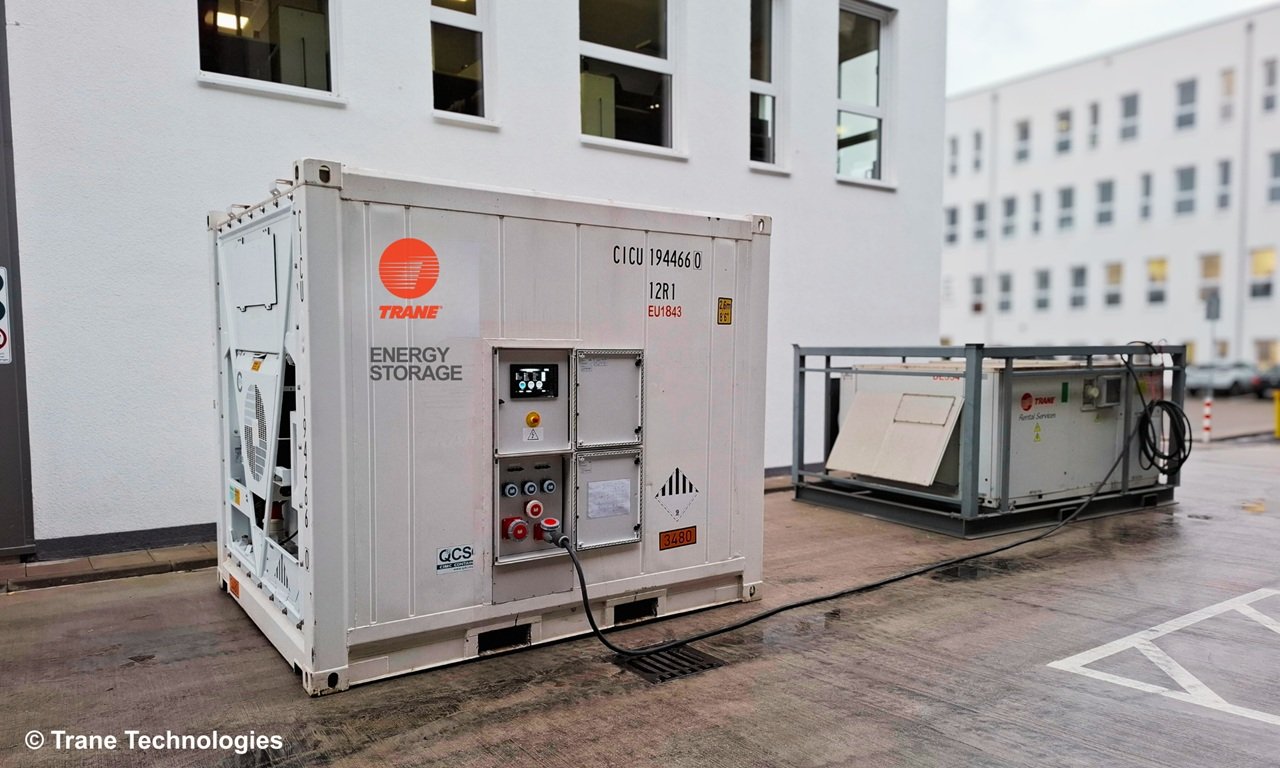
Trane, a brand of Trane Technologies, has launched a Battery Energy Storage System (BESS) rental offering as part of Trane Rental Solutions. Announced in Belgium, the offering is now available across Europe, the Middle East and Africa (EMEA) as well as Australia and New Zealand, targeting applications such as cold storage and small heating, ventilation and air conditioning (HVAC) installations with zero direct emissions.
Trane said the large-scale, containerised BESS units are engineered to store energy and provide reliable power during peak demand, fluctuating rates, or potential grid instability. The company described the battery pack as fully autonomous and designed for temporary and permanent installations.
The portfolio includes the BESS 200, Trane Rental Services’ first battery storage system housed in a robust 10-foot (approx. 3.05 m) container, with fuel-free battery capacity starting at 230 kWh and 50 kW output. Integrated within a container featuring Thermo King refrigeration technology, the unit is specified to operate from -30°C to +50°C (-22°F to 122°F) and has an IP55 protection class.
Trane said the BESS can be rented short- or long-term and positions it alongside other Trane Rental Services power solutions, including traditional diesel gensets, hybrid genset-battery set-ups, and fully electric and modular battery packs starting with compact 35 kWh units. The company also said its battery systems can be equipped with advanced telematics for real-time information and alarms, and supported by a 24/7/365 service network.
“As we see a growing need for energy storage solutions that support temperature-controlled equipment, we designed a solution to provide customers with greater operational flexibility and control over their energy costs and carbon footprint,” said Grigory Ulubabyants, services product manager at Trane EMEA. “By enabling flexible, emissions-free power for cold storage, HVAC, and other temporary or remote applications, we help customers adapt to changing energy demands and operate confidently beyond the limitations of the grid.”