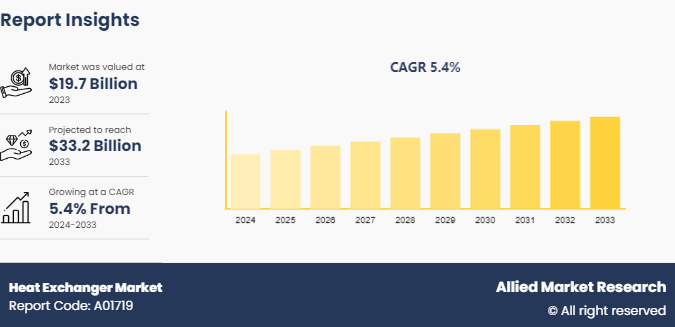
Allied Market Research said the global heat exchanger market was valued at USD 19.7 billion in 2023 and is projected to reach USD 33.2 billion by 2033, at a CAGR of 5.4% from 2024 to 2033. The report covers heat exchangers by type, material and end-use industry.
According to the report, market growth is driven by rising industrialization, expanding energy demand and stricter efficiency regulations. Demand from oil and gas, power generation, HVAC, chemicals and food processing, together with policies supporting energy conservation and waste heat recovery, are identified as key factors behind the outlook. The report also points to China and India, as well as investments in renewable energy and district heating networks, as supporting factors.
The report lists high initial installation costs, maintenance expenses and volatility in raw material prices, particularly stainless steel and copper, as restraints. It also cites fouling and corrosion as technical challenges that reduce operational efficiency and increase lifecycle costs. At the same time, it highlights opportunities in compact and high-performance designs, digital monitoring integration, green hydrogen projects, electric vehicles and data centers.
By type, the shell and tube segment held a major share in 2023 and is expected to maintain its lead through 2033, supported by suitability for higher operating temperatures and pressures, lower price compared with plate type coolers, ease of servicing and compatibility with different types of seawater coolants. By end-user industry, the chemical segment led the market in 2023, while North America accounted for the largest revenue share, supported by upstream activity and demand from oil and gas refining, chemical processing, HVAC and food processing.
Read More