Researchers in China have developed a helium-3-free cooling technology that reached 106 millikelvin (0.106 kelvin, approximately -273.05 °C [-459.49 °F]), which the study describes as the lowest temperature achieved by a metal magnetocaloric material without using helium-3. The work was carried out by teams from the Hefei Institutes of Physical Science of the Chinese Academy of Sciences, the Institute of Theoretical Physics of the Chinese Academy of Sciences, and Shanghai Jiao Tong University. The findings were published in
Nature.
According to the source, ultralow-temperature environments below 1 kelvin (-272.15 °C [-457.87 °F]) are required for quantum computation, precision measurement, and quantum matter studies involving large-scale scientific facilities operating under extreme conditions. The article states that current sub-kelvin dilution refrigeration technology relies heavily on helium-3, and identifies that dependence as a limiting factor for further development in quantum technologies and other applications requiring ultralow temperatures.
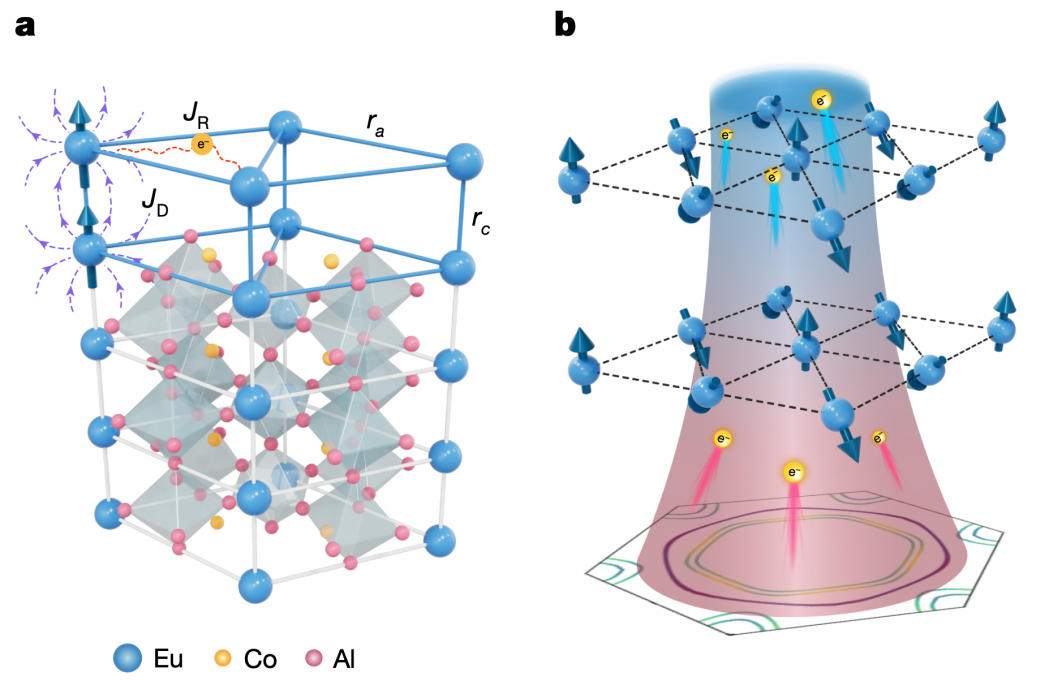
To address this, the researchers designed and synthesized a three-dimensional alloy. Experiments showed that the material enters a metallic spin supersolid state, which the source says combines magnetocaloric cooling with metallic heat transport. In the study, the material cooled to 106 millikelvin and showed thermal conductivity 50 to 100 times higher than conventional magnetocaloric materials.
The source says this combination allows the material to generate cooling and dissipate heat instantly. It also describes the work as a shift in spin supersolid research from basic research toward practical application, with expected relevance for quantum technologies and other fields that depend on ultralow-temperature environments.