A team led by Prof. LI Bing from the Institute of Metal Research at the Chinese Academy of Sciences has introduced a novel cooling technology based on the “dissolution barocaloric effect.” Published in Nature, the study presents a fluid-based approach that could offer a zero-carbon alternative to conventional refrigeration systems.
Traditional vapor-compression cooling systems are energy-intensive and emit significant carbon emissions. While solid-state cooling has been explored as a cleaner option, its adoption has been limited due to inefficient heat transfer. The new method addresses this by combining solid-state materials with liquid-phase behavior, allowing the refrigerant to also act as the heat-transfer medium.
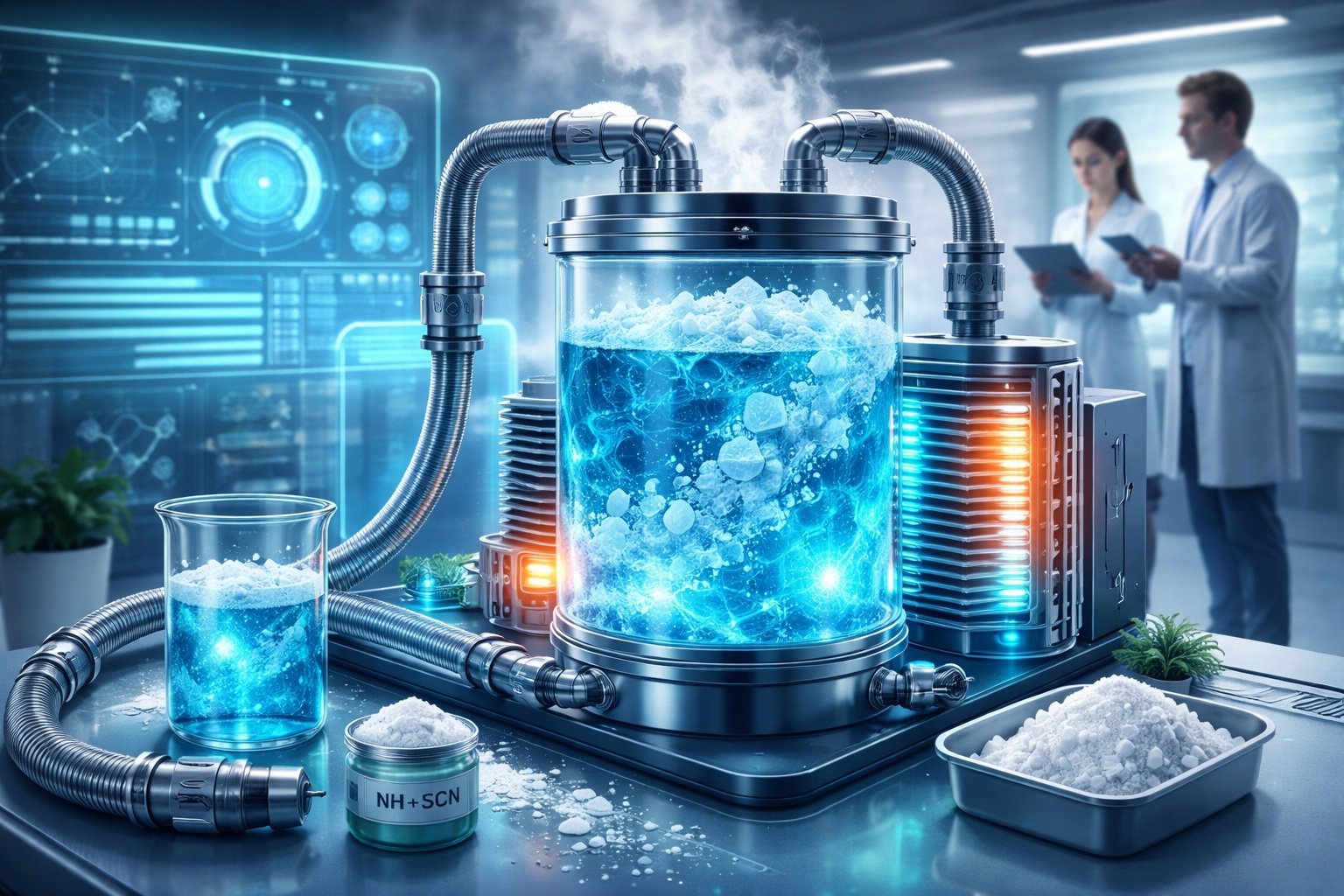
The researchers demonstrated the effect using ammonium thiocyanate (NH₄SCN) dissolved in water. The dissolution releases heat, and applying pressure causes the salt to precipitate, enabling a reversible cooling cycle. This process allows efficient heat transfer and avoids the limitations of solid-state material interfaces.
Experimental results showed a temperature drop of nearly 30 K in 20 seconds at room temperature, and up to 54 K at higher temperatures—significantly higher than existing solid-state barocaloric systems. In a prototype cooling cycle, simulations indicated a cooling capacity of 67 J g⁻¹ and an efficiency of up to 77%.
The team used in-situ spectroscopic techniques to confirm the system’s stability, reversibility, and rapid response to pressure changes, making it suitable for practical applications.
According to the researchers, the fluid-based design offers new opportunities for powerful, emission-free refrigeration systems. Its strong performance at elevated temperatures also positions it as a potential solution for thermal management in high-performance computing facilities.