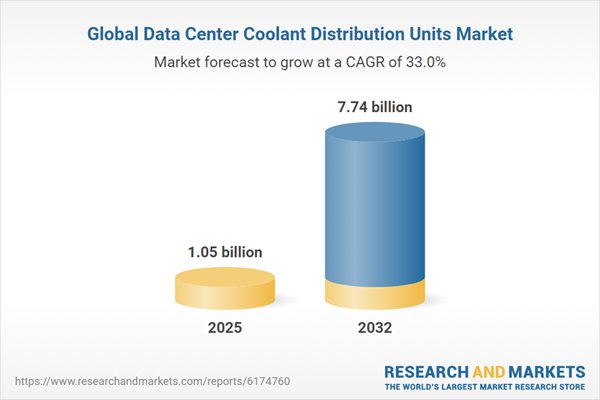
Research and Markets says it has added a new report on the global data center coolant distribution units (CDUs) market, forecasting growth from USD 1.05 billion in 2025 to USD 7.74 billion by 2032, at a CAGR of 33.0%. The report positions CDUs as a core element of liquid cooling systems used to connect facility-level cooling infrastructure with IT equipment for heat removal at the source.
According to the report summary, CDUs support precision cooling, higher rack densities, and optimized energy use, which it links to rising adoption in hyperscale, colocation, enterprise, and edge data centers. The report is intended to provide revenue estimates by segment and region, along with analysis of competitive dynamics, drivers, restraints, challenges, and opportunities.
By type, the Floor-Mounted Distribution Unit (FDU) segment is expected to register the fastest CAGR, which the summary attributes to increased deployments of high-density racks and growing AI, HPC, and cloud-intensive workloads. By cooling type, Direct to Chip Cooling is projected to record the highest CAGR, with the summary citing heat removal from high-performance processors and GPUs and increased investment by hyperscale and colocation providers in liquid-cooling infrastructure.
By end user, the hyperscale data center segment is forecast to grow at the highest CAGR, as traditional air cooling is described as inadequate for higher rack densities and power demands. Regionally, North America is expected to account for the largest market share during the forecast period, supported in the summary by a large installed base of hyperscale, colocation, and enterprise data centers, cloud adoption and AI-driven infrastructure in the US, and investment by companies cited including Google, Microsoft, Amazon, and Meta.
The summary names Schneider Electric, Vertiv Group Corp., Delta Electronics, Inc., nVent, and DCX Liquid Cooling Systems as major players, and says companies are using product launches, acquisitions, collaborations, and expansion to grow share and revenue. It also lists opportunities including integration with waste heat recovery systems, innovation in nanofluids and next-generation coolants, and AI-based cooling control and predictive optimization.
Source