Ductless heating & cooling systems market
The ductless heating & cooling systems market includes major Tier I and II players like DAIKIN INDUSTRIES (Japan), Johnson Controls (US), Carrier (US), Trane Technologies plc, (US), LG Electronics (South Korea) and others.
Impact of Covid-19 on Ductless Heating & Cooling Systems Market
The pandemic was disruptive for every industry, and the ductless heating & cooling systems market was no exception. The beginning of the year 2020 saw the greatest hardships for nonresidential construction, according to data from Associated Builders and Contractors (ABC). In the first quarter of 2020, the US economy dipped by 4.8% due to the pandemic. In March 2020, the Air Conditioning Contractors of America (ACCA) conducted a survey to gain insights into how HVAC professionals felt about the market’s future amid the outbreak. A majority of those surveyed (70%) believed that the medical implications of the pandemic would last for a mere 3 months, while 65% anticipated a long-term impact on business viability, and 9% were worried that their businesses might not survive. In the process, it was expected that construction activities pertaining to hotels declined by more than 20%, while there would be a decline of 13% in recreational and amusement establishments, 11% in offices, 8% in retail, and 7% in education.
Market Dynamics of ductless heating & cooling systems market
Drivers: Growing trend of Smart Homes
According to the Comfy Living, the number of smart homes in the US was approximately 41.3 million units by 2020. The growth in smart homes is expected to create demand for ductless heating & cooling systems. Ductless systems are used in smart homes for controlling air temperature, humidity, and fresh air intake. Moreover, the energy consumption level of a ductless system can be optimized to a large extent by utilizing various components such as smart thermostats, sensors, control valves, heating and cooling coils, dampers, actuators, pumps, and fans. These smart devices save energy and control the working of ductless heating & cooling systems with the help of technologies such as wireless communication, Internet connectivity, handheld devices, and cloud computing. For example, ENERGY STAR certified ductless mini split systems use 60% less energy for heating and 30% less energy for cooling as compared to conventional room air conditioners. The energy-saving is possible as more sophisticated compressors and fans are used that can adjust speed to save energy. The continuous development in technology and rapid innovation in various devices has increased the interest of customers toward the use of ductless systems in smart homes. These factors, in turn, are expected to accelerate growth in the ductless heating & cooling systems market during the forecast period.
Restraints: Rising Environmental Concerns
According to the International Energy Agency, the sales of air conditioners witnessed a growth of around 15% during 2019-2020. An increase in the sales of air conditioners will also lead to an increase in air pollutants released during the functioning of the systems. Air conditioners release hydrofluorocarbons (HFCs) and hydrochlorofluorocarbons (HCFCs), which trap heat in the atmosphere, contributing to global warming. The increasing demand for ductless systems will consequently increase the amount of energy and power consumed during the operation. To avoid these, manufacturers of ductless heating & cooling systems and refrigerants are required to develop energy-efficient and low carbon-emitting systems, as well as eco-friendly refrigerants. For example, Daikin developed R-32, a next-generation refrigerant that has lower environmental impact and efficiently carries heat. R-32 can reduce electricity consumption by 10% compared to air conditioners using refrigerant R-22. This, in turn, is expected to result in an increased overall cost of ductless systems, along with the development of eco-friendly refrigerants, which is estimated to put pressure on ductless systems manufacturers.
Challenges: Lack of awareness about the benefits of ductless heating & cooling systems
With continuous technological developments, it is very important to make end users aware of the benefits of new products. In the case of ductless systems, the awareness regarding cost- and environment-related benefits of ductless systems is low; they are normally perceived to be expensive, which acts as a challenge for market penetration in the region. There also exists a lack of awareness regarding energy-efficient ductless systems.
Despite various innovations, such as the development of low GWP refrigerants for ductless systems, the adoption rate of ductless systems is not at par with the benefits they provide. Additionally, with respect to contractors of ductless systems, there is a lack of awareness regarding the standards for ductless systems. Recently, higher SEER standards such as 21 SEER units have been launched in North America, about which residential HVAC construction firms in the US, Canada, and Mexico are unaware, which ultimately hampers their business.
Opportunities: Rapid transformation of IoT in HVAC systems
The Internet of Things (IoT) represents a scenario where HVAC systems can be connected to the Internet to allow data sharing. It manages HVAC systems, collects data, stores it in the cloud; improves HVAC operations for better efficiency; and runs a predictive maintenance schedule. It also monitors, controls, and diagnoses units over the Internet in a cost-effective way. In addition, IoT enables low ongoing maintenance and repair costs of the HVAC system. IoT allows access to real-time performance data of HVAC systems and interprets it correctly. For instance, IoT-enabled buildings can alert facility managers with early warnings of any operational abnormalities and allow for the remote diagnosis and adjustment of units, which, in turn, could save costs by minimizing system failures.
Moreover, HVAC systems in commercial or residential buildings consume maximum energy. Implementing IoT in these applications would offer cost-saving, predictive maintenance, comfort control, and healthy building performance. Thus, the increasing adoption of IoT in the HVAC industry offers growth opportunities for ductless heating & cooling systems.
Residential: Largest application of ductless heating & cooling systems market
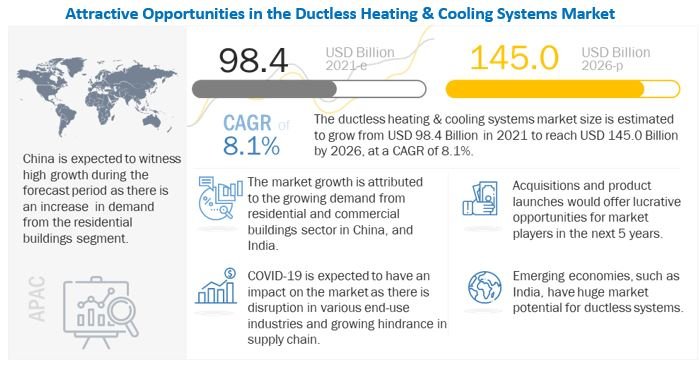
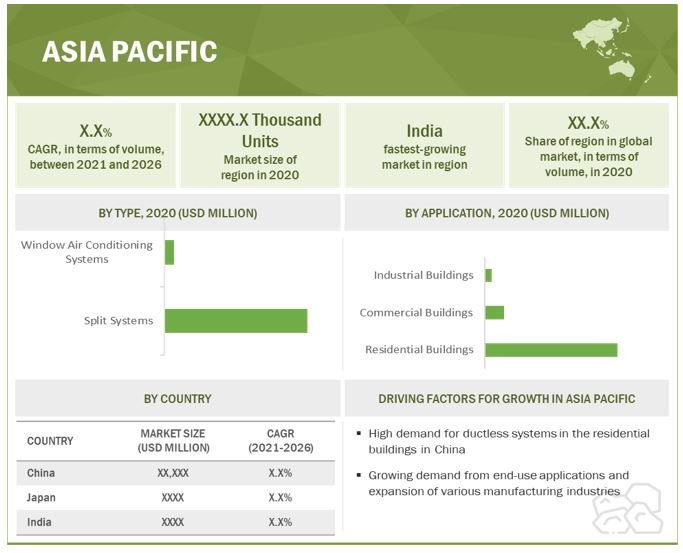
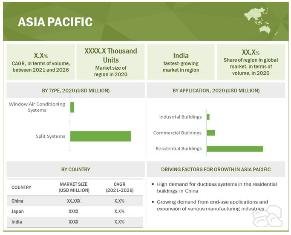
The residential application segment is expected to hold the largest market share during the forecast period. The growth is attributed to the increasing adoption of ductless heating & cooling systems in residential buildings, growing demand for energy-efficient devices, and rising awareness regarding energy conservation in developing regions such as APAC and RoW. Moreover, increasing investments by governments for the construction of residential spaces are also expected to propel the growth of the ductless heating & cooling systems market for residential application.
APAC is the fastest-growing market for ductless heating & cooling systems
APAC is projected to be the fastest-growing ductless heating & cooling systems market. The growth of the APAC ductless heating & cooling systems market can be attributed to the growing investment in building & construction in the region. Additionally, Ductless heating & cooling systems manufacturers are targeting this region, as it is the strongest regional market. China is the leading producer and consumer of ductless heating & cooling systems in the region. Other major markets in the region are emerging economies such as Japan, India, and Thailand.
Extensive primary interviews were conducted in the process of determining and verifying sizes of the type, and application segments of the ductless heating & cooling systems market gathered through secondary research.
Key Market Players
DAIKIN Industries (Japan), Johnson Controls (US), Carrier (US), Trane Technologies plc, (US), LG Electronics (South Korea), Emerson Electric Co. (US), Honeywell International Inc. (US), Mitsubishi Electric Corporation (Japan), Nortek Air Management (US), Samsung Electronics (South Korea), FUJITSU (Japan), GREE (China), Hitachi (Japan), Midea (China), Panasonic (Japan), Haier Smart Home (China), Whirlpool (US), Electrolux (Sweden), and Lennox (US) are the leading players operating in the ductless heating & cooling systems market.
These companies have adopted various organic as well as inorganic growth strategies between 2018 and 2020 to strengthen their position in the market. New product development, merger & acquisition, and expansion were among the key growth strategies adopted by these leading players to enhance their product offering and regional presence and meet the growing demand for ductless heating & cooling systems in the emerging economies.