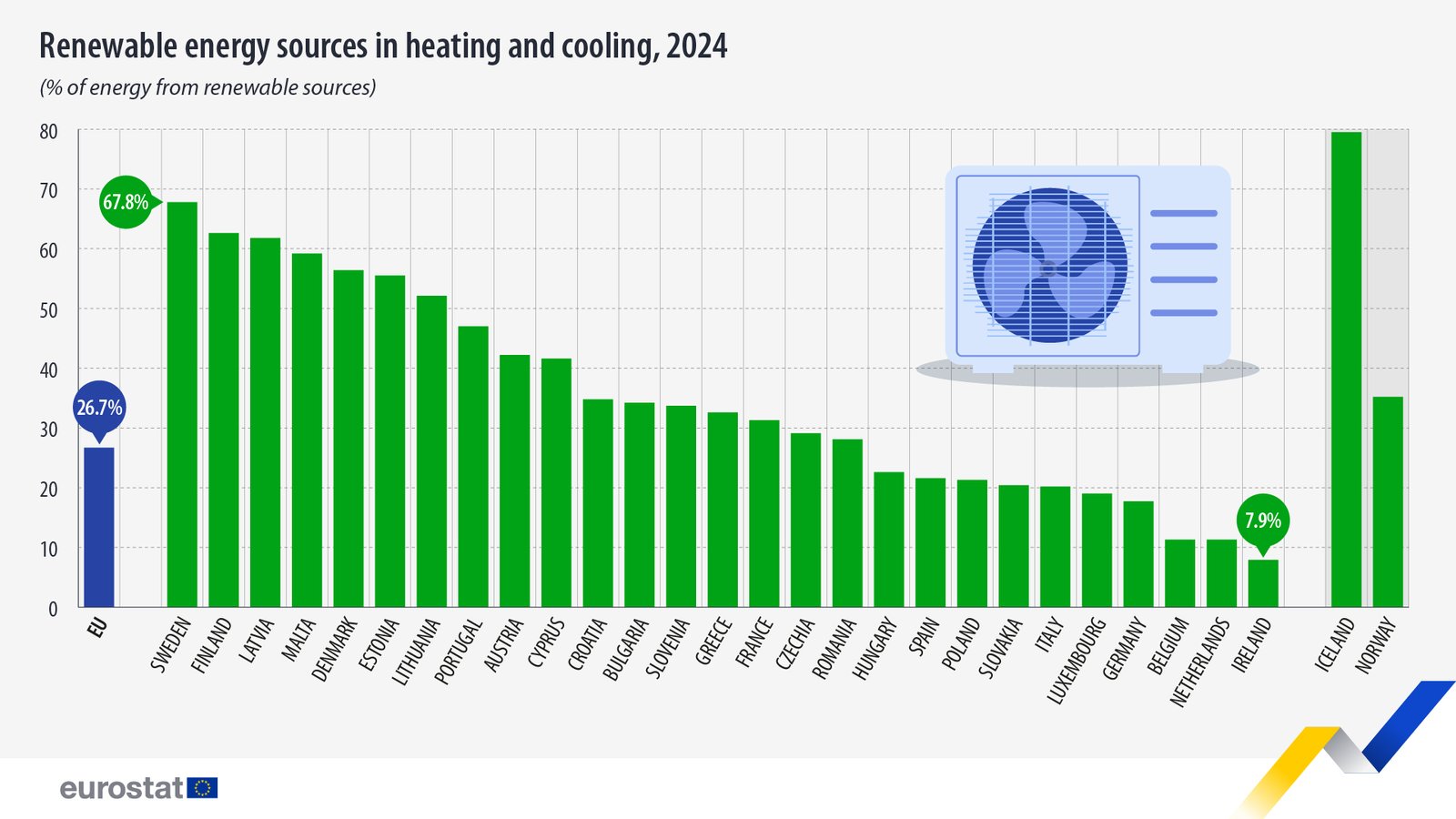
The share of renewable energy used for heating and cooling in the EU reached 26.7% in 2024, according to Eurostat. This marks the highest level since records began in 2004 (11.7%) and represents a 0.5 percentage point (pp) increase from 2023 (26.2%). However, the annual growth remained below the long-term average increase of 0.75 pp from 2004 to 2024.
The overall gross final consumption of renewable energy in heating and cooling has gradually increased, driven primarily by biomass and heat pump technologies.
Under EU Directive 2023/2413, Member States are required to raise their renewable share in heating and cooling by an average of at least 0.8 pp annually from 2021 to 2025, and by at least 1.1 pp from 2026 to 2030. Between 2021 and 2024, the EU-wide average annual increase was 0.93 pp.
Sweden led the EU in 2024 with the highest share of renewables in heating and cooling (67.8%), followed by Finland (62.6%) and Latvia (61.8%). The lowest shares were recorded in Ireland (7.9%), and both the Netherlands and Belgium (11.3%).
Sixteen EU countries saw year-on-year increases in 2024. Malta reported the largest rise (+6.0 pp), followed by Luxembourg (+3.7 pp) and Denmark (+1.9 pp). The largest declines occurred in Estonia (-11.1 pp), Greece (-2.9 pp), and Bulgaria (-1.9 pp).