Subscribe to the daily news Sign in
En
European Commission report flags F-gases in refrigeration and air conditioning
12 March 2026

European Commission report flags F-gases in refrigeration and air conditioning

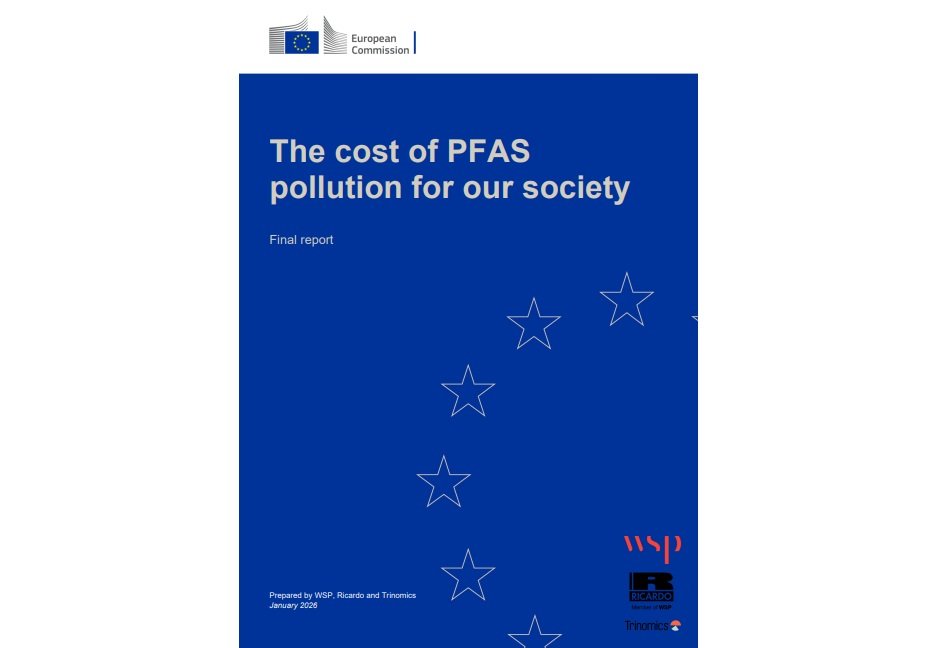
A final report prepared for the European Commission includes fluorinated gases in its PFAS scope and says the more prominent concern for this group is their degradation to trifluoroacetic acid (TFA). The study, prepared by WSP, Ricardo and Trinomics, covers four hypothetical scenarios for the European Economic Area through 2050.

The report says F-gases comprise hydrofluorocarbons, which account for approximately 90% of all F-gases, plus perfluorocarbons, sulfur hexafluoride and nitrogen trifluoride. In its review of human exposure, it says inhalation exposure occurs primarily following equipment leaks such as from refrigeration systems, recycling systems or other uses.

The study says TFA is likely to be the terminal end product from degradation of other PFAS, including the photolytic degradation of fluorinated gases emitted to air from air conditioning sources. For the TFA case study, it identifies fluorinated gases and fluorine-based organic pesticides as the two primary sources, and says F-gas emissions and emission projections from the universal PFAS restriction were used to determine current and future emission rates.

A literature review used in the report suggests that 20% to 70% of all fluorinated gases are converted to TFA in the atmosphere. The study uses 20% as its low estimate, 40% as its medium estimate and 70% as its high estimate, and says that under the business-as-usual scenario increasing emissions for fluorinated gases would cause “background” TFA concentrations to continue rising in the coming years.

For its 2024 baseline, the report uses TFA concentrations of 700 ng/l in background drinking water and 3,900 ng/l in elevated drinking water, 4,700 ng/l and 23,900 ng/l in surface water, and 300 ng/l and 3,200 ng/l in groundwater. In a hypothetical full-stop scenario, it says air conditioning systems, both mobile and static, would likely qualify as problematic recalls, with fluorinated-gas emissions continuing for 3-5 years after 2030, while emissions from products still in use such as air conditioning are computed to cease after 2033.
Share
Subscribe to the Refindustry Daily Newsletter
Trusted by 3,000+ refrigeration professionals worldwide
or sign up with
Google
LinkedIn
Facebook
No spam. Only industry-relevant news.
Unsubscribe anytime.

Related news

Global Carbon Dioxide Market Outlook and Growth Strategies to 2034
The global carbon dioxide (CO₂) market reached a value of $13.12 billion in 2024 and is projected to grow to $21.11 billion by 2029, according to a new report published by Research and Markets. Gro...
07 Jan 2026
Brazil MMA and UNDP open call for refrigerant recycling and regener...
Brazil’s Ministry of the Environment and Climate Change (MMA), in partnership with the United Nations Development Programme (UNDP), has opened an Expression of Interest to select vocational technic...
09 Mar 2026
Top-down model compares food chain emissions across 10 EEA countries
A new study published in the Journal of Cleaner Production presents a harmonised top-down method for calculating greenhouse gas (GHG) emissions from the food chain in ten European Economic Area (EE...
30 Dec 2025
Refrigeration Equipment Market, Global Report 2025-2030
The global refrigeration equipment market reached a revenue of $67.06 billion in 2024 and is projected to grow at a compound annual growth rate (CAGR) of 8.7% through 2030, according to the lat...
06 Jan 2026
German associations call for stronger measures against illegal refr...
Three German industry organizations—BIV (Federal Guild Association of Refrigeration Air Conditioning Heat Pumps), VDKF (Association of German Refrigeration and Air Conditioning Companies), and ...
16 Dec 2025
European Patent Office upholds Chemours HFO-1234yf process patent
The Chemours Company announced that the Boards of Appeal of the European Patent Office have upheld European Patent EP 2546225, which protects manufacturing processes for the refrigerant HFO-1234yf....
05 Mar 2026