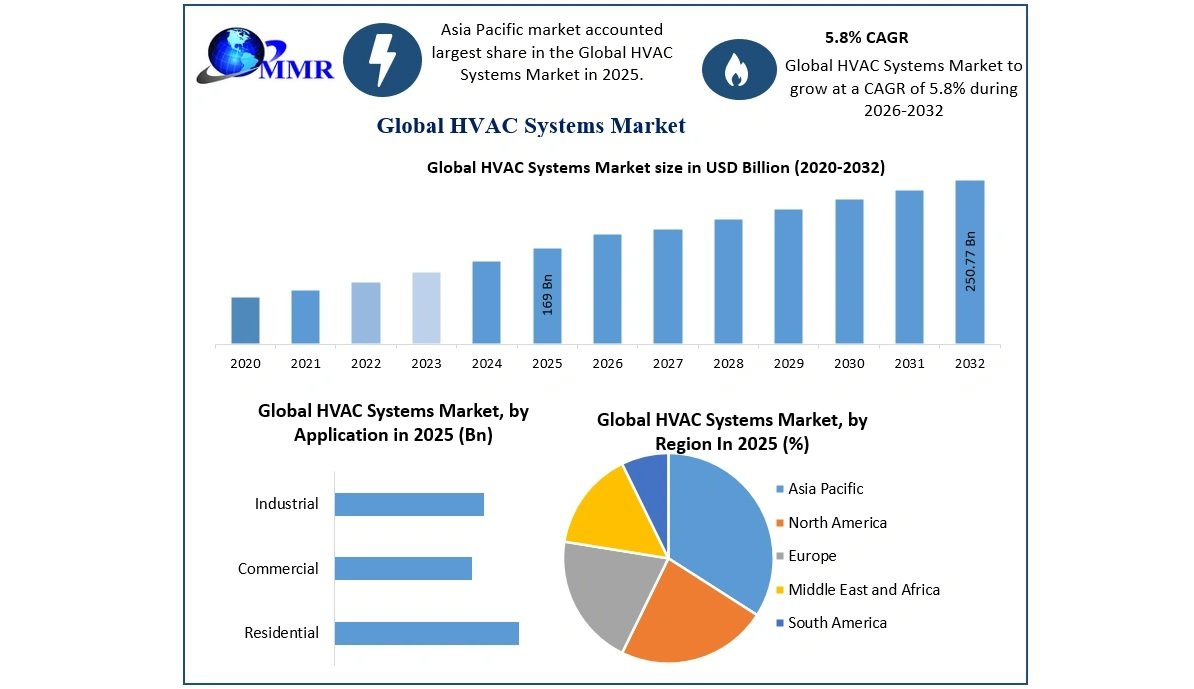
Maximize Market Research (MMR) says the global HVAC systems market was valued at USD 169 billion in 2025 and is expected to grow at a 5.8% CAGR from 2025 to 2032, reaching nearly USD 250.77 billion by 2032. The forecast is presented in MMR’s report “HVAC Systems Market – Global Industry Analysis and Forecast (2025-2032).”
MMR states that the HVAC system market is transitioning toward retrofit-led, efficiency-driven applications, supported by advancements in digital controls, system optimization, and low-emission technologies. The company also cites regulatory enforcement around energy efficiency and refrigerants as a factor supporting the market forecast, and points to regional demand leadership from Asia-Pacific, value-led adoption in Europe, and service-intensive growth in North America.
In its analysis, MMR highlights technology evolution focused on reliability, system optimization, and lifecycle efficiency, including adoption of intelligent controls, modular architectures, and compliance-driven refrigerant platforms. It also points to execution constraints such as supply localization requirements, skilled labor availability, and regulatory redesign pressures that can influence delivery timelines and cost structures, and describes value capture shifting toward service intensity and performance-based monetization.
MMR’s segmentation includes heating equipment (heat pumps, furnaces, boilers, unitary heaters), ventilation equipment (humidifiers, dehumidifiers, air purifiers, air filters, ventilation fans, air handling units), and cooling equipment (room air conditioners, unitary air conditioners, chillers, coolers, cooling towers, VRF systems), along with implementation type (new construction, retrofit) and application (residential, commercial, industrial).
“HVAC system market growth now favors reliability-led replacement cycles, challenging assumptions that innovation alone delivers sustained global value creation outcomes,” says an analyst at Maximize Market Research. MMR lists key players including Daikin, United Technologies, Johnson Controls, Ingersoll-Rand, LG Electronics, Honeywell, Lennox, Samsung Electronics Co. Ltd., Mitsubishi Electric Corporation, Carrier Global Corporation, Trane Technologies plc, Rheem Manufacturing Company, Danfoss Group, Hitachi Global Life Solutions, Bosch Thermotechnology, and others.
Source