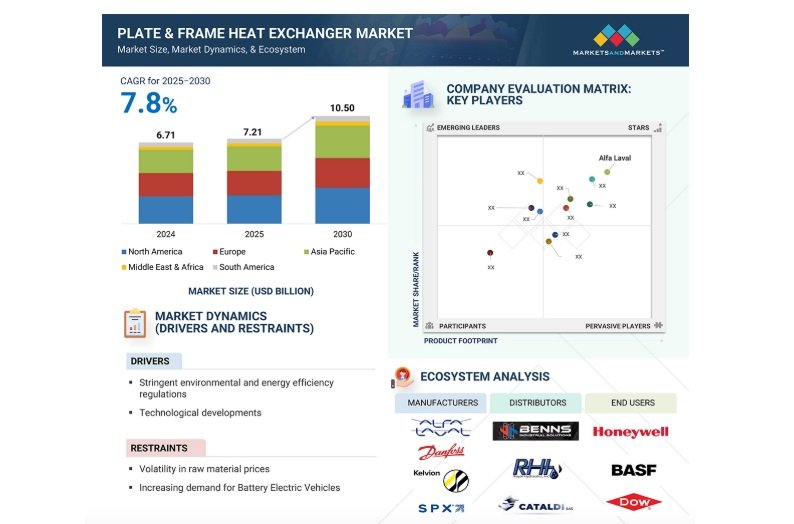
The global Plate & Frame Heat Exchanger Market is projected to grow from USD 7.21 billion in 2025 to USD 10.50 billion by 2030, registering a compound annual growth rate (CAGR) of 7.8%, according to a recent report by MarketsandMarkets.
The market's expansion is driven by rising demand for efficient thermal management solutions across industries such as HVAC, power generation, food & beverage, and chemicals. Plate & frame heat exchangers offer advantages including high heat transfer efficiency, compactness, low maintenance, and adaptability to various fluid viscosities. Their modular design also supports scalability and fast thermal response.
The report highlights that the welded plate heat exchanger segment is expected to be the fastest-growing during the forecast period, due to its durability and suitability for high-pressure and high-temperature applications, particularly in petrochemicals, power generation, and pharmaceuticals.
By application, the HVAC & refrigeration segment is projected to witness the highest growth. The trend is attributed to the increasing demand for energy-efficient and compact systems in residential and commercial infrastructure, as well as regulatory support for green building initiatives.
Leading companies in the market include ALFA LAVAL (Sweden), Danfoss (Denmark), Kelvion Holding GmbH (Germany), SPX Flow (US), Xylem (US), API Heat Transfer (US), H. Guntner (UK) LTD. (UK), Boyd Corporation (US), Johnson Controls (Ireland), and Wabtec Corporation (US).
The Asia Pacific region held the second-largest share of the global market in 2024. The report notes increasing adoption of brazed plate heat exchangers in data centers and industrial sectors, as well as innovations in gasketed and welded designs by key players to improve performance and longevity in demanding environments.
Read More