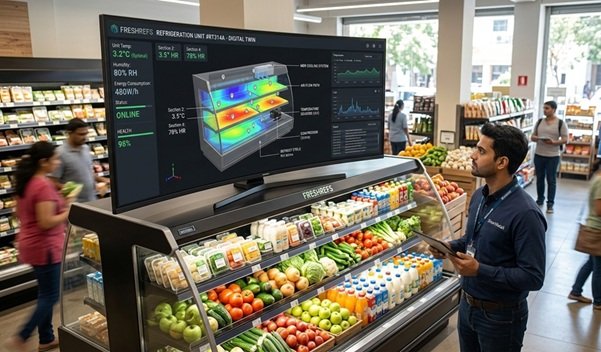
According to Growth Market Reports, the global Digital Twin Retail Refrigeration market stood at USD 1.74 billion in 2024 and is projected to reach USD 13.43 billion by 2033, at a CAGR of 28.2%. The report attributes the growth to rising demand for real-time asset monitoring, energy efficiency and predictive maintenance in retail refrigeration.
The source describes digital twin technology as a virtual replica of a physical refrigeration system that enables real-time monitoring, predictive analysis and performance optimization. In supermarkets, hypermarkets and convenience stores, the technology is used to support the preservation of perishable goods, food safety and product quality. The report says digital twin models are integrated with IoT sensors, artificial intelligence and cloud computing to improve visibility into refrigeration equipment.
Growth Market Reports identifies the rising use of IoT-enabled refrigeration systems as a key market driver. According to the source, sensors embedded in refrigeration units collect data on temperature, pressure and system performance, which is then analyzed on digital twin platforms to detect anomalies and improve operations. The report also says digital twin solutions can help retailers identify inefficiencies, reduce electricity consumption and lower operating costs.
The source also links adoption to food safety and waste reduction goals. It says digital twin technology can help maintain consistent temperature conditions, detect deviations in real time and predict equipment failures, reducing food waste and supporting product quality. Growth Market Reports further notes that retailers are adopting AI, cloud computing and data analytics as part of wider digital transformation efforts, with digital twin platforms used to improve visibility into refrigeration assets and store operations.
Looking ahead, the report says the combination of IoT, AI and cloud computing is expected to improve simulation accuracy and real-time optimization, while advances in edge computing, real-time analytics and automation are expected to support further adoption. Companies named in the source include Carrier Global Corporation, Emerson Electric Co., Danfoss A/S, Honeywell International Inc., Johnson Controls International plc, Siemens AG, ABB Ltd., Schneider Electric SE, GE Digital, Rockwell Automation, Bosch Thermotechnology, Trane Technologies plc, Axiom Cloud, Daikin Industries Ltd. and Panasonic Corporation.
Source