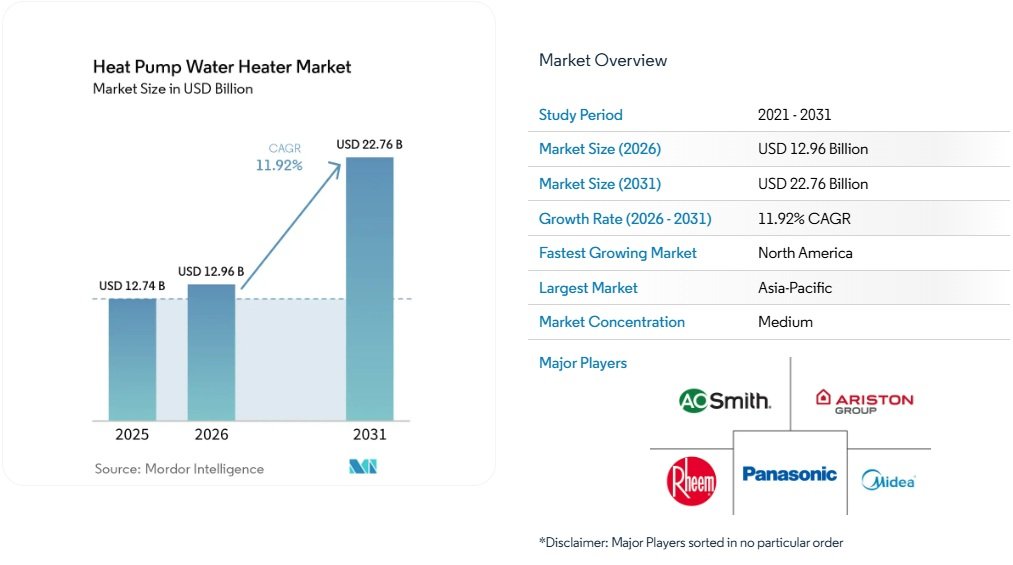
The global heat pump water heater market is expected to grow from USD 12.96 billion in 2026 to USD 22.76 billion by 2031, according to Mordor Intelligence. The report forecasts an 11.92% CAGR from 2026 to 2031, driven by energy-efficiency regulations, refrigerant transition policies and zero-emission initiatives in major economies.
In the United States, upcoming Department of Energy standards are accelerating the adoption of heat pump-based systems. Federal tax credits and rebate programs are also helping reduce installation costs for consumers. Smart connected heat pump water heaters are gaining momentum as utilities promote flexible energy use and lower-carbon electricity consumption.
Mordor Intelligence said high-temperature heat pump water heaters using R744 and R290 refrigerants can now produce very hot water for hygiene-sensitive applications, including hospitals, hotels and large residential complexes. These systems support sanitation needs such as Legionella control while maintaining efficiency. Their modular and scalable design allows large facilities to adopt them in phases.
Asia-Pacific remains a major center for demand, supported by early adoption and familiarity with CO2-based systems, especially in Japan. Product development in the region is focused on smarter operation, including systems that optimize heating based on weather and energy pricing. Manufacturers are also designing compact units for dense urban housing, apartments and shared buildings.
North America is expected to record the fastest growth rate from 2026 to 2031. Tighter federal efficiency rules, tax credits and rebate programs are lowering upfront cost barriers for households and rental properties. Local restrictions on gas-based systems in some areas are also supporting the shift toward fully electric solutions in residential and commercial buildings.
“Our analysis of the heat pump water heater market incorporates cross-verified inputs on manufacturer activity, policy direction, and adoption trends, with Mordor Intelligence applying a consistent, multi-source validation approach to deliver conclusions grounded in observable industry data rather than single-source assumptions,” said Jayveer V, Senior Research Manager, Mordor Intelligence.
Source