Continuing emissions from industrial use of ozone-depleting substances as chemical feedstocks could delay recovery of the mid-latitude stratospheric ozone layer by 7 years, according to a
Nature Communications study by Stefan Reimann and co-authors.
The Montreal Protocol has restricted global production and consumption of long-lived ozone-depleting substances for emissive uses, including CFCs and other chlorinated and brominated compounds. However, production and consumption of ODS as feedstocks for manufacturing other chemicals are not restricted under the Protocol.
The study says this exclusion was based on earlier assumptions that feedstock emissions were about 0.5% of production and that feedstock production would decline. The authors report that current feedstock emissions are assessed as substantially higher, typically 3.6% of production, while feedstock production and use have increased rather than fallen.
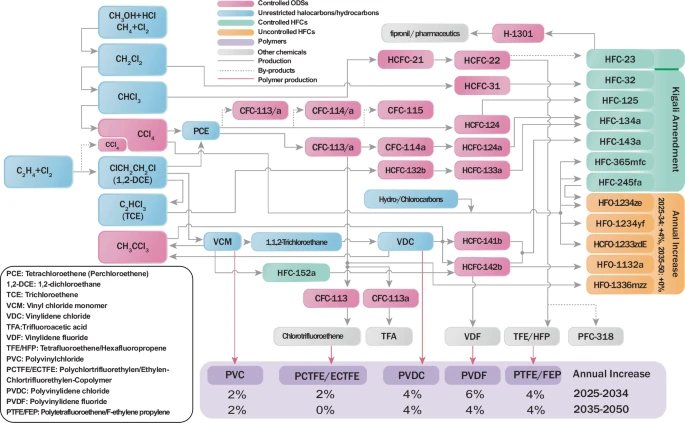
ODS feedstocks are used to produce HFCs, HFOs, HCFOs, halogenated polymers and additional halogenated chemicals. The study notes that ODS feedstock use rose by 163% between 2000 and 2024, with the highest growth between 2014 and 2024 for HCFC-22, CCl4, CFC-113/a and HCFC-142b.
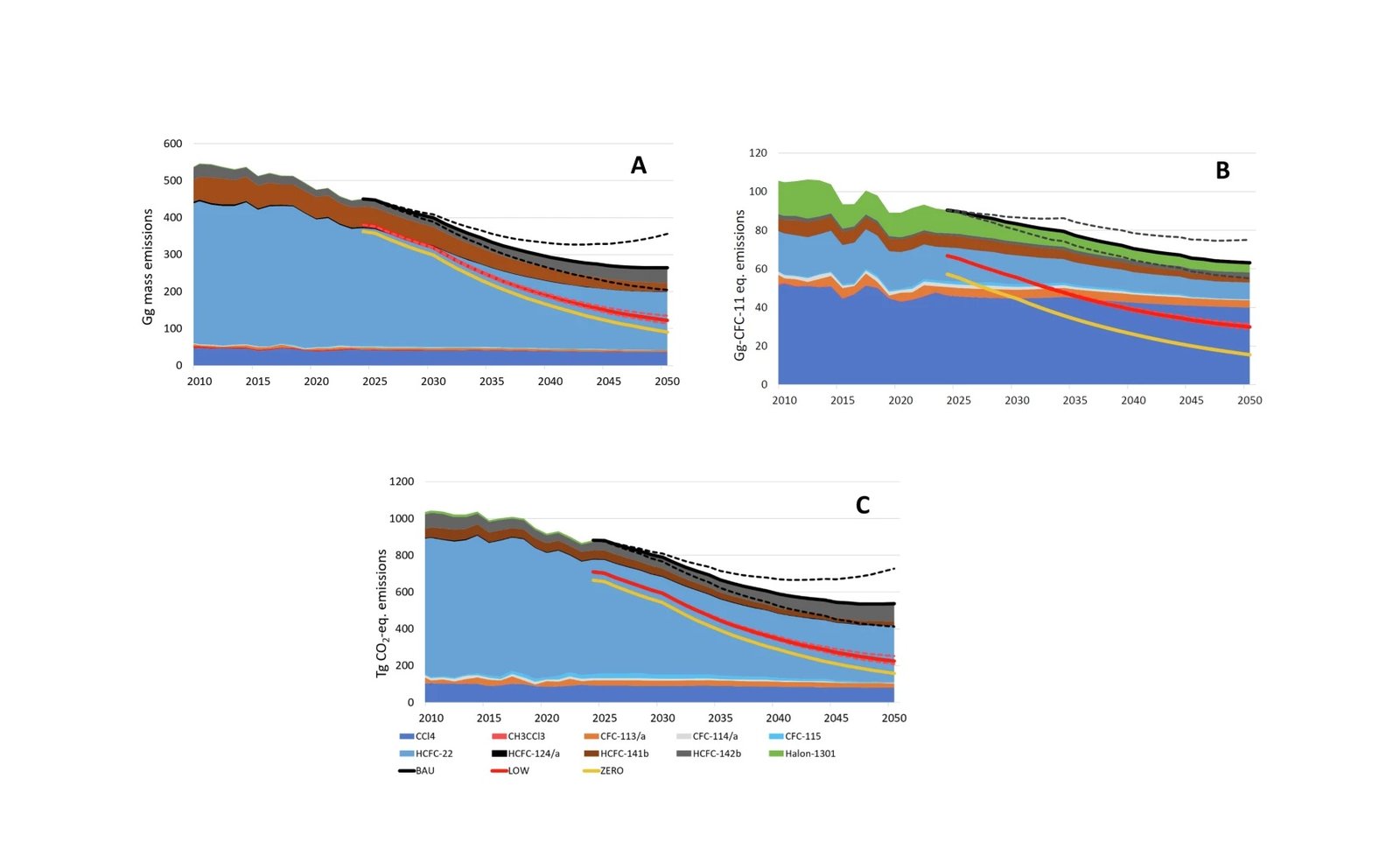
The authors compared a business-as-usual scenario with low- and zero-emission scenarios through 2100. In the low-emission scenario, feedstock emissions are assumed to be 0.5% of production from 2024 onward. In the business-as-usual scenario, the mid-latitude ozone layer returns to its 1980 benchmark level in 2073, compared with 2066 in the low-emission scenario and 2065 in the zero-emission scenario.
The study also says limiting ODS feedstock emissions would reduce direct radiative forcing and climate impact. In 2100, the difference in radiative forcing between the business-as-usual and low-emission scenarios is projected at 28 mW m-2, with an uncertainty range of 14–45 mW m-2.