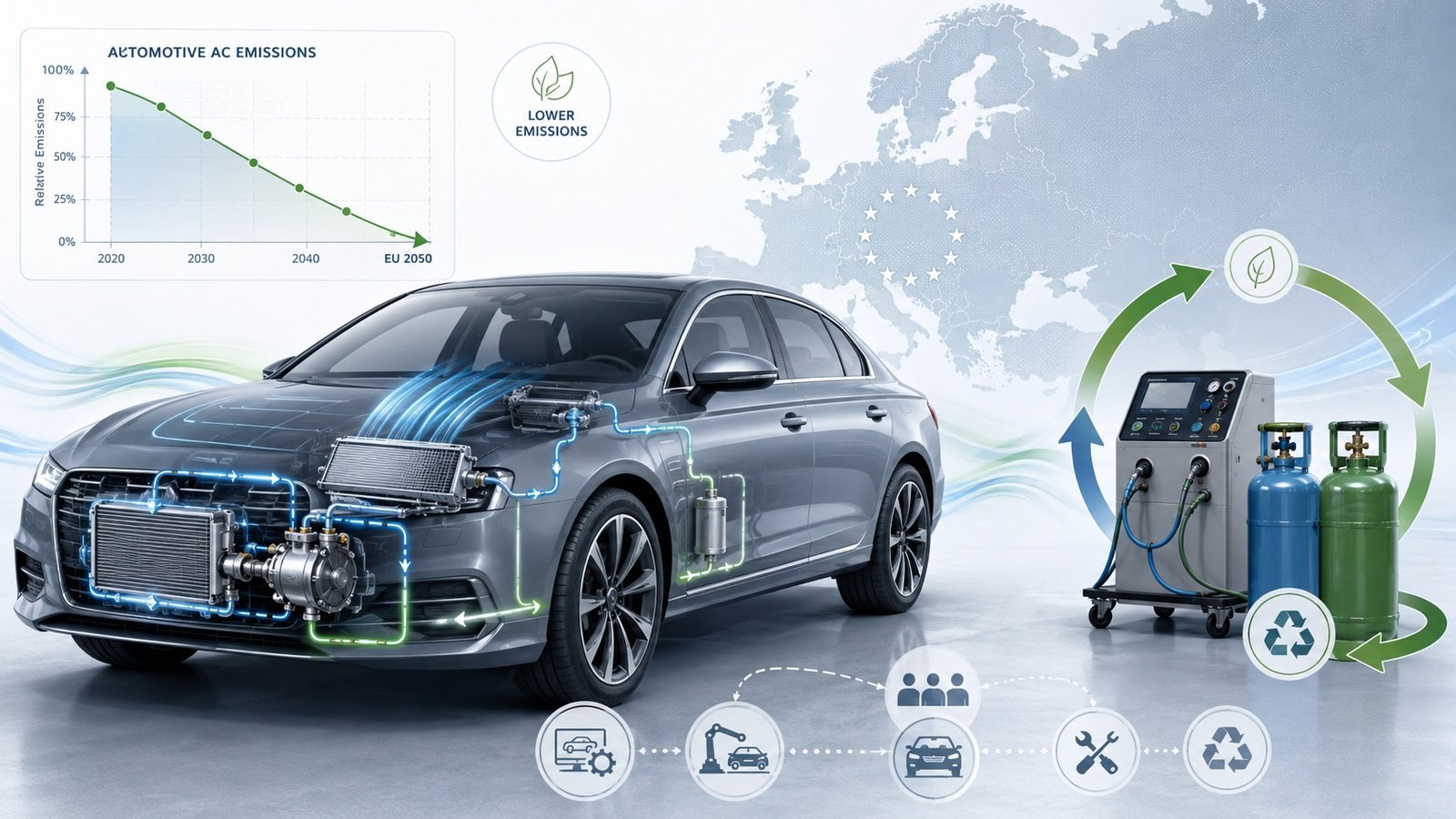
A technical working group of automakers, suppliers and refrigerant producers has submitted a set of regulatory measures to EU authorities that could reduce annual refrigerant emissions from passenger vehicle air-conditioning systems by 60% by 2050. The proposals were developed to support ECHA and the European Commission as they assess emission reduction options under the proposed PFAS restriction in REACH covering F-gases in the transport sector.
The working group was co-led by Chemours and Solstice Advanced Materials and included 8 OEMs covering light and heavy-duty vehicles, 6 Tier 1 component suppliers, a garage chain, a distributor and 2 end-of-life operators. The analysis sets a 2021 emissions baseline of 14,979 metric tonnes per year across the EU vehicle AC value chain and models scenarios through 2050. Vehicle design accounts for roughly three-quarters of baseline emissions, driven primarily by compressor shaft seal leakage on ICE vehicles, hose permeation and aged elastomer seals.
The proposed regulatory package combines design requirements with service and end-of-life obligations. Design measures include maximum leak rate limits for new vehicle type approval, set at 7.6 g/year for ICE by 2030 and 6.5 g/year for BEVs by 2050, and a new condenser robustness specification modelled on SAE J2842. Repair and inspection measures cover compulsory UV dye inclusion under SAE J2297, AC system checks and condenser cleaning every two years tied to roadworthiness testing, AC health monitoring, and mandatory tethered service port caps. The full lifetime cost is estimated below €230 per vehicle, with the group concluding that extended component life of 30-50% offsets the additional spending.
End-of-life and service measures address a gap between EU and US practice. SAE J2788 requires US recovery, recycle and recharge machines to capture at least 95% of refrigerant during servicing and depollution, while machines used in the EU currently recover around 80%. The proposal would require all RRR machines sold in the EU from 1 January 2030 to comply with SAE J2788 or J2843, extend F-gas Regulation 2024/573 logbook reporting to all motor vehicles, and require registration and audit of authorised treatment facilities under REACH conditions of use.
The 2030-2050 scenario projects a cumulative reduction of 183,413 tonnes against the baseline, with annual emissions falling to 6,083 tonnes by 2050. Average AC charge size is projected to rise from 550 g per vehicle today to 1,100 g by 2035 as heat pump systems become standard in BEVs, partially offsetting per-vehicle leak rate improvements.
"The biggest opportunity for emissions reductions lies in improving how systems are maintained and how refrigerants are recovered at the end of vehicle life," said Julien Soulet, Vice President and General Manager, Solstice Refrigerants and Applied Solutions.
Read the full study
here.