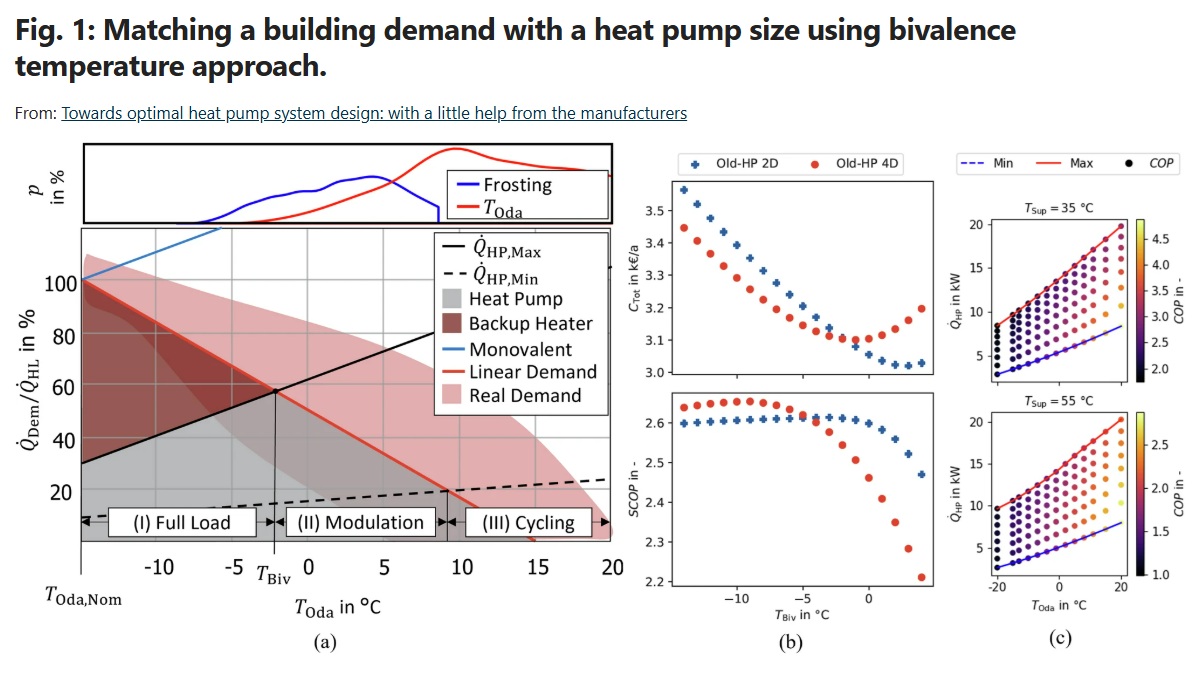
Researchers at RWTH Aachen University say heat pump systems should be designed to minimize total costs rather than defaulting to oversized, monovalent configurations. They argue that existing standards and energy labels can overestimate real-world seasonal coefficient of performance (SCOP) because standardized tests do not fully account for controller interactions, cycling losses and defrost effects.
Under EN 15450, a monovalent heat pump covers the nominal heat load defined by EN 12831 without a second heat source. A bivalent system can use a smaller heat pump with a backup heater, reducing capital costs but potentially increasing operating costs when the backup heater runs.
The researchers report that, across 72 typical German scenarios, sizing a heat pump at twice the capacity associated with the optimal bivalence point increased total costs by more than 15%. Limiting the oversizing factor to 1.2 kept the total cost increase to no more than 5%. Using proposed utilization thresholds, the authors estimate that about 53% or 65% of systems in an earlier field-test dataset would be classified as oversized.
The study also identifies five limitations in the ErP energy-label procedure based on EN 14825 and EN 14511. These include deactivated native controls, no direct cycling assessment, insufficient evaluation of defrost operation, combined specification of heat pump and backup-heater capacity, and flexibility in selecting nominal heating capacity. RWTH Aachen measurements found that the ErP method overestimated COP by 12.7% at one part-load test point and 18.9% at another.
The authors propose that manufacturers publish additional measurements and dynamic time-series data covering full-load, modulation and cycling operation. They recommend testing at supply temperatures of at least 35°C (95°F) and 65°C (149°F), together with information on backup-heater control, while further research determines the minimum measurements required for accurate SCOP prediction.
Source