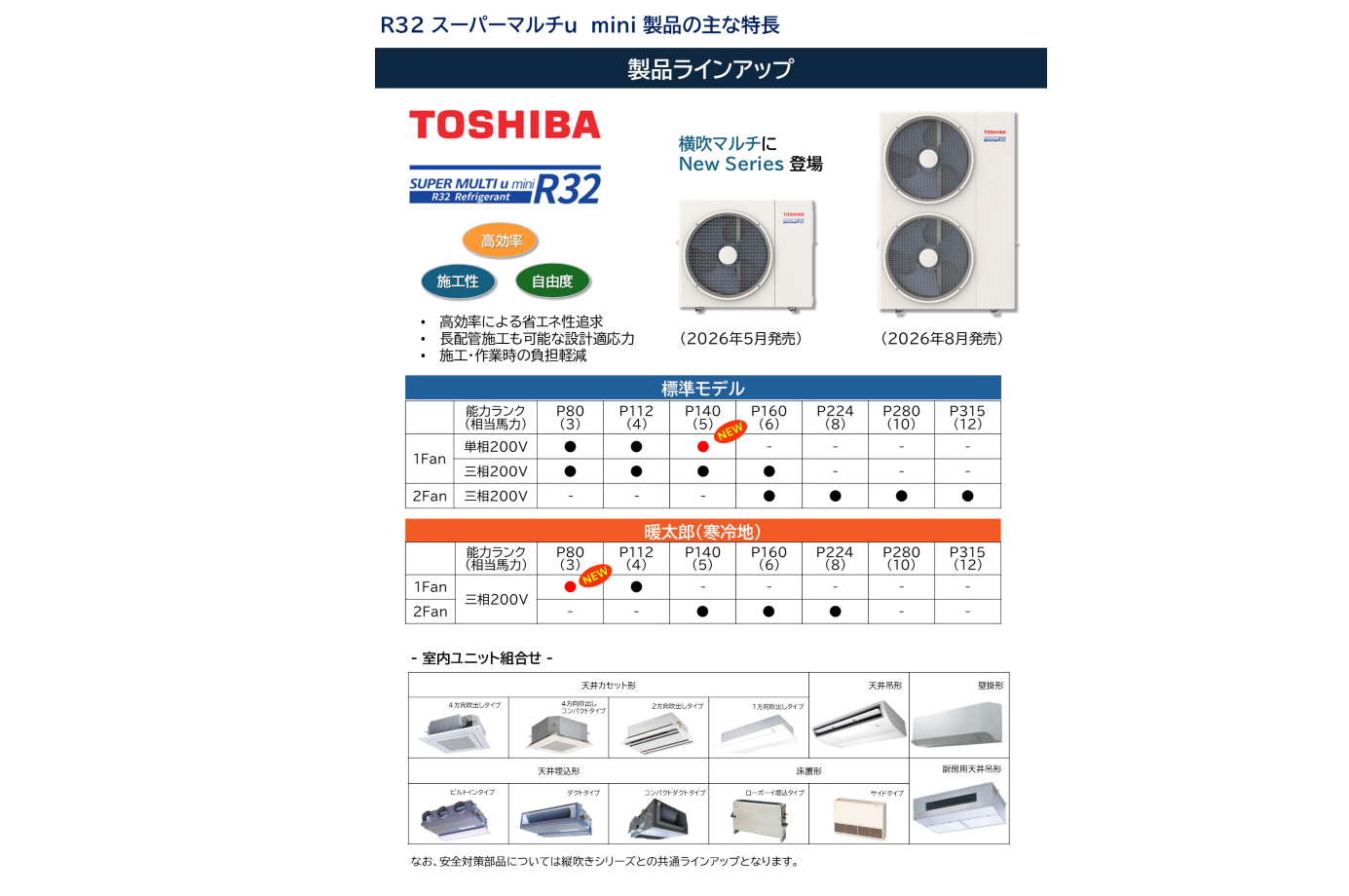
Carrier Japan Corporation says it will launch a new model in its Super Multi-u mini VRF series for commercial applications in Japan, adopting low global warming potential (GWP) R-32 refrigerant in response to Japan’s F-gas regulations. The company says sales are scheduled to begin in May 2026.
Carrier Japan said the new model is positioned for a market environment shaped by the phased introduction of GWP regulations and Japan’s Building Energy Efficiency Act, enforced in 2025, which establishes energy performance standards for residential and commercial buildings. The company said commercial air-conditioning systems are increasingly required to reduce environmental impact while delivering high energy efficiency.
On energy performance, Carrier Japan said all models comply with the 2015 energy efficiency standards (APF2015) and achieve “industry-leading” APF levels. The company said the use of a large-diameter fan and R-32 refrigerant delivers a high coefficient of performance (COP), contributing to reducing the Building Energy Index (BEI) and supporting improved energy efficiency in buildings where air conditioning accounts for a significant share of energy use.
For system design and installation, Carrier Japan said the lineup includes a 5HP model compatible with single-phase 200V power and the cold-climate Dantaro series. The company also highlighted a piping configuration of up to 300 meters (approx. 984 ft) in total piping length and a 50-meter (approx. 164 ft) vertical separation between outdoor and indoor units when the outdoor unit is installed above, and said existing refrigerant piping can be reused when upgrading from top-discharge outdoor units. Carrier Japan also said the system has “industry-leading” low noise levels and that reduced rated current supports design flexibility, including multiple-unit installations or sites with limited circuit breaker capacity.
For installation and maintenance, Carrier Japan said the handle position has been redesigned to sit 100 mm (approx. 3.94 in) lower than previous models and that the unit has been made lighter. The company said the front panel uses a slide-type design with fewer screws to make removal easier, and that power can be supplied from the outdoor unit to the indoor units to support flexible installation where indoor power sources are not readily available. Carrier Japan said a fin guard is provided as standard equipment to enhance safety during installation.
“Amid growing societal focus on environmental sustainability, we believe our role as a provider of intelligent climate and energy solutions carries greater responsibility than ever before,” said Toru Kubo, President of Carrier Japan. “We will continue to value the voices of users, as well as professionals engaged in design and installation on the front lines and remain committed to delivering products and solutions that help address the challenges faced by all of our stakeholders.”