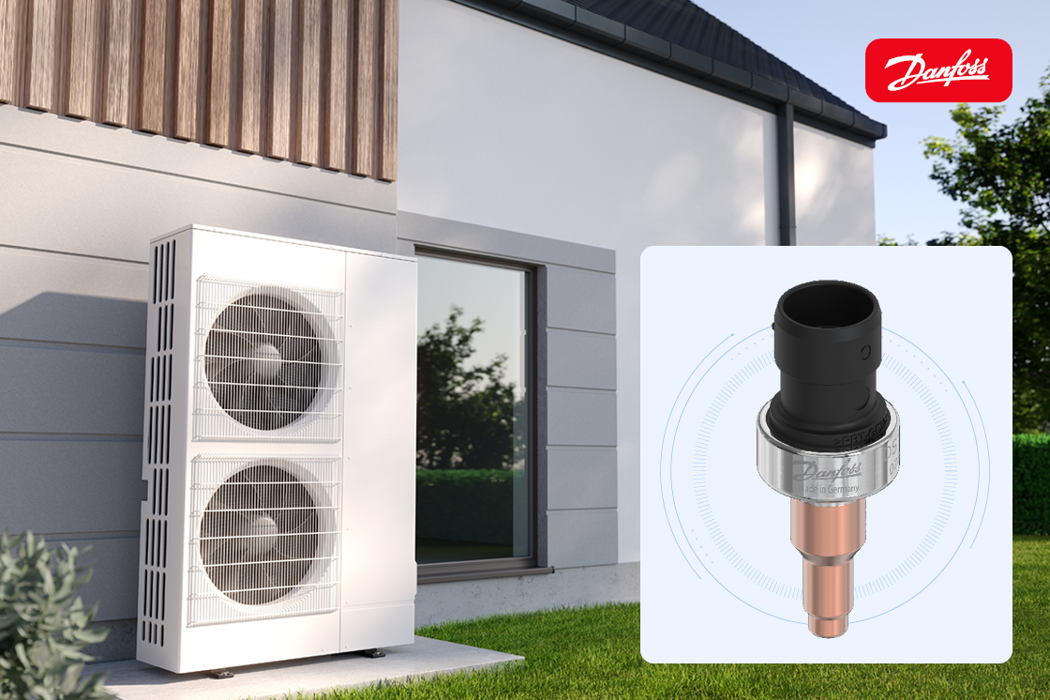
Danfoss Sensing Solutions has introduced the DST P070, a compact pressure sensor developed for heat pumps and other HVAC applications with limited installation space. The sensor is designed to support the growing demand for smaller, sustainable HVAC systems as part of the transition away from fossil fuels.
The DST P070 uses backside MEMS technology and features a compact bi-metal pressure connection suited for narrow spaces in systems such as heat pumps, chillers, residential and transport air conditioning, and food service refrigeration. Its design includes the shortest solder tube on the market, a small sensor body and a single-brazing point to simplify installation. The sensor's lightweight design reduces the need for vibration support.
The bi-metal solder tube combines copper and stainless steel, eliminating the need for cooling protection during installation and reducing heat transfer to protect system components. According to Danfoss, this contributes to easier installation and extended sensor life.
The DST P070 is compatible with a range of low-GWP refrigerants, including R290 and R1234ze, and is suitable for A1, A2L and A3 refrigerants. It features patented sealing technology for hermetical tightness and has undergone extensive validation, including helium leakage, overpressure, thermal stress, vibration and combined stress testing. The sensor complies with ISO 14903 and is certified for ATEX Zone 2 and HazLoc environments.
To ensure supply chain reliability, Danfoss has launched a high-volume, automated production line in Minden, Germany. The facility sources 70% of its materials from within the EU and is certified to ISO 14001, ISO 9001 and IATF 16949 standards. It is also expected to become carbon neutral by 2030.
The sensor contains over 50% recycled stainless steel and is packaged using pulp tray material that reduces CO₂ emissions and transport volume by 50%, while maintaining durability during shipping.
“We’ve developed a pressure sensor that fits within the space constraints of heat pump systems, is compatible with low-GWP refrigerants, and supports sustainability across its entire lifecycle,” said Iro Dragoumi, Segment Manager for HVAC&R at Danfoss Sensing Solutions.