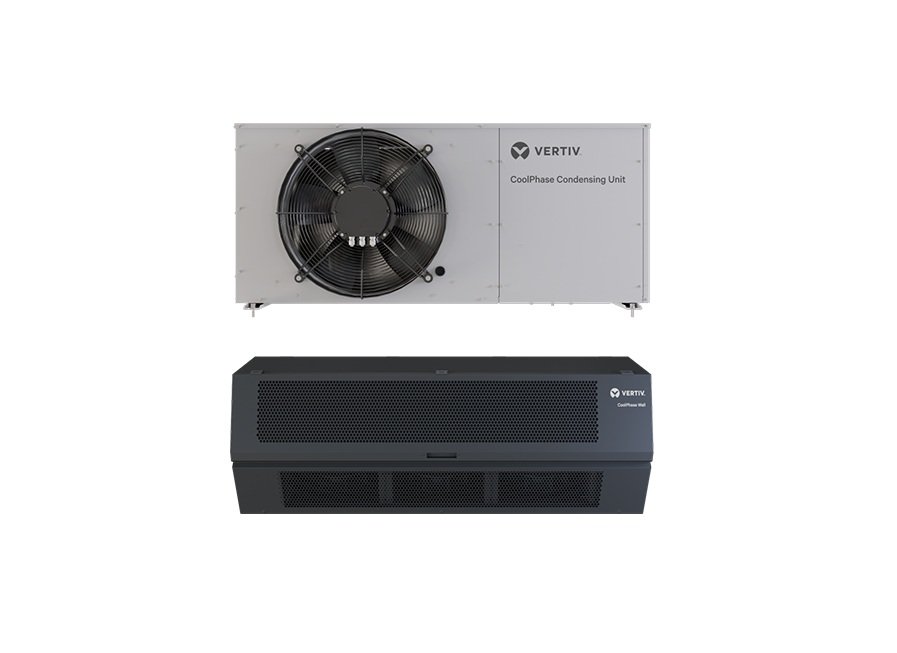
Vertiv has launched the Vertiv CoolPhase Wall, a wall-mount cooling system for small IT spaces and edge environments. Announced in the UK and now available across Europe, the Middle East and Africa, the system is designed to remove heat from IT equipment, support continuous operation and use no floor space.
The split system includes an indoor wall-mounted cooling unit and is designed for the high sensible heat ratio and airflow requirements of sensitive electronic systems. Vertiv said the system delivers up to 60% greater airflow than standard comfort cooling systems and uses variable-speed compressors and variable-speed fans to modulate to heat load demand and improve energy efficiency.
Vertiv CoolPhase Wall is designed to handle thermal loads up to 11 kW (approx. 37,500 BTU/h) and to operate in outdoor ambient temperatures from -35 C (-31 F) to 48 C (118.4 F). It includes Vertiv Liebert iCOM operational control for local configuration and supervision of key operating parameters, as well as onboard remote communication capability for real-time alerts and operational status through a secure web interface.
The system uses R-32 refrigerant, which Vertiv described as a low-global warming potential alternative intended to reduce environmental impact while maintaining thermal performance. The company said this supports compliance with evolving requirements including the European Union’s F-Gas regulations on high-GWP refrigerants.
“As IT continues to expand into areas that were not originally intended for high-density electronics, the demand for adaptable and energy-efficient cooling solutions is increasing across EMEA,” said Sam Bainborough, vice president, EMEA thermal business at Vertiv. “The Vertiv CoolPhase Wall is engineered to support continuous operations, enabling customers to maintain reliable, efficient thermal performance in small IT rooms and edge sites year-round.”
Vertiv said the new system expands its thermal management portfolio for edge deployments, enterprise data centres and high-density AI environments, including room-based cooling, direct-to-chip liquid cooling and rear door exchangers.