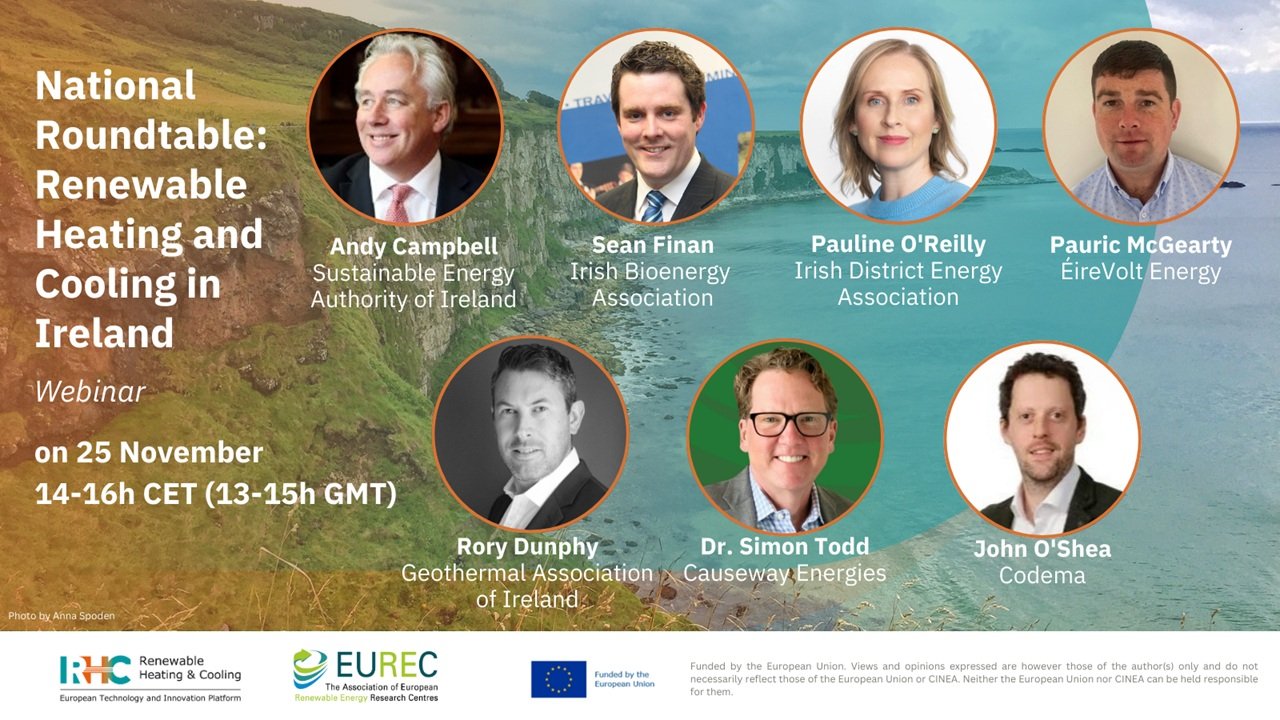
The European Technology and Innovation Platform on Renewable Heating and Cooling (RHC-ETIP) held an online national roundtable on November 25, 2025, bringing together stakeholders from across Ireland to discuss developments in the country's renewable heating and cooling (RHC) sector. The event, organised by EUREC, focused on the challenges and opportunities in deploying RHC technologies and featured contributions from industry and policy experts.
Moderated by Anna Spoden (EUREC), the session began with an overview of Ireland’s new Renewable Heat Obligation, which aims to reduce emissions and improve energy security in the heating sector. Andrej Misech (EUREC) introduced RHC-ETIP’s tools, such as the RHC Projects Database, the RHC Accelerator, and a funding repository connecting research with market deployment.
Andrew Campbell from the Sustainable Energy Authority of Ireland (SEAI) presented data on Ireland’s energy emissions and the current share of renewables in the national energy mix. This led into the first panel session titled “RHC Technologies in Ireland: Status and Future,” featuring Andrew Campbell (SEAI), Seán Finan (Irish Bioenergy Association), Rory Dunphy (Geothermal Association of Ireland), and Pauline O’Reilly (Irish District Energy Association). Panelists addressed sector-specific challenges and noted that the absence of a historic heating infrastructure in Ireland allows for a faster transition to renewable systems, especially through integrated technologies such as district heating combined with geothermal sources, heat pumps, and thermal storage.
The second panel highlighted perspectives from companies active in the sector. John O’Shea presented Codema’s work on district heating and thermal energy storage, including a best-practice guide and feasibility templates developed for SEAI. One of Codema’s studies showed that thermal energy storage could meet 76% of Ireland’s 2030 flexibility target. Dr. Simon Todd presented Causeway Energies’ work in geothermal solutions and heat pump systems, and shared insights from his advisory role at Senergy Innovations, a startup developing solar thermal panels using nano-composite polymers. Pauric McGearty introduced ÉireVolt Energy, a new company offering renewable energy installations including infrared panels, heat pumps, and thermal storage for energy-neutral homes.
The roundtable emphasised the need for cooperation between technologies and sectors. Participants agreed that no single solution would dominate the transition, and highlighted the importance of integrating RHC systems with electricity networks to address mutual challenges.