Pilot project integrates battery, solar, and kinetic energy for zero-emission cold transport.
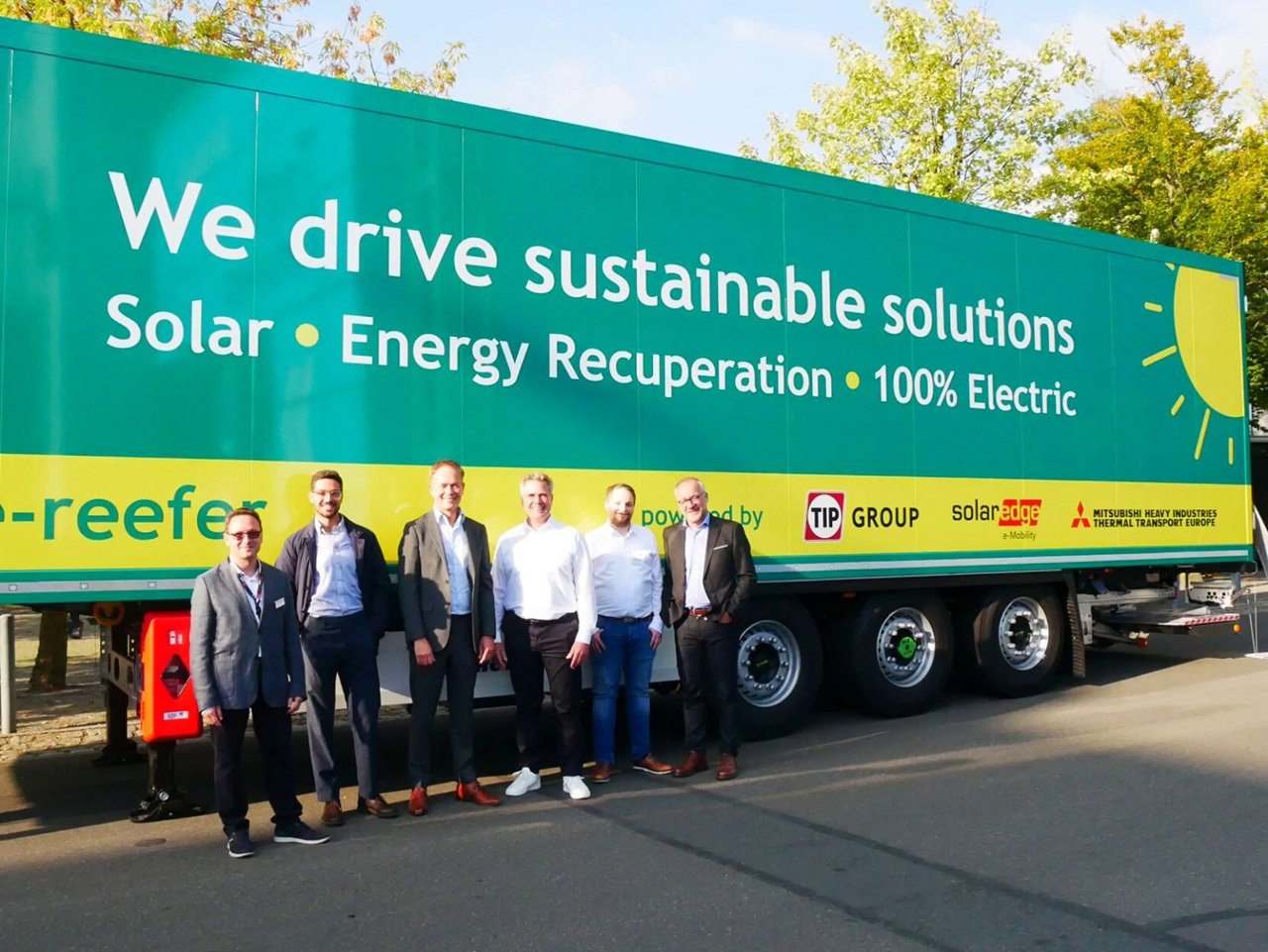
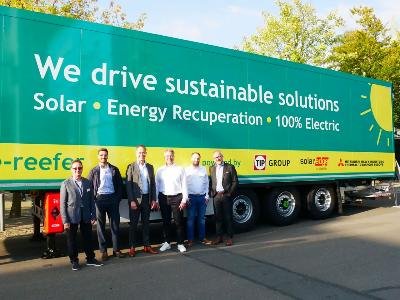
TIP Group, in partnership with SolarEdge e-Mobility and Mitsubishi Heavy Industries Thermal Transport Europe GmbH, has launched its first fully electric reefer trailer, known as the Powered Trailer. The new system integrates solar, battery, and energy recuperation technologies to eliminate the use of diesel-powered refrigeration, aiming to support zero-emission temperature-controlled transport across Europe.
Product Overview
Unveiled at the IAA Transportation exhibition in Hannover, the Powered Trailer uses a solar panel roof that supplies between 20–120% of the refrigeration unit’s energy demand, depending on external conditions and customer usage. An energy recuperation axle captures kinetic energy—mainly during braking—and stores it in a high-capacity battery that powers the all-electric refrigeration unit from Mitsubishi Heavy Industries. The trailer can also be charged via a standard 400V external grid connection.
“Our cooling units use highly efficient inverter technology to ensure that no energy is wasted,” said Gunnar Hilge, Head of Development at Mitsubishi Heavy Industries Thermal Transport Europe GmbH. “In an ideal scenario, the trailer’s energy demand is fully met through renewable sources.”
Market Trial and Use Case
The system is currently in a pilot program with Zippel Group, a logistics provider specialising in temperature-controlled transport. The goal is to validate the technology’s reliability, energy efficiency, and economic viability. According to SolarEdge e-Mobility Senior Director Pavel Gilman, the pilot focuses on telematics-driven KPIs such as operational reliability and return on investment.
Compared to traditional diesel refrigeration units, Mitsubishi Heavy Industries estimates that operational costs could be reduced by up to 50%, with potential return on investment achieved in two to four years.
Adoption Challenges and Regulatory Hurdles
Despite its promise, the Powered Trailer faces barriers to broad market adoption. Regulatory approval for energy recuperation axles remains pending in some countries, including the Netherlands. “We expect this to be resolved by Q2 2025,” said Rogier Laan, Vice President Sales and Marketing at TIP Group. “In the meantime, we are working with alternative markets to push adoption forward.”
High electricity costs and operator hesitancy also slow adoption, though TIP Group is addressing these through real-world trials, customer support, and financing models.
“The technologies required to make a quantum leap in sustainable logistics are already available,” said Gilman. “The question is not if, but when. The pace of adoption will depend on legislation, customer acceptance, and continued proof of operational benefits.”
As the pilot progresses and infrastructure adapts, the Powered Trailer represents a practical, scalable solution for decarbonising refrigerated logistics.