Esta página solo está disponible en inglés. Ir a la portada en español

×

Questa pagina è disponibile solo in inglese. Home page in italiano

×

Diese Seite ist nur auf Englisch verfügbar. Zur deutschen Startseite

×

Cette page est disponible uniquement en anglais. Aller à la page d'accueil en français

×

Walmart Canada’s fleet has expanded to include first 60-foot multi-temperature refrigerated trailer

Walmart Canada’s fleet has expanded to include first 60-foot multi-temperature refrigerated trailer

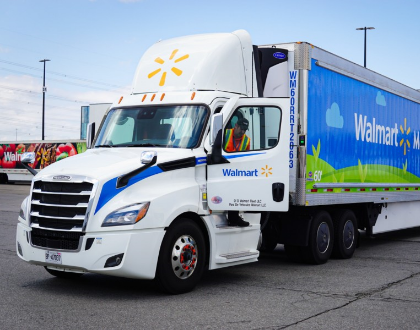
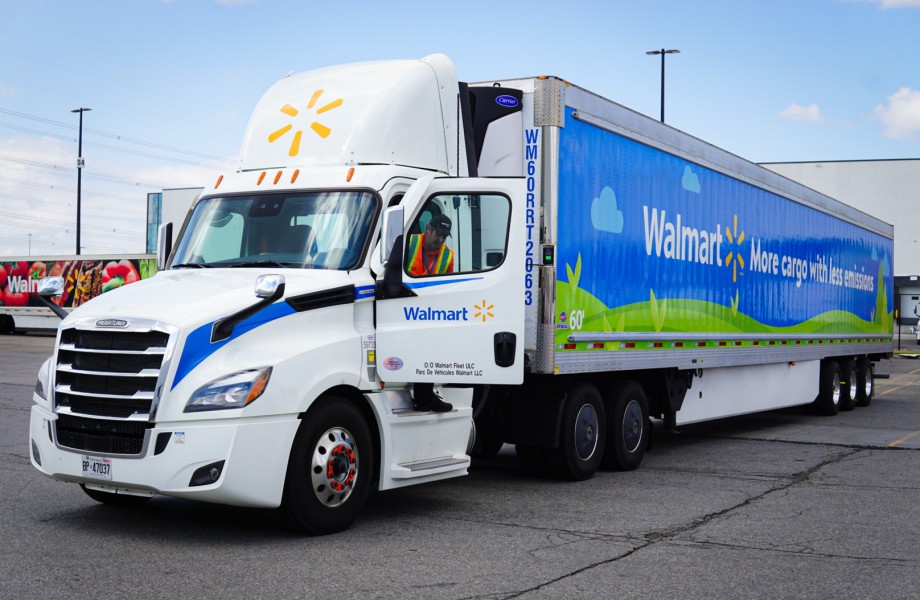
Walmart Canada’s fleet has expanded to include first 60-foot multi-temperature refrigerated trailer. It’s also the first of its kind for Walmart in North America.

The custom-built multi-temp refrigerated trailer allows to ship more freight to stores in a single trip, resulting in improved efficiency within our supply chain and less C02 emissions.

“Introducing this 60-foot, custom-built, multi-temperature refrigerated trailer into our fleet is latest example of how Walmart Canada is continually innovating within supply chain and pushing boundaries in the industry,” explains Patricio Dallan, SVP, Supply Chain, Walmart Canada. “When Walmart makes a change, it has a ripple effect. In this case, we’re introducing a new custom solution to the Canadian market that helps to reduce our total number of trips and emissions. We’re incredibly proud of this milestone.”

This trailer can fit as many as 30 pallets of perishable goods, like meat and dry/wet produce, requiring different temperatures. For context, a standard 53-foot trailer can fit about 26 pallets. The increased capacity and multi-temperature zones provide the flexibility to service our stores in the most efficient manner by pairing certain stops together that would not normally ship on the same trailer.

“This is a truly custom solution, purpose-built for Walmart Canada to help us bring innovation to the industry and work towards reaching our regeneration goals,” shares Brian Sookhai, Senior Manager, Transportation Innovation and Planning, Walmart Canada. “Working closely with Utility Trailer Manufacturing Company, we manufactured this trailer that allows for multi-temperature control and more capacity than ever before. This allows us to ship products at a variety of temperatures and make fewer overall trips, reducing our carbon emissions by having fewer trucks on the road.”

Get the daily refrigeration briefing

One email a day. Trusted by 3,000+ RACHP professionals.

More on Cold Chain

All on Cold Chain →

Insights

Secop's Solar Direct Drive (SDD) System Earns WHO PQS Approval – The Team Behind It
Article

Secop’s Solar Direct Drive (SDD) System Earns WHO PQS Approval – The Team Behind It

Partner's material In March 2026, Secop’s Solar Direct Drive Power Management Module was granted WHO PQS prequalification and officially listed in the WHO Catalogue of Prequalified Immunization Devices. The WHO IMD-PQS (Immunization Devices Performance, Quality and Safety programme) is the global benchmark for cold chain equipment used in immunisation. Being listed in its catalogue is

22 Jun 2026
Case Study - Effect of Louvers or diffusers on air flow distribution and cooling time on a meat log during Chill cycle
Tech Guide

Case Study – Effect of Louvers or diffusers on air flow distribution and cooling time on a meat log during Chill cycle

By Kushal Aurangabadkar An experimental analysis was conducted on a cooler space measuring 3.66 m × 6.096 m (12.0 ft × 20.0 ft), equipped with an ammonia refrigeration coil, five 30 cm (12 in.) fans, and five diffusers. The study measured airflow patterns, cooling rates, and heat transfer efficiency in meat storage by testing two configurations:

Kushal Aurangabadkar · 21 Jan 2026
Total Cost of Ownership (TCO) for Modular Refrigeration Systems in Life Sciences Distribution Centers
Tech Guide

Total Cost of Ownership (TCO) for Modular Refrigeration Systems in Life Sciences Distribution Centers

by Ramez Naguib, P.E. Introduction Life sciences distribution centers are under immense pressure to deliver consistent temperature control, comply with increasingly stringent regulations, and optimize operational efficiency. Traditional built-up refrigeration systems often prove cumbersome, costly, and slow to implement. In contrast, modular, factory-assembled refrigeration systems have emerged as a compelling alternative. Drawing on lessons from

Ramez Naguib · 14 Jan 2026
Everything on Cold Chain: 2,057 articles, 2 case studies, 23 insights

Most read this month

All news →